
29 Oct 2026
In the wake of recent significant wastewater failures, looking to good engineering from the past could help strengthen the wastewater sector now, and for future generations.
In February, Te Whanganui-a-Tara Wellington’s Moa Point wastewater treatment plant failed, resulting in millions of litres of untreated water flowing into the capital’s south coast. This is just one a number of wastewater incidents that have plagued Aotearoa, from the persistent stench emanating from Christchurch’s fire-damaged Bromley wastewater treatment plant to sewage pipe leaks and a host of other related problems.
“Some of these events have a very low probability of occurrence. And yet when they do fail, they have extreme results,” says wastewater engineer Garry Macdonald ONZM DistFEngNZ CMEngNZ, a past President of Engineering New Zealand who was recognised as an Officer of the New Zealand Order of Merit in the 2026 King’s Birthday Honours for services to wastewater engineering.
“They are very high risk, so we need to apply a proper risk framework.”
Decades of underinvestment coupled with ageing infrastructure and deferred maintenance characterise the crisis the country’s wastewater sector is facing.
“The infrastructure that delivers water and takes away wastewater is a hidden asset. Unfortunately, hidden assets tend to not get looked after and we’re seeing that around the country,” Garry says.
“It’s so easy to forget that these assets have defined lives and will wear out. You’ve got to have sufficient capacity to take them out of service to repair or replace them, which can take weeks or months. We haven’t done a good job of recognising that.”
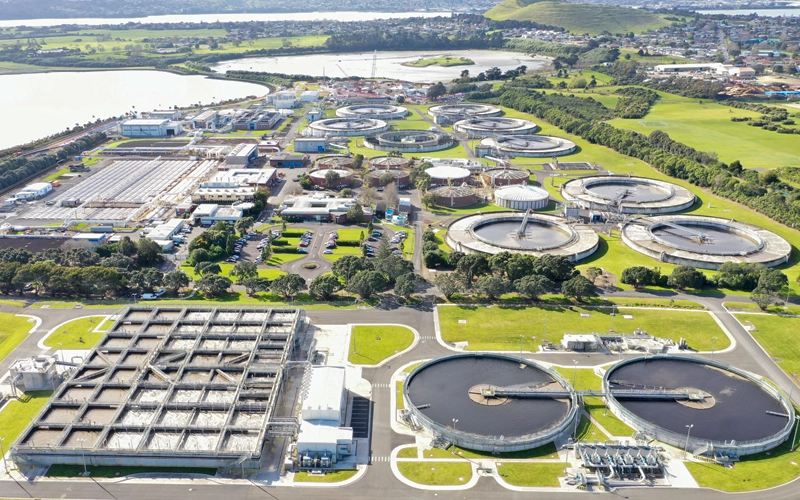
The Māngere Wastewater Treatment Plant in Tāmaki Makaurau. Photo: Watercare
Coming full circle
Aotearoa has come a long way when it comes to wastewater, from not treating it at all to rudimentary treatment followed by fine screens, disinfection and sludge intensification.
Such progress is evident in the Māngere wastewater treatment plant in Tāmaki Makaurau. It went through a major upgrade in the early 2000s, which entailed implementing advanced treatment processes such as biological nutrient removal in bioreactors, clarifier tanks, filtration and UV disinfection. These processes shortened treatment time from 21 days to 13 hours.
“The big decision was to remove the 550-hectare oxidation ponds and restore the Manukau Harbour and foreshore,” says Garry, who cites the upgrade as one of the projects he’s most proud of in his years as a water market leader at Beca.
“We were very pleased about that and the project has been really successful, winning the IPENZ Environmental Award in 2004 and the Supreme Award for Engineering Excellence the following year.”
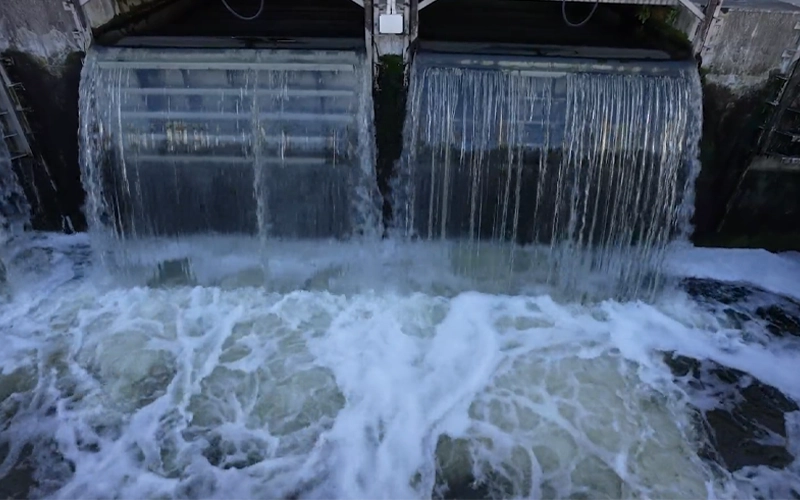
Final treatment coming out of the UV channels. Photo: Watercare
Jim Bradley DistFEngNZ CPEng IntPE(NZ), a recently retired environmental and public health engineer, cites the East Clive Wastewater Treatment Plant upgrade in the early 2000s as one of the most remarkable projects he worked on during his tenure at Stantec. The upgrade involved a no-sludge system, with a modified biological trickling filter process without clarifiers.
According to Hastings District Council, fine-screened wastewater is pumped through large tanks and trickles through flower-shaped plastic media. The media act as bug factories, housing naturally occurring microorganisms that break down and remove organic material from the wastewater. This treated wastewater then flows through a rock-lined channel named Rakahore (the personification of rock and stone), allowing it to reconnect with Papatūānuku (Earth Mother) to regain its mauri (life force) before being discharged into the ocean via a long outfall.
“It’s nature at work,” Jim says. A vital component of the project’s success, he believes, was the close collaboration between engineers, Hastings District Council and tangata whenua in co-designing a wastewater scheme that takes into account cultural, economic, environmental and sustainability considerations. Part of the treatment plant’s resource consent conditions also include an annual compliance report and a comprehensive review of the plant’s performance every nine years.
A recent development in the wastewater sector that both Garry and Jim find exciting relates to a circular water economy. It treats water as a resource rather than waste, Garry says, and includes resource recovery from wastewater, including the purified recycled water.
Water resource recovery facilities best illustrate the circular water economy, according to Jim. These facilities adopt a factory approach, linking energy, nutrient, product and water together.
“It gives that message of what resources we have and how we can better use it,” he says.
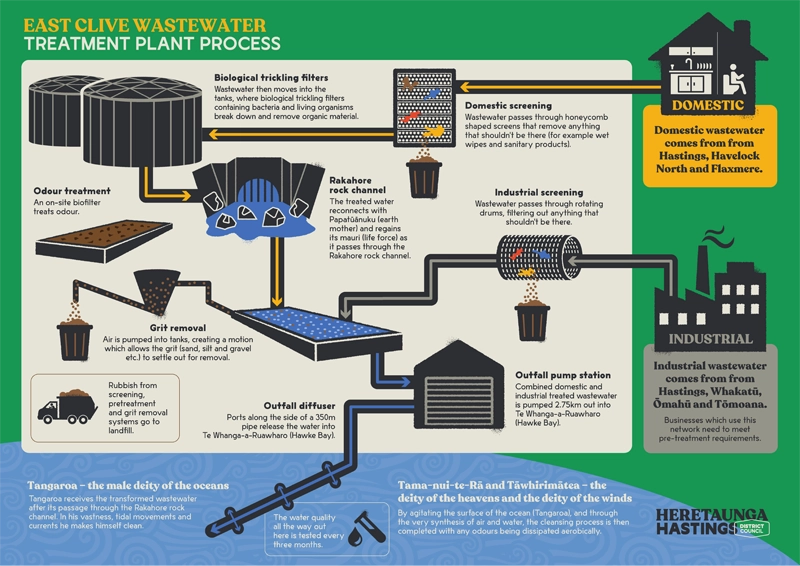
Māori community view of the East Clive Wastewater Treatment Plant process. Image: Hastings District Council
Embracing Te Ao Māori
The team behind Neuflow Projects, which specialises in delivering complex water-related infrastructure, believes that embedding kaupapa Māori is a way forward for wastewater engineering. Founder and director Adam Donaldson of Patuharakeke | Ngāpuhi descent, is currently involved in a wastewater treatment upgrade in the Whangārei district.
“It’s close to my heart because I whakapapa back to that area. Working on behalf of my hapū as a technical advisor is something I deeply care about and I’m committed to achieving the results that genuinely reflect our cultural values and outcomes long term.”
He’s helping to find alternatives for the treated wastewater discharge.
“It’s not just infrastructure, it’s more a holistic way as to how we can treat and enhance wastewater,” says Adam.
“It’s interesting to support the project and learn the concept of mauri restoration and enhancement and the kaitiaki elements of a wastewater project, as opposed to just designing and constructing a physical asset.”
As part of the project, the team developed a framework encompassing different cultural and spiritual elements, including mātauranga (knowledge, wisdom) and maramataka (Māori lunar calendar). They combined that cultural framework with a multicriteria analysis framework to inform decision-making on the best option for wastewater discharge.
“Every wastewater project should have an element of kaupapa Māori – how we must understand, treat, and respect wai to enhance it and restore its mauri. In addition to traditional engineering outcomes, cultural outcomes are also a key project driver and you can’t do that without partnerships with mana whenua groups,” Adam says. “There are iwi and hapū that associate to all areas throughout Aotearoa and should be engaged with as soon as possible to form close working relationships that then inform partnership and collaboration early.”
Jim has worked with iwi for decades, and he attests to the importance of “acknowledging cultural protocols, understanding the cultural background as best you can, listening and developing approaches that integrate mātauranga Māori with Western science”.
Similarly, Garry emphasises that engineers need to think beyond their technical expertise and realise that cultural practices are “grounded in basic public health” and rooted in the belief that water is the essence of life. Garry also noticed that countries like Australia and the United States are looking to Aotearoa as an example of working with Indigenous groups in the wastewater sector.
“They’re decades behind where we are and there is a curiosity as to how we got to where we have.”
Adam says that merging mātauranga Māori with Western engineering and science principles has been a long time coming, yet despite the strides our nation has taken, we still have a long way to go.
Strength and resilience
Envisioning the future, Jim notes that strengthening the wastewater sector requires more focus on asset management, particularly ageing infrastructure, including physical monitoring of the condition of the infrastructure. He adds that adaptive management approaches can help identify the next course of action after a review.
Meanwhile, Garry admits that even though “… we’re known for being quite successful in delivering water and wastewater, I feel as though we haven’t done as well as we could have”. He recommends keeping up with technology, specifically innovation in resource recovery, to help revitalise the sector.
Beyond the technical aspect, increasing resilience relies on connectivity between governance, compliance and investment, Garry says.
“In other words, what is the best way to achieve compliance with environmental and public health goals as cost-effectively as possible? Balancing levels of service and compliance with affordability all comes down to our public, our community.”
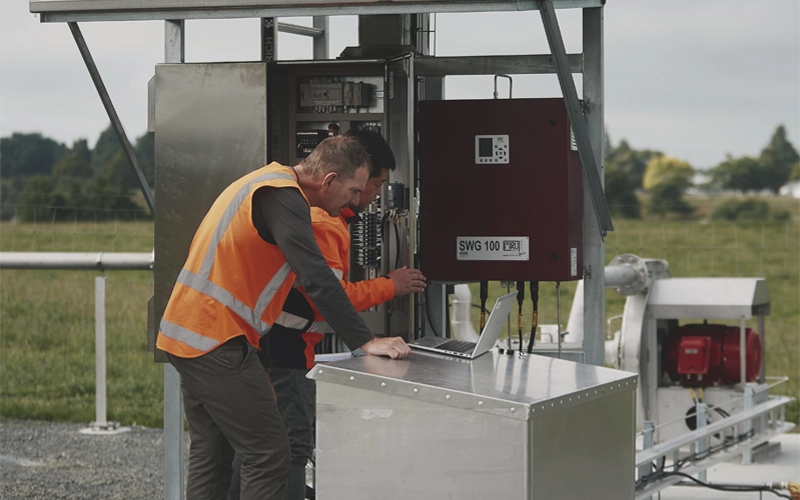
Adam Donaldson (left) and colleague commission a new gas flare to manage gas produced from the closed Horotiu landfill site in Hamilton. Photo: Neuflow
He believes the new national wastewater standards can help improve compliance across the industry.
“The idea is to enable a better assessment of discharge options to the receiving environment and speed up the consenting process while still protecting environmental standards and public health,” Garry says.
“It’s to give certainty to communities as to what standard of wastewater treatment is appropriate, and hopefully it’ll be cost-effective in the long term.”
Bolstering the workforce is also crucial to future-proofing the wastewater sector.
“I want young engineers or secondary school students to see the excitement of the water services sector. This is not just making sure the taps run and the wastewater gets treated, it’s looking at preserving our water sources and treating water as a taonga,” says Garry.
“We need the profession to be seen as worth getting involved in and get young people excited about the fact that we’re not just delivering a utility – we’re actually delivering the basis of life.”
Resource recovery
As a mechanical engineer, Elise O’Brien has helped deliver capacity upgrades for a water treatment plant in Tauranga and the Rosedale wastewater treatment plant in Tāmaki Makaurau. She's also managed pilot projects for emerging drinking water treatment technologies in the Netherlands and now works in Sydney, Australia, where her current project looks at rainwater reuse in an organic waste transfer facility.
“The aim is to reduce the source water demand, but it also inherently reduces your wastewater loads and looks at the site as more of a circular system.”
While she's only been in her new role for a few months, she's noticed some differences in how Aotearoa and Australia approach wastewater.
“Australia is a lot bigger, so the scale of projects and the varied legislative context and policy frameworks we must navigate makes it complex,” she says. “It’s a much drier environment, so accessibility and availability of water are challenging. But when you have a lack of something, it generally drives ingenuity.”
This includes recovering nutrients from wastewater streams and applying it to agricultural settings. “There’s this nutrient gold that I think Australia is tapping into a lot more than New Zealand.” says Elise.
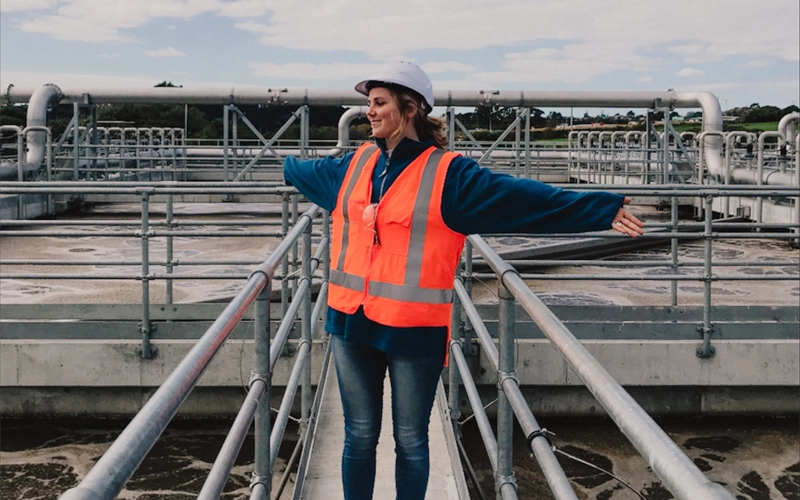
Elise O’Brien. Photo: Supplied
She views resource recovery as an opportunity to build resilience in the wastewater sector.
“It requires a shift away from waste disposal and instead looking at how we can treat these products as resources to facilitate that recovery back into the natural nutrient cycle.”
Elise adds that the right people need to be in the room developing these solutions together. “We need tangata whenua, engineers, scientists, environment and community specialists, and diverse people of different ages and backgrounds. We’re going to strengthen the wastewater sector in New Zealand by listening to the right people.”
In addition to being an engineer, she’s a former Engineering New Zealand Wonder Project Ambassador and a Keystone Trust mentor. She has a Master of Sustainable Development Goals degree from Massey University, with First Class Honours in Environmental Sustainability.
In July, Watercare’s Central Interceptor wastewater tunnel in Tamaki Makaurau Auckland became fully operational. The $1.66 billion project – the country’s largest-ever wastewater infrastructure investment – has been designed to dramatically reduce wet weather overflows, improve the health of Auckland’s waterways and harbours, and support growth across the region for decades to come. Find out more about some of the innovative engineering behind this project at bit.ly/central-interceptor
What good looks like
Metro Water Recovery, a wastewater treatment provider in Colorado in the United States, operates the Robert W. Hite Treatment Facility. It serves more than two million people and consists of four factories: energy, water, nutrient and product. Jim Bradley says that this overseas project that Stantec was part of demonstrates exemplary wastewater infrastructure that Aotearoa can learn from.
The energy factory currently operates turbines on its digester gas and generates about one-third of its total electrical power demands. There are plans to replace the turbines with a renewable natural gas facility and deliver the gas to the utility natural gas network, as well as draw heating and cooling energy from an existing sewer interceptor to supplement the building’s year-round energy needs.
During the drier portions of the year, the facility’s water factory can account for more than 80 percent of the receiving water body’s flow, enhancing water quality and ecology.
The nutrient factory incorporates a phosphorus removal system to sequester and recover phosphorus as struvite, which can be reused as a slow-release fertiliser product. Meanwhile, biosolids from the product factory can be applied to dry land farming of wheat, corn and other crops.
This article was first published in the September 2026 issue of EG magazine.