
22 Apr 2026
While not without its challenges, the completion of the award-winning Waimea Community Dam has not only increased water security, but provided the engineering community with direct, local experience in the construction of large dams in Aotearoa after a long dry spell.
The Nelson-Tasman region’s population has grown substantially, and the climate has changed, since the last large public sector dam was built in the region. Additionally, much of the civil construction workforce that worked on the new 53-metre-high concrete-faced rockfill dam had never built anything like it before.
In March 2019 at the start of construction, Damwatch Engineering Ltd was appointed to provide design and construction quality supervision services and deliver technical input. In the weeks and months that followed, Damwatch discovered numerous geotechnical challenges. The first involved the excavated rock, intended to form the bulk of the dam's embankment.
“The rock was not the predominantly strong greywacke sandstone that was predicted by earlier investigations and necessary to ensure the dam drained properly if ever necessary,” says Peter Amos FEngNZ CPEng IntPE(NZ), Managing Director of Damwatch. “It included at least 50 percent argillaceous mudstone and siltstone. As it was being compacted the rock broke down really easily, compromising its drainage properties.”
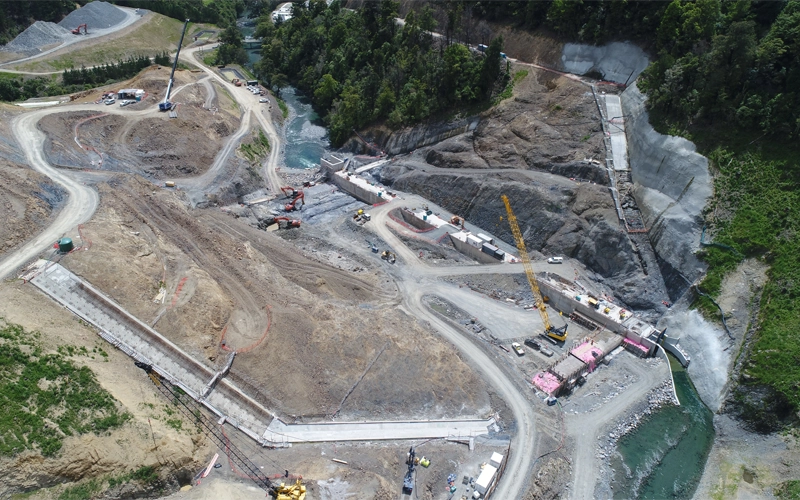
Dam foundation with river diversion. Photo: Tim Cuff
As the dam sits at the tectonic plate boundary between the Alpine Fault and the Hikurangi subduction zone, its safe performance is critical. The location is upstream of around 1,600 people, and has to be able to withstand a magnitude 7.1 earthquake to meet New Zealand’s Dam Safety Guidelines. The structure needs to safely drain any post-earthquake leakage through a damaged concrete face without saturating the embankment, which could induce failure.
Damwatch’s response was to completely redesign the embankment zoning, incorporating a chimney drain behind the concrete face that extended down to a nine-metre-thick drainage blanket at the base of the dam. Imported rock was then mixed with local alluvial gravels, which were hard-wearing and pervious.
“This solution is a first for New Zealand rockfill dams,” says Brian Benson CMEngNZ CPEng IntPE(NZ), Lead Embankment Engineer at Damwatch.
“This internal drainage layer behind the concrete face, coupled with the blanket drain at the base, limits earthquake and aftershock leakage and prevents destabilising seepage pressures.” Dr Lelio Mejia, a globally recognised earthquake geotechnical engineer from the United States, provided oversight for this novel approach.
Another challenge involved the entrance to the spillway, which, upon excavation, revealed a large crush zone in the foundation rock running almost down the middle. Left untreated this could erode over time, creating dangerous seepage paths undermining the spillway.
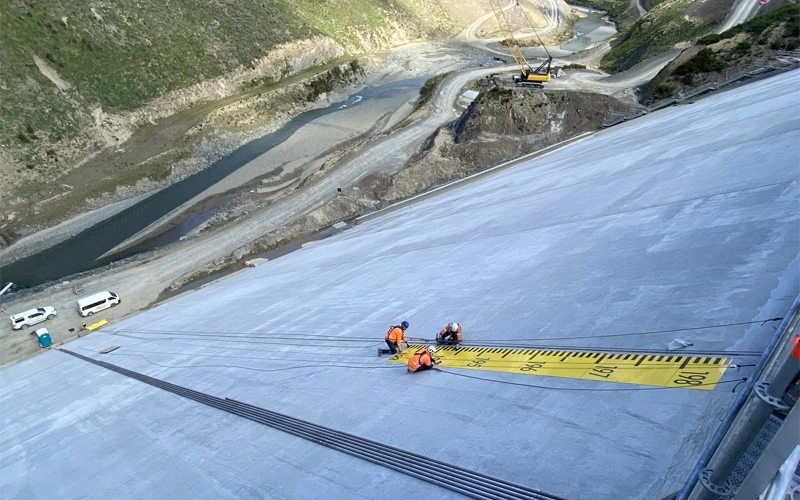
Waimea Dam's 12,000m2 concrete face, completed in 2023. Photo: Tim Cuff
“That led to a change in the construction of the foundation of the spillway,” says Peter. “The shear zone material was excavated and replaced with mass concrete.” He says the spillway was then anchored into the ground with rock bolts, with a drainage system running through the trench underneath the spillway.
This solution combined intensive grouting of the rock with a flexible Carpi Tech waterproof synthetic liner, or geomembrane, to provide a blanket over the approach channel floor and walls, so water can’t seep under the spillway. Beneath the geomembrane is a bedding foundation that has been compartmentalised to isolate and monitor any signs of leakage.
“It’s a material used overseas to seal leaking dams that had only been used once before in New Zealand, in 2013, on part of the Tekapo Hydropower Canal,” says Peter.
This project has provided the engineering community with direct, local experience in the construction of large dams in New Zealand.
Through earthquake modelling, predicted movement posed another challenge: how to keep parapet wall joints at the dam crest watertight when they could open substantially during seismic events. “The analysis revealed the crest could settle by up to 1.1m, with another 350mm from a big aftershock,” says Peter.
The solution was a flexible external waterstop system using the same geomembrane.
“We worked with Swiss manufacturer Carpi Tech to develop bespoke connection pieces that could accommodate the expected deformations while maintaining a water seal,” says Peter.
“This means it can stretch and allow for large movements without compromising its integrity.”
The project also showcased how computational tools are transforming dam engineering in Aotearoa. Computational fluid dynamics (CFD) software was used to redesign the spillway approach and plunge pool, optimising flow conditions without the time and cost of building a laboratory physical hydraulic model. The CFD analysis resulted in modifications to the approach channel shape, ensuring even flow distribution that wouldn’t overtop the spillway walls during extreme floods. It also refined the plunge pool geometry to minimise erosion during discharge events.
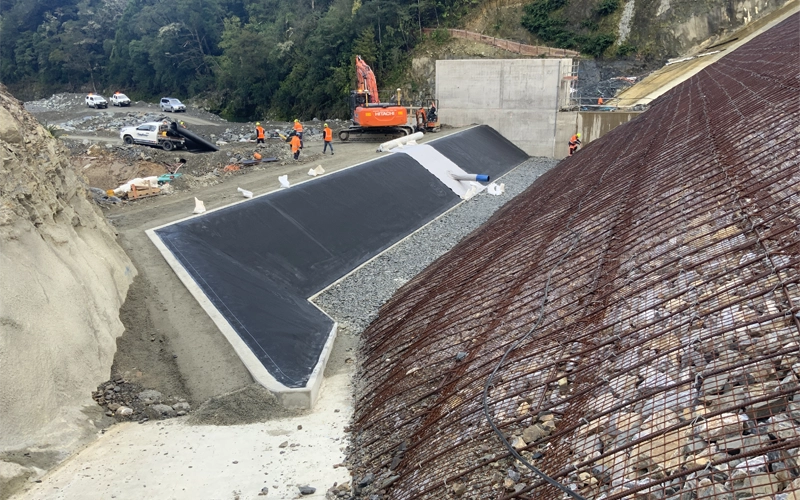
Drainage collection from toe of dam. Photo: Damwatch Engineering Ltd
The Waimea Community Dam was officially opened in February 2025. The reservoir was named Te Kurawai o Pūhanga by Ngāti Koata and can hold 13 million cubic metres of water, providing long-term water security for the people of the Tasman District and the region’s horticultural industry. It also improves river health by increasing minimum flows. Damwatch, with mechanical engineers MTL (NZ) Ltd won a Silver Award at the 2025 ACE Awards for this project. With no major dams built in Aotearoa for decades, a generation of engineers and construction workers had little experience with these structures. Peter, as a 25-year member and past Chair of the New Zealand Society on Large Dams (NZSOLD), says: “This project has provided the engineering community with direct, local experience in the construction of large dams in New Zealand. In NZSOLD’s mission to protect people, property and environment from the harmful effects of dam failure, the building of this dam has provided invaluable experience for future generations.”
This article was first published in the March 2026 issue of EG magazine.