
Engineering New Zealand Te Ao Rangahau acts as the voice of the profession by engaging in significant government reforms and contributing expert advice and perspectives from our members as policies and legislation are developed.
Quick links
Earthquake Prone Building (EPB) System reform
The Building (Earthquake-prone Buildings) Amendment Act 2026 passed at the end of September 2026. This Act shifts the earthquake-prone building system to a more proportionate and risk-based model. It focuses on high-risk building types and areas most vulnerable to earthquakes, while prioritising remediations that are proportionate to the level of risk. Read the Government’s announcement
Summary of the changes
- Seismic zones have been updated. The EPB system will no longer apply in Auckland, the Chatham Islands or the upper North Island low seismic zone. Parts of Dunedin, coastal Otago and Stewart Island that were previously in a low seismic zone will move to a medium seismic zone. This document provides details of the changes by location.
- From 1 July 2027, only buildings in medium and high seismic zones will be able to be designated EPBs. To be classified as an EPB, a building must:
- be made of unreinforced masonry; or
- be made of heavy materials, such as concrete, and be three or more storeys high.
- All other buildings will no longer be designated as EPBs and will be removed from the EPB Register. This process has begun already.
- There will be three types of strengthening requirements for EPBs. The applicable requirement will depend on the type of building, where it is located, and whether it is in an urban area or smaller town. The three types are:
- Register and display EPB sign.
- Façade risk mitigation.
- Targeted retrofit.
Next steps
The new EPB system relies heavily on supporting methodology that will set out how buildings are identified and assessed, and how their EPB status is determined. The methodology will need to be consulted on and finalised well before 1 July 2027, to ensure there is time to provide the industry with guidance and training.
Consultation is expected to commence shortly.
Further information
- Find out more information about the changes
- Read the EPB legislation
- Read the article about the new legislation.
- Watch the webinar on the changes when the Bill was introduced.
- Read our submission on the Bill
Building Amendment Bill
The Building Amendment Bill amends the Building Act 2004 to address inefficiencies in the building system that increase costs, delay delivery and constrain performance, including through clearer allocation of roles, responsibilities and risk.
The Bill is currently being reviewed by the Transport and Infrastructure Select Committee. The Committee has called for public submissions, and Engineering New Zealand is preparing a response on behalf of our members and the wider profession. You can also make an individual submission.
Summary of the proposals
The Bill’s primary proposal is to replace the existing joint and several liability model with proportionate liability. To support this change and help protect homeowners, the Bill proposes to introduce mandatory professional indemnity insurance for design professionals, including engineers, and mandatory home warranties.
The Bill also proposes to:
- improve consistency and efficiency across New Zealand’s 69 Building Consent Authorities (BCAs) by enabling voluntary consolidation of BCA functions and reducing Project Information Memorandum (PIM) processing times from 20 to 10 working days
- introduce a fast-track 10-working-day building consent pathway for new residential buildings with solar generation or other sustainable features
- expand the building consent exemption for granny flats by allowing offsite-constructed dwellings to be built in advance of a PIM
- reform building research funding by combining the Building Research Levy with the Building Levy and introducing a more contestable funding model.
Proportionate liability 101
Engineering New Zealand organised a Proportionate Liability 101 webinar, presented by Mark Anderson of Martelli McKegg. The webinar covered the proposed changes, key aspects of the Bill, considerations for engineers and questions raised by members.
Proportionate liability 101 slides | 571.8 KB
Next steps
The closing date for submissions is likely to be set early in the next parliamentary term. Once submissions have closed, the Committee will hear oral submissions before presenting its report to Parliament. The Bill will then continue through the legislative process.
No changes will take effect until after the Bill has passed.
Further information
- Find out more information about the Building Amendment Bill
- Watch BusinessNZ’s briefing that explores the Bill’s proposals
- Read the Bill
- Read the Beehive announcement
- Read the article about the proposed legislation.
Resource management reform
In September 2026, the Government passed two Bills that form the basis of New Zealand’s new resource management system – these are the Planning Act and Natural Environment Act.
Summary of the changes
The new planning system includes a range of changes that affect which activities need approval and how planning and environmental decisions are made.
Compared with the RMA, fewer activities are expected to need a consent, permit or designation where they comply with the relevant rules. More issues are also expected to be addressed earlier through national direction, national standards and regional plans, so planning and consenting processes can focus on matters that still need decisions.
This means the new system will work differently from the RMA in several ways, including:
- allowing more activities to go ahead without a consent or permit when they meet the relevant rules
- introducing environmental limits to guide how natural resources are managed
- requiring councils to consider the impact of certain rules relating to how landowners can reasonably use their land when developing plans, and to provide relief where the impact is significant
- requiring every region to develop a spatial plan for growth, infrastructure, natural hazards and environmental management
- making greater use of national standards to ensure plans, rules and requirements are more consistent across the country
- reducing the need to revisit matters already addressed through national direction and plans
- creating a Planning Tribunal to provide a simpler and more cost-effective way to resolve specified disputes and accountability matters
- making planning information easier to find, use and compare through improved digital tools and data systems
- requiring ongoing monitoring and reporting on how the planning system is performing.
The new system will be introduced in stages. Some changes will take effect during the transition period (see below), while others will be introduced over time through national policy direction, national standards, regional combined plans and new digital tools.
Next steps
Implementation will occur in stages, as shown below.
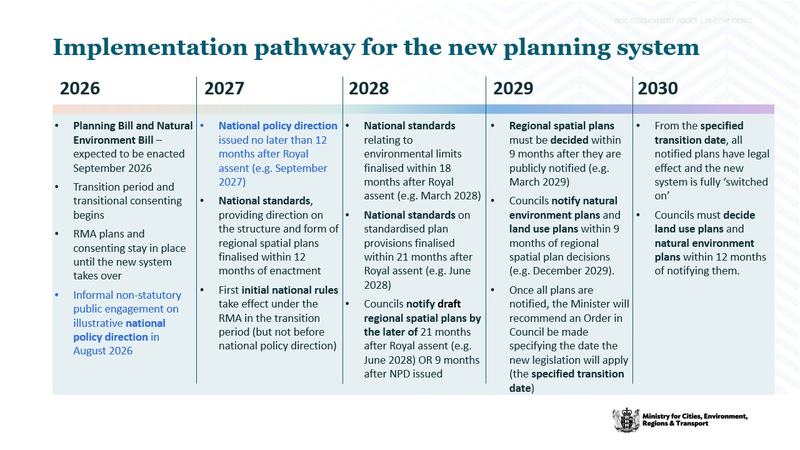
There will be further opportunities to influence the next phases of implementation, including through consultation on the National Policy Direction and National Standards. We will continue to advocate for our members and the wider profession throughout the implementation process.
Further information
- Detailed information about the new system, how it may impact you, and guidance for practitioners
- Read the Beehive announcement
- Read our outstanding concerns with the legislation
- Read our submission on the Bills