
27 Oct 2026
Over the last 12 months, the Engineering New Zealand Otago Heritage Chapter has increased the size of its committee and continues to work steadily on ensuring that the engineering heritage of Otago is acknowledged, recorded and preserved as appropriate.
Advocacy
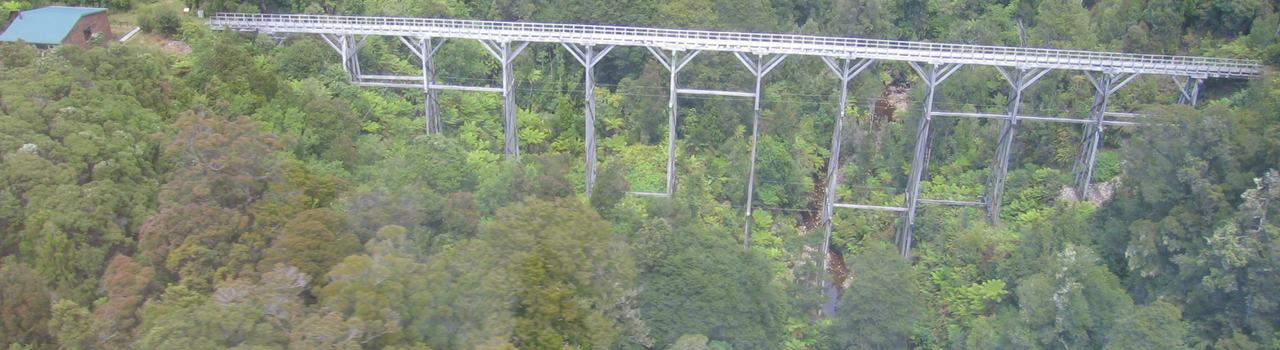
In February, the Percy Burn Viaduct, on the Hump Ridge Track near Port Craig, was closed due to concerns about its structural integrity. Percy Burn Viaduct was built in the 1920s to service an isolated timber milling operation and is the largest timber viaduct in New Zealand. The viaduct underwent significant restoration and repair in the 1990s and again in 2018. The 2018 work was undertaken as a partnership between the Department of Conservation (DOC), Southland District Council (SDC) and the Port Craig Viaducts Charitable Trust. DOC and SDC are unable to financially contribute to any future repairs. We have provided a letter of support to the Hump Ridge Charitable Trust to assist in funding applications.
Recording and storytelling
The heritage section of the Engineering New Zealand website is a repository of information for exploring, researching, and enjoying New Zealand's engineering heritage. The Otago Chapter is regularly adding Heritage Records related to the region. Most recently we have been checking and updating our older Records to reflect changes in ownership, use, or condition. We have also been researching and gathering information about the Waianakarua bridges on SH1 and the Otago Central railway line with the aim that these will be added to the Heritage Register – the list of our most significant engineering heritage.
The Engineering Heritage Board has noted that significant flood and drainage schemes, of which there are a number in New Zealand, have been under-represented in our Heritage Records and should be acknowledged. Accordingly, we are currently preparing a record to cover the Taieri flood and drainage scheme which has been under on-going development over the past 150 years.
Events
Much of our heritage is hidden from view or located in remote places. One such piece is the Waipori Hydroelectric scheme. The scheme consists of four stations in the Waipori Gorge and has been supplying electricity to the city of Dunedin for well over 100 years. In late 2025 we held a joint meeting with the Otago Branch, where Chapter Chair Rob Crosbie FEngNZ (Ret.) presented on the Scheme history. A field trip, held in early 2026, proved sufficiently popular to warrant a repeat in the coming summer.
The Chapter undertook a slightly different project in July 2026. The International Science Festival ran a ‘Science Train’ from Dunedin and through the Taieri Gorge. On both sellout trips there were several science demonstrations on matters relating to the railway and the physics of movement. We prepared kits containing paper drinking straws; cardboard diaphragms with holes to accept the straws; two pre-cut pieces of string; four pieces of Sellotape and some simple instructions. From these our young engineers (with mums and dads) were to build a truss bridge and test load it – all within 15 minutes, before our team of four supervisors moved on to the next carriage. Test loading involved placing 200g bags of sand midspan – and more than 20mm deflection was failure. The most carefully constructed bridges readily accepted a 2kg load, or 40 times the structure weight.
The design criteria were tight, and the model was refined considerably after two rehearsals. The formal feedback was excellent, and we have been asked back in 2027 so thinking caps are on for our next trick!
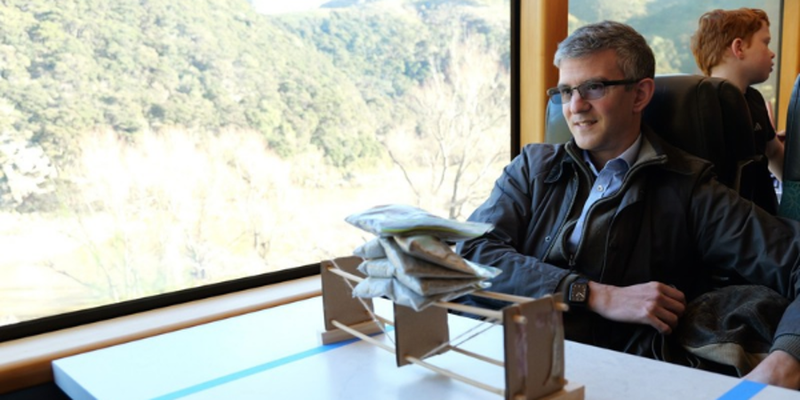
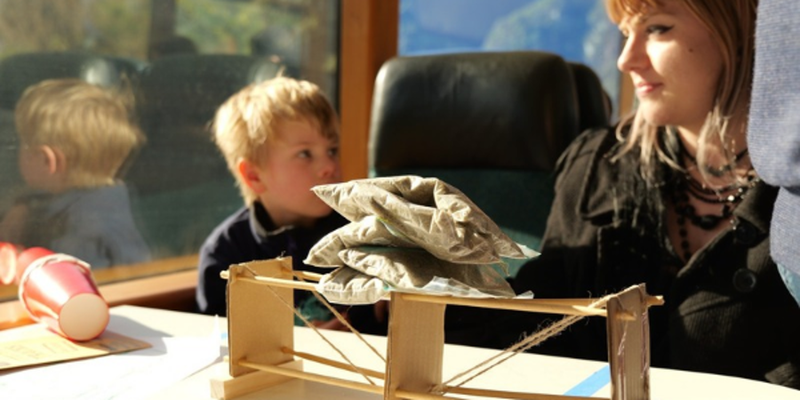
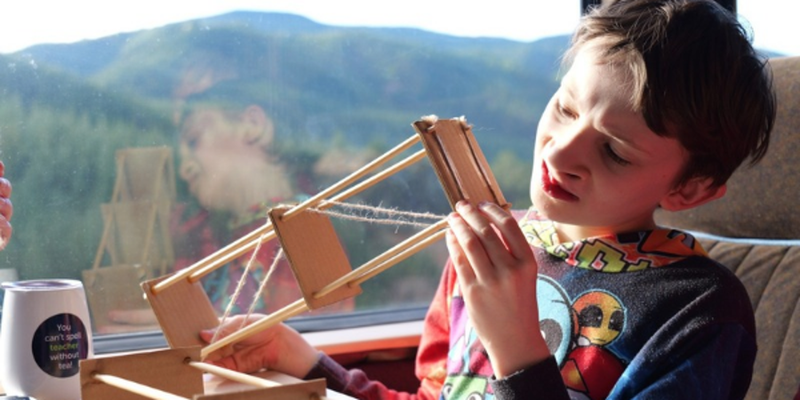
Photo credits: The New Zealand International Science Festival
This update was written by Trevor Kempton, Secretary of Otago Heritage Chapter.