
29 Jun 2026
While raising the standard of temporary works in Aotearoa has been a slow process, there’s now an increased understanding – in part as a result of failures – about the need to get things right.
It was lunchtime on 6 May 1975, when the falseworks supporting a 55-metre span of bridge under construction in central Auckland began to buckle. An investigation later determined that prestressing of the concrete had caused “hogging” of the girders, overloading scaffolding and initiating a progressive collapse. Thankfully, everyone working on this key element to connect Auckland’s Southern Motorway to the city was at lunch and no one was hurt. Even so, the Ramp A collapse was a landmark in the evolution of temporary works in New Zealand – the ultimate cautionary tale.
“It was such a catastrophic failure and it could have been easily avoided if good process had been followed,” says Downer Senior Principal Engineer Mark Hedley, a veteran temporary works engineer and new Distinguished Fellow of Engineering New Zealand. Mark, a key figure in the founding of the Temporary Works forum (TWf) in 2018 and its Chair until recently, says he doesn’t believe a qualified engineer was involved in designing Ramp A’s falseworks.
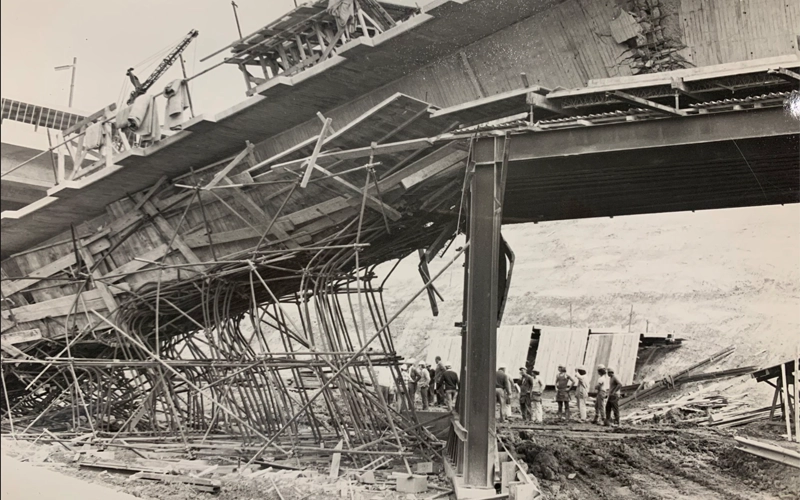
Karangahape Ramp A collapse, 1975. Photo: WSP
“As I understand, it was pretty much left to the scaffolding company,” he says, adding that that wasn’t unusual at the time.
“But when something like Ramp A occurs, you can’t just let that keep happening. There has to be some engineered design.”
An important outcome of the incident was the advent of a Code of Practice for Falsework.
“It documented good processes, values and numbers to be used in design, so that people could work off the same standard.”
Even so, raising the standard of temporary works in this country has been a slow process, despite the fact that “we are dealing with structures that are taking the same sorts of load as permanent structures”.
Strictly speaking, temporary works, like permanent structures, come under the Building Act. But in practice, the Health and Safety in Employment Act has been used as the governing legislation, Mark says.
“All prosecutions for serious failures have been through the HSE Act. And because that legislation doesn’t have acceptable solutions or verification methods, it has really been left to temporary works engineers to do what it takes to make things safe. Some do a good job, some don’t.”
We need more support and education for those smaller players to get good practice right across the industry.
Certainly, Ramp A wasn’t the last temporary works failure in this country. In February 2017, for example, scaffolding suspended from the Panmure Bridge in Auckland fell into the water. This time there were injuries, but fortunately no deaths.
Soon after, Mark and a few others founded the TWf. A Technical Interest Group of Engineering New Zealand, the forum promotes best practice through open discussion – including of failures – and the development of research and guidance.
“The goal was to bring everyone onto the same page and provide processes that everybody could follow. Since our initial document – a guidance note on procedural control – we’ve put out others that address gaps in knowledge,” he says, citing examples like temporary works for marine environments and designing propping for precast panels.
What difference has it made? Mark says there has been a significant improvement in the approach to temporary works taken by tier one and two contractors, scaffolding companies, falseworks suppliers and others.
“But we’re on a journey and we’re not quite there yet. I think it’s more difficult for smaller contractors. Because they don’t have in-house engineering teams, they can struggle to get timely assistance for good design of temporary works. We need more support and education for those smaller players to get good practice right across the industry.”
Susan Temple FEngNZ, who has succeeded Mark as forum Chair, says “there’s been a massive shift in awareness” of the need to get temporary works right. Where organisations might have “winged it” in the past, increasingly they are running plans past engineers.
“They’re asking ‘What are we loading, what’s it landing on, how are we going to build it?’,” Susan says, adding that engineers are being brought into the process at tendering “rather than as an afterthought”.
Unfortunately, increased awareness has been partly driven by temporary works failures.
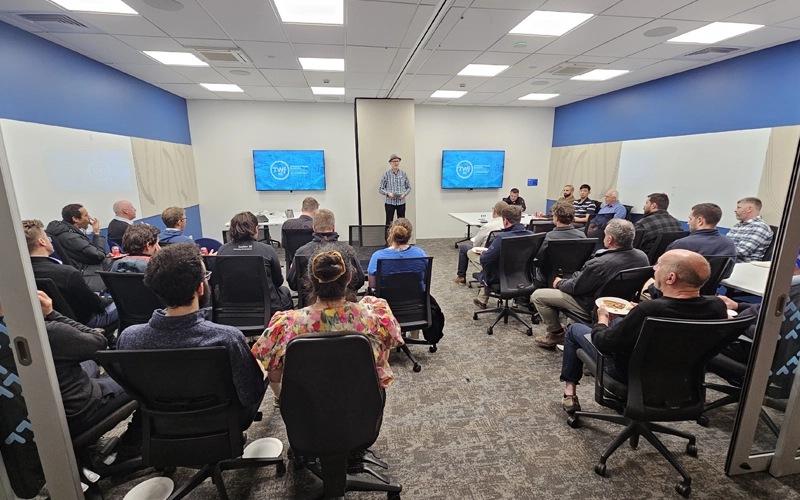
A Temporary Works forum (TWf) public meeting in Dunedin. Photo: Adam Moffat
“It takes an accident to really make some people stop and think,” she says. But she also credits the forum’s awareness-raising efforts, the presentations it makes and the public meetings it holds, as well as its presence on committees in industries where temporary works come into play.
Susan has been engaged with temporary works since she was an engineering graduate in the United Kingdom. One of her earliest projects involved the temporary damming of historic canals so they could be strengthened. Arriving in New Zealand in the early 2000s, she handled temporary works on the Supreme Court building in Wellington, a role that required collaborating with structural steel and demolition teams on a tight, heritage-listed site.
She is now Lead Engineer at Temporary Works Consulting (TWC), heading a specialist team devising solutions for public events and construction. TWC, an entity of the New Zealand Scaffolding Group, is responsible for temporary works on projects such as the Rotorua Museum, Wellington District Court and the Timaru Basilica. It also handles the design of temporary staging and seating for events including the Electric Avenue music festival, the ASB Classic tennis tournament and Supercars.
“The scaffolding looks amazing when it’s dressed, but there’s a huge amount of work that goes on in the background.”
That sums up something about temporary works: it’s a crucial element to get right, but it’s not exactly a glamorous field. So, what’s the attraction for engineers who make it their specialty?
Nick Bamford CMEngNZ CPEng IntPE(NZ) of Bamford Consultants, a construction and engineering firm that specialises in structural temporary works engineering, says the appeal lies in its immediacy.
“I fell into it by accident in the UK, designing tower cranes and temporary works for high rise buildings in London. What I found interesting was that you were designing solutions to complex problems one week and they were being installed the next. There’s very quick feedback.”
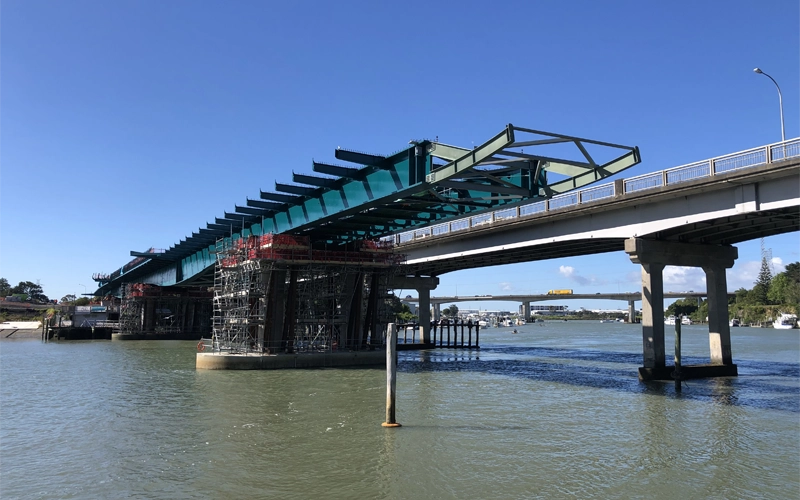
Temporary works for Auckland's Eastern Busway bridge launch was lead by Bamford Consultants in conjunction with the Fulton Hogan delivery team. Photo: Fulton Hogan
Among recent projects, Nick designed temporary works for the bridge launching of the Eastern Busway Bridge over the Tāmaki River. That was tricky and required complex analysis, he says, adding that the bridge-launching strategy included “some very innovative rollers to accommodate the curved bottom flange of the girders, without strengthening the permanent works”. Currently, he’s working on a bridge on the unfolding Penlink O Mahurangi project north of Auckland.
“We have a big, suspended formwork system there to allow for 200-tonne concrete segment pours, up to 40m above the waterway.”
Normally calculations are only a small part: it’s about working with the construction team to figure out the right answer for each specific application.
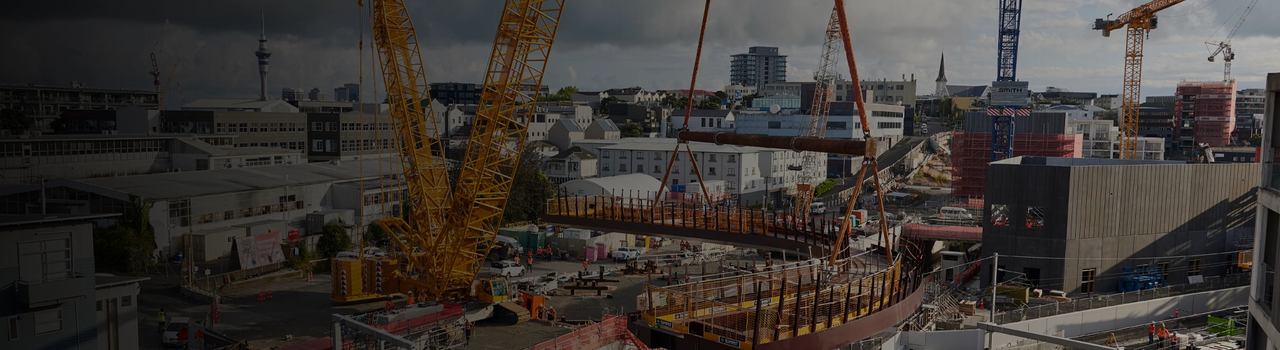
Even more challenging was the Auckland City Rail Link (CRL) project, where the temporary works included tower crane installations, conveyors for spoil removal, falsework and formwork, plus several temporary bridges to enable the 900-tonne boring machines to manoeuvre around the site. (The machine’s shield was 425-plus tonnes and 10m long, so these bridges were substantial.) This was on a busy inner city brownfields site, where there was often very little information about existing underground services. At one location near Aotea Square, Nick says, the team had to rely on details gleaned from a 1925 Auckland Star article.
Solutions on the CRL tended to be bespoke, he explains, and they were arrived at in concert with the wider project team. But that’s generally true of most temporary works assignments.
“Normally calculations are only a small part: it’s about working with the construction team to figure out the right answer for each specific application.”
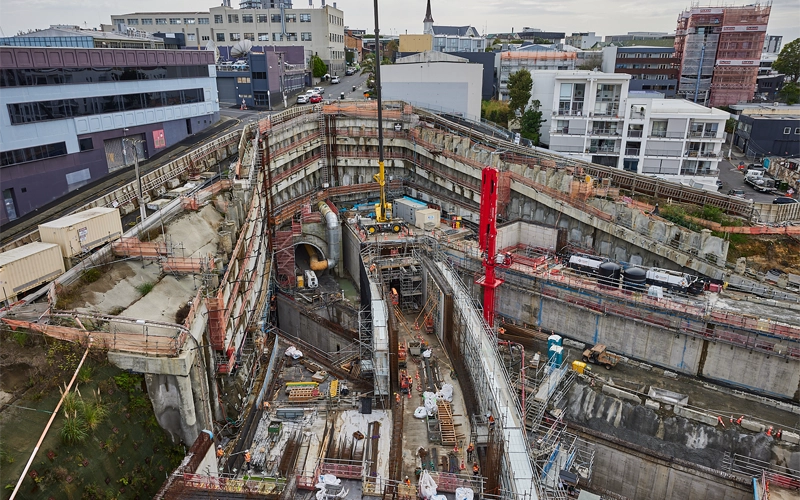
Installation of temporary works for Auckland's Mt Eden tunnel was delivered by Bamford Consultants in conjunction with the City Rail Link delivery team. Photo: CRL
Aurecon’s Will Watkins CMEngNZ CPEng says that same collaborative mindset was critical to the success of a recent project he was involved in to create a temporary accommodation ward at Wellington
Hospital. The 12-bed ward, required while the hospital’s copper pipe network was being replaced, had to be delivered in 12 months.
“We all put our heads together and the decision was made early to use offsite prefabrication to accelerate the programme and minimise disruption to the hospital,” Will says, noting that the location chosen was on a fourth-floor roof above the operating theatres.
Using warehouse space in Upper Hutt, the building was prefabricated in the form of eight pods, each weighing 15 tonnes.
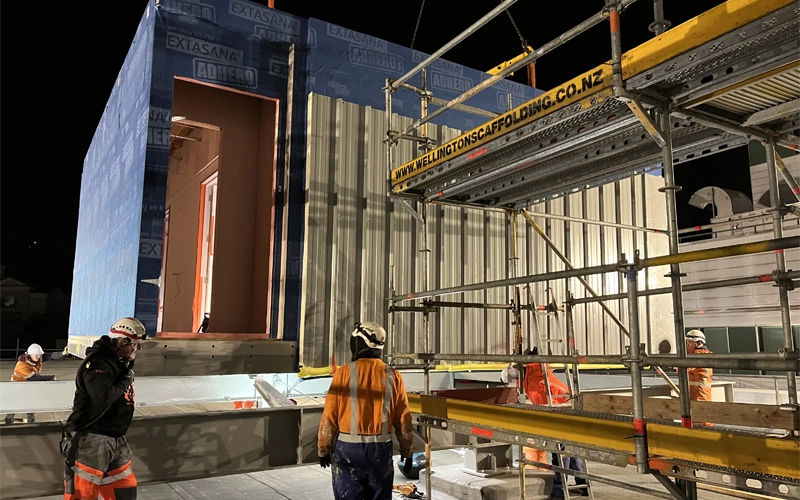
Partially fitted-out pods are craned into place at Wellington Hospital. Photo: Dan Herbison
“There was a lot required in the design to understand and detail how they would bolt together on site and to make allowance for future removal and reassembly elsewhere,” says Will, who is Buildings Mechanical Practice Area Leader for Aurecon.
The other challenge was to transport the pods to site and crane them on to the roof.
“We were fortunate to have an industrial engineer on our team, Stephen Jenkins, a Distinguished Fellow of Engineering New Zealand, who brought his knowledge of moving wool baling machinery around the South Island.” Stephen worked closely with the contractor and subcontractors to work out a methodology, Will says. He adds that the temporary ward, which won a silver at the 2024 ACE New Zealand Awards, is still in use. Even better, “Its success has seen a programme of similar facilities currently being rolled out at several hospital sites around New Zealand.”
This article was first published in the June 2026 issue of EG magazine.