

30 Jun 2026
Sound plays a vital part in the built environment. So what role do acoustic engineers play?
“What people hear should match what they see around them,” says Jeremy Trevathan, a Principal Acoustic Engineer and Managing Director at Acoustic Engineering Services. This means aural qualities must complement the space, such as reverberant, live sounds for huge stadiums or a productive hum in office environments.
“It’s one of the factors that needs to be well designed to make a building successful overall,” he says, because poor acoustic design can make a space challenging to use. Consider a cafe where you strain to hear conversations over all the buzz and hubbub, or a seemingly private meeting room whose discussions can be heard out in the hallway.
“You end up with parts of buildings that have a lot of thought and money put into them but aren’t being utilised as they should,” adds Jeremy.
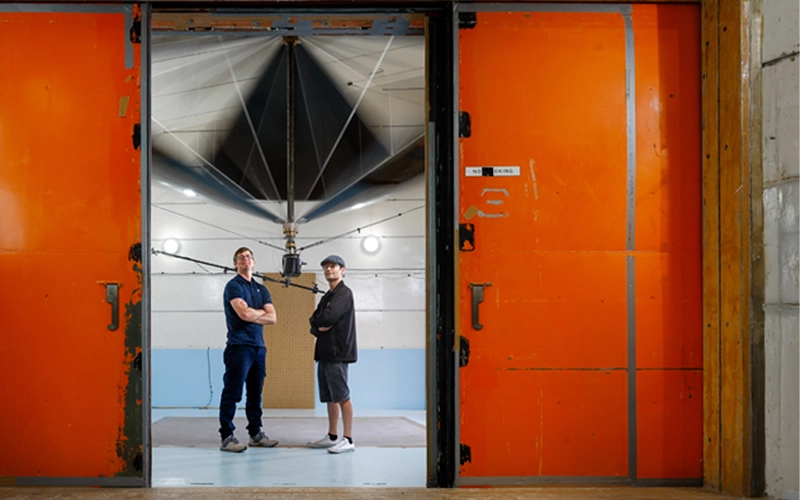
Dr Andrew Hall (left) and Gian Schmid in one of the reverberation chambers at the University of Auckland's Acoustics and Vibration Research Centre. Photo: Media Productions, University of Auckland
Yet acoustics goes beyond noise. Kezia Lloyd-Marsh, a Chartered Acoustic Engineer and Head of Building Engineering Services at WSP, describes other elements of acoustic engineering: sound absorption and how sound resonates throughout a space, sound insulation to prevent the transfer of sound, and vibration and how it might impact structural integrity.
“What I love about acoustic engineering is that you could be figuring out what the main parameters are to make a great chamber music space or how to make sure people aren’t getting fully disturbed by construction noise outside their bedroom window,” Kezia says. “They’re important in their own way but very different, so it’s a really varied job.”
In building acoustics, mass is normally your friend, so something heavier is better for preventing the transmission of sound.
Spanning the audio spectrum
This variety is where acoustic engineers excel in Aotearoa. For instance, Jeremy recalls his involvement with customising the glass wrapped around the control cab atop Ōtautahi airport’s control tower.
“That turned into a high-stakes item and it pushed us beyond normal engineering,” he says. The glass had to be light and sturdy from a seismic standpoint and clear enough for air traffic controllers to see without any distortions from various visual angles. But it also had to carry the right thickness to mask the whir of propellers, thrum of engines and zoom of planes taking off and landing.
Another challenging project was The Grounds, a multi-unit residential development in Tāmaki Makaurau that employed mass timber and prefab components. While timber can be engineered as huge thick slabs akin to concrete, it offers less of concrete’s noise suppression effect due to its lighter weight.
“In building acoustics, mass is normally your friend, so something heavier is better for preventing the transmission of sound,” says Jeremy.
“From an acoustics point of view, one of the ways to improve the performance of the systems is to cover them up. You’d have a ceiling below the timber slab, or you would have framework and then plasterboard on your walls still.”

Principal Acoustic Engineer Jeremy Trevathan spent time at Point Durham Wind Farm in the Chatham Islands, measuring and modelling noise produced by turbines. Photo: Chatham Islands Enterprise Trust
Jeremy also has experience in environmental acoustics, where he gets to measure and model noise levels and assess how that might propagate into the environment. He sometimes presents evidence at council hearings or serves as an expert witness at the Environment Court.
“It’s an important part of the checks and balances in the system we currently have.”
His environmental acoustics work has taken him to the Chatham Islands, where he measured, modelled and analysed the noise produced by wind farms. He’s currently involved with the Tāwhaki National Aerospace Centre, helping determine how much noise each aircraft will make and if they comply with the noise limits outlined in resource consents.
Innovative insulating
The country’s acoustic engineers also shine when it comes to innovation. Andrew Hall, a Senior Research Fellow and Senior Lecturer at the University of Auckland’s Department of Mechanical and Mechatronics Engineering, is all ears on metamaterials for sound insulation in houses, with the intention of commercialising them in the future.
For floors, Andrew and his students are studying the right mix of granular metamaterials – aggregate, granulated polyester, gravel, recycled tyre chips, sand and sawdust – to either spread and reduce the amplitude of sound, or sharpen and push it up to higher frequencies for easier dissipation.
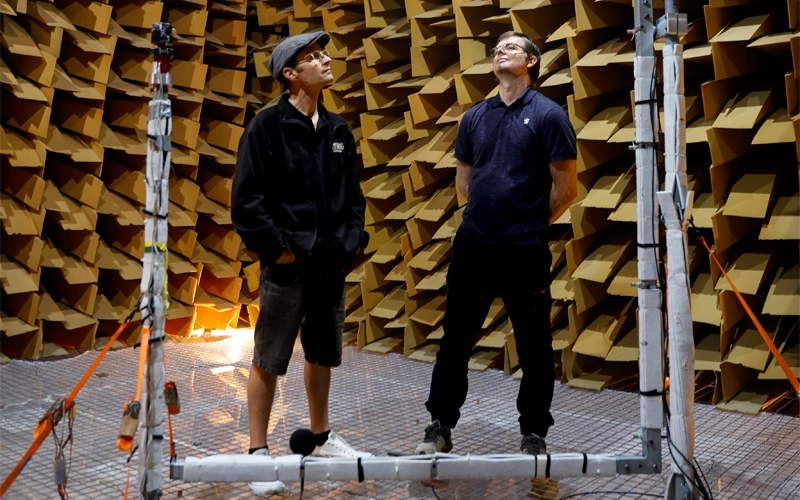
Andrew Hall and Gian Schmid working in the Acoustic and Vibration Research Centre's anechoic chamber. Photo: Media Productions, University of Auckland
“The idea is that these materials provide mass,” Andrew says. “Because they rub together, creating heat, they increase damping. But they also provide sound absorption within the cavity.”
For windows, Fano resonance acoustic airborne materials such as Helmholtz resonators absorb airborne noise through a duct.
“We can open a duct underneath the window so air flows through but minimal sound will come through,” Andrew says.
The team are also looking into mechanical metamaterials for doors and walls, attaching oscillators and other mechanisms that absorb and reflect sound.
“These moving parts make the wall or door appear much heavier,” says Andrew. “We’re targeting low frequencies, like the footfall of a toddler jumping around, because they’re difficult to attenuate.”
Human and social aspects
Such new materials form part of the trends in acoustic engineering, according to Kezia. Others she deems noteworthy include the increasing integration of data, and adapting noise models to comparable environments.
In Australia, for example, Kezia and her team carried out noise modelling for the entire city of Melbourne. They then harnessed that same technology for an entertainment precinct, another large and acoustically complex site.
Acoustic engineering has a lot of advisory components and it’s about understanding the human experience of space, which varies from person to person and space to space.
“It was interesting to apply the noise modelling of a city into a mixed-use environment, making it more detailed and being able to inform where the challenges might be for future development and how noise emissions from the site could be controlled.”
And while artificial intelligence may be the talk of the town, “it hasn’t yet made the biggest splash on acoustics in particular,” says Kezia.
“Acoustic engineering has a lot of advisory components and it’s about understanding the human experience of space, which varies from person to person and space to space. That is something AI needs to improve at before we can rely on its outputs. From an automation point of view, there are certainly processes that AI can optimise in the short-term.”
The human and social aspects are what keep Kezia connected to acoustic engineering.
“You have to put yourself into the mind of someone who would be using a space and think about how you can make that space better for them.”
Flexible generalists
Despite many boundary-pushing projects, Kezia observes that Aotearoa is not heading the charge in acoustic engineering.
“Unlike structural engineering, where we’re internationally sought after for seismic expertise to help other countries, it’s not the same for acoustics.”

Kezia Lloyd-Marsh, Chartered Acoustic Engineer and Head of Building Engineering Services at WSP. Photo: WSP
Scale might be a major reason behind it. “Compared to regions in Europe and Australia with a larger economy to develop cutting-edge infrastructure, in New Zealand, we don’t have the same scale. However, we can draw upon international practices,” she says. She points to Australia and the United Kingdom as examples of leaders in the field, noting that the latter has certain standards for several aspects of acoustics based on building type, while each Australian state has its own requirements for distinct noise categories.
A brighter, more optimistic side to New Zealand’s generalist capabilities is our flexibility to fit varying acoustic scenarios.
“We are great at being able to see the bigger picture and do a whole lot of different things, whereas internationally, acoustic engineers and consultants can be narrower and more specific in what they do,” Kezia says.
Sound masking
Workplaces can be noisy environments, which makes acoustics integral to designing these spaces. Sound masking can help enhance acoustic privacy and comfort. This technique adds low-level background sound emitted through tiny speakers from the ceiling. The ambient sound is tuned to match the frequency of human speech, so it’s comfortable to the human ear and fades into that natural workplace hum. The sound also makes it more difficult to understand conversations, protecting speech privacy.
Sound masking can help boost productivity, “lowering that radius of distraction” says Jacques Paterson, ANZ Sales Director at audio company Biamp.
“Most people are unaware that every time you get interrupted in your workspace, it takes roughly 23 minutes to get yourself back into focus mode.”
Musical backgrounds
True to form, both Kezia and Andrew are musicians. Kezia started on the recorder at the age of around four or five, progressing to piano and cello and singing in choirs. These days, she still sings and plays the guitar and ukulele. Her musical background came in handy when she helped design a chamber music space, and the piano and music rooms at some of Google’s offices.
Andrew’s musical journey began at the age of about five or six on the recorder and piano, before switching to wind instruments such as the clarinet, saxophone and trumpet. In addition to his engineering honours degree and PhD in acoustic engineering, he also earned a scholarship to study at the New Zealand School of Music.
As an accomplished musician, Andrew was formerly a member of dDub and the Rodger Fox Big Band. He mostly plays the saxophone nowadays in jazz and fusion groups such as the Auckland Jazz Orchestra, where he serves as an arranger and composer.
He also tries to blend more of his passion for music into his research. He’s spearheading a Music Technology Group at the University of Auckland, hoping to bring together engineers and musicians.
“Music is a place where I can escape and get my brain to relax and be more creative.
“We need more creativity, especially in engineering, and music helps with looking at things from a different perspective.”
Wellington Town Hall
The stage is set for the return of Te Whare Whakarauika, the Wellington Town Hall in 2027. It’s envisioned to be a national centre of music and a home to the New Zealand Symphony Orchestra (NZSO) and Te Herenga Waka Victoria University of Wellington’s New Zealand School of Music Te Kōkī.
“The nature of the building has fundamentally altered into a performance and teaching acoustic space, so a lot of thought has gone into the acoustic design of the building,” says Gervais Lawrie, Senior Project Manager of the Wellington Town Hall redevelopment project.
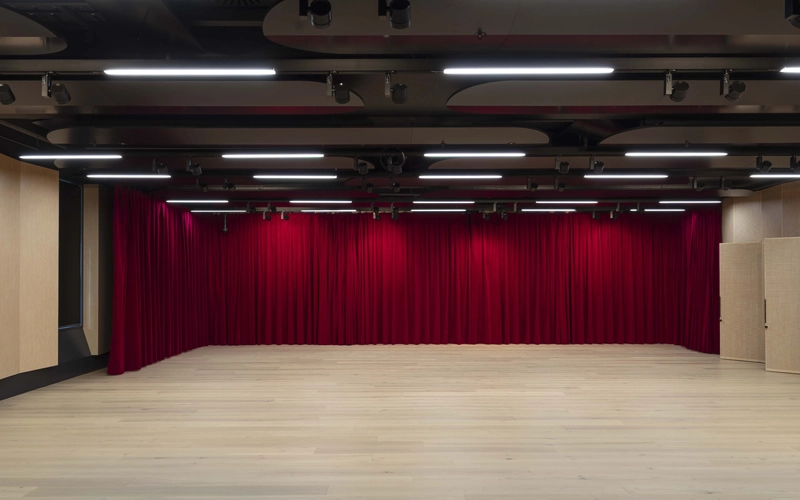
Mason Mercer box-in-box at the Lloyd Morrison Theatre – part of Te Herenga Waka Victoria University of Wellington’s New Zealand School of Music Te Kōkī. Photo: Neil Price
As the main performance space, the Adam Auditorium’s high acoustic qualities have been preserved. An extra set of windows has been installed for acoustic isolation, while sound insulation has been added to the corridors surrounding the auditorium. Even the thickness of the foam on the fixed seats was a factor because “we didn’t want them to be too absorbative, which would have changed the reverberation time in a way that may have been deleterious to recording or performances,” Gervais says.
Beneath the auditorium, the basement has been converted into a control room and recording suite for the NZSO. The auditorium’s timber floor had to be laid directly onto a concrete floor, changing its reverberation characteristics. To counteract that, a new acoustic floor has been installed in the roof space above the auditorium, doubling as a shield to block outside noise from intruding and ruining a performance or recording.
This article was first published in the June 2026 issue of EG magazine.