
8 Jul 2026
What does AI look like when it moves beyond prototypes and into everyday infrastructure? Following a recent delegation to China with the New Zealand AI Forum, a member of Engineering New Zealand Te Ao Rangahau’s AI Advisory Committee, Blake Harkness, shares observations from a week spent on the ground with companies deploying AI at scale. Explore what holds up in production, where the real constraints lie, and how these developments could shape the future of engineering practice in New Zealand.
I went to China on behalf of a New Zealand AI Forum delegation, not knowing what to expect. I came back thinking about engineering fundamentals: where the real bottlenecks sit, how fast you can iterate, and what actually survives contact with a factory floor or a substation.
My background is mechatronic engineering, with embedded software and a stint working on AI at a New Zealand electricity distributor before I started Harkness AI. So I wasn't watching the demos as a tourist. I was watching them the way an engineer watches anything: what is the system, where does it break, and would it hold up in production. Here is what stood out across seven days on the ground, framed for the people who actually build things.
The first impression: AI as ambient infrastructure
The first thing we saw stepping off the plane was a large "AI x Olympics" banner in the centre of the terminal. From there it did not stop. An autonomous drink station at the Summer Palace where you pay through a QR code and a robot hands you the drink. A voice assistant in every room controlling the TV, air conditioning, blinds and lights. The majority of vehicles on the road in Beijing were EVs, almost none older than about five years.
The example that stuck with me was the hotel food delivery. At every hotel we stayed in, the delivery riders, China's version of our Uber Eats drivers, never came upstairs. They handed the order to a robot waiting in the lobby that was wired into the hotel's own system. It called the lift, rode up to the right floor, found the door and rang the bell to hand the food over, covering several floors of a large hotel on its own with no one bridging the two systems by hand.
The engineering takeaway is not any single gadget. It is that AI in China is being deployed as ambient infrastructure, not as a feature bolted onto an app. The word "AI" is on buildings, ads and cars the way "smart" or "digital" was a decade ago, except here it is wired into the physical environment.
The bottleneck has moved from hardware to data
The clearest lesson of the trip came from Galbot, who had a humanoid serving coffee and food inside a FamilyMart and demonstrating box-moving and parts-sorting on the manufacturing side. They also had a dancing humanoid, which is gimmicky, but the engineering underneath a two-legged robot holding balance is genuinely hard, and that is before it does quality control on a production line.
Their headline insight: the hardest problem in robotics is no longer the hardware. It is data, specifically closing the gap between simulation and the real world. They are building a "world action model" to attack that sim-to-real gap, with a deep partnership with NVIDIA behind it.
For New Zealand engineers this reframes where the value sits. We tend to fixate on the mechanical and electrical build. The companies moving fastest in China have largely solved "good enough" hardware and are now competing on data pipelines, simulation fidelity and the model layer on top. That is a software and systems problem, and it is one we can contribute to without owning a factory.
Iteration speed is the new manufacturing advantage
Dreame was the company that reframed China's edge for me. Their old advantage was manufacturing. Their new advantage is iteration speed, data and scale. Because manufacturing is cheap and fast, they can test, fail and rebuild quicker than anywhere else. Over 200 businesses operate under their ecosystem through licensing or co-branding, shipping things like a fridge that adjusts temperature based on the vegetables inside and a voice-activated stair-climbing vacuum.
The cultural mechanism behind that speed is worth flagging because it is uncomfortable. In some verticals Dreame runs two internal business units competing on the same problem, and if a unit misses its targets, it is gone. MagicLab, founded in January 2024, already has 500 staff (80% engineers), 90% in-house hardware, and is shipping robot dogs at roughly iPhone prices. Full stack, moving fast.
You do not have to admire the model to learn from it. The engineering point is that shortening the build-test-rebuild loop beats almost any single clever design. Whoever cycles fastest wins.
Robotics is finding real utility, and it is not the humanoids
The most hyped form factor is the humanoid. The most useful one, repeatedly, was the robot dog. As I put it in my notes: robotic dogs by far have the most use cases relative to the complexity of human-operated tasks. We are not as close to "Terminator" as I expected.
The example that hit closest to home was DEEPRobotics. My last role before Harkness AI was at an electricity distributor, so I already knew the asset-maintenance case: a quadruped that walks a site scanning and photographing assets to catch degradation. What I had not seen was their experiment with a humanoid that lives on a substation and is capable of doing the switching and other operations we currently treat as human-only.
For New Zealand's lines companies and utilities, that is the demo to pay attention to. Substation switching is exactly the kind of high-consequence, hard-to-staff, often remote task where a reliable robotic operator changes the economics. We are a long way from trusting it, and rightly so. But the trajectory is real, and our regulatory and safety thinking should start now, not after the hardware lands.
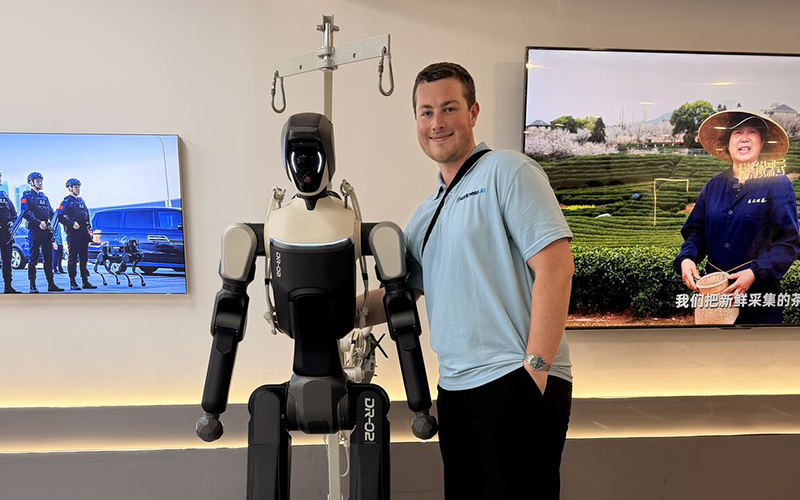
Blake posed with a humanoid. Image: provided
AI is going deep into sectors engineers underwrite
Beyond robotics, the sector deployments were striking for an engineering audience because they touch infrastructure we are responsible for:
Healthcare. One group we visited runs an AI hospital that works in two directions at once. It triages real patients with AI doctors, and it gives human doctors a simulated world of AI patients and fabricated lab results to practise against, so they can test their own judgement, learn and upskill with no risk to a real patient. On the other side of the spectrum, one hospital we toured serves around five million patients a year and has cut image-analysis time by roughly 80% with AI. Its pharmacy is automated end to end: you scan a QR code and the system collects and dispenses your medicines with no human in the loop.
Smart cities. The Hangzhou City Brain centre showed AI drafting legal documents and answering council questions at 90% accuracy, hard hats with fall detection, lone-worker monitoring, and traffic-signal optimisation to reduce congestion.
Banking. China Construction Bank runs 400+ internal AI assistants on an open internal marketplace, where staff build their own tools and a feedback system keeps the useful ones alive and lets the rest die off.
The common thread is governance and systems design, not just models. A lot of this is driven top-down: the national five-year plan sets direction for how agentic AI should be developed, and organisations align to it. You can debate that approach, but the result is an unusually coherent rollout across competitors who openly compare deployment numbers.
The sovereignty and trust angle
Z.AI was not what I expected. Their base model, GLM, has reached state of the art for open-source coding, but most of their pitch was the ecosystem on top, focused on sovereign AI deployments: helping countries set up the talent, data and compute to run their own information locally. That is the opposite of the Western assumption that Chinese AI is purely about siphoning data.
There was also a recurring lesson about trust and the limits of full automation. Alibaba tried generating fashion designs end-to-end with AI. It failed. The designs were soulless and the human designers had no idea how the outputs were produced, which killed trust. So they rebuilt it: AI handles market intelligence, competitor scanning, trend prediction and digital-twin testing, and that analysis feeds the design work rather than replacing the designer. That is probably the right pattern for most engineering disciplines too. Use AI to widen and pressure-test the option space, keep a human accountable for the decision.
What this means for New Zealand engineers
A few things I am taking away, and that I think are worth the profession discussing:
- The competitive frontier is data and iteration speed, not hardware. We can play here with software, simulation and systems work without out-spending anyone on factories. Our edge is most likely in specific verticals where we already hold deep, hard-to-replicate data. Agriculture and farming sit at the top of that list, where New Zealand's domain expertise and decades of on-farm data give us something the scale players cannot simply buy.
- Robotics is arriving in our infrastructure. Asset inspection by quadruped is effectively here; substation and high-consequence operations are next. Safety, standards and verification frameworks should be drafted ahead of deployment.
- The winning pattern is human-in-the-loop, not full automation. The failures we saw came from removing the engineer's judgement, not from too little AI. The teams getting it right use AI to widen and pressure-test the option space, then keep a named human accountable for the final call, which is exactly how we already run safety-critical engineering decisions.
- Skills are the real constraint. A distinguished professor we met summed it up when we asked what degree people should study now. His answer: it does not matter whether it is engineering, humanities or anything else, as long as you are using AI alongside it. That is the only criterion. Even with one of the strongest STEM pipelines in the world, his team admitted no one has education figured out for this era, and their answer was to let students use any AI tool they like and assess them on explaining how and why they used it.
I left China with my brain fried, in the best way. The scale is genuinely different from anything I have seen. But the lessons are not exotic. They are the same fundamentals we already value as engineers: solve the real bottleneck, shorten the loop, keep a human accountable, and build for production rather than for the demo.
That production mindset is also the work I spend my time on back home, helping New Zealand engineering firms move past AI as a novelty chatbot towards something closer to an AI operating system that runs quietly underneath the business. The trip only sharpened how I think about that shift, and I am always happy to talk it through with anyone in the profession weighing up the same move.
This article was provided by Blake Harkness, a member of the Engineering New Zealand Te Ao Rangahau AI Advisory Committee. The views expressed are those of the author.