
29 Sep 2026
As well as completing her final-year of engineering studies, Nitya Chatla works part-time as a Front-End Engineer at Sharesight, a Wellington fintech building software that helps investors track their portfolios. And when she’s not studying or working, she’s likely to be found dancing – or teaching – the classic Indian dance form Bharatanatyam.
What’s your current involvement with dance?
I’m a graduate of Natraj School of Dance, a Bharatanatyam school in Lower Hutt, and I’ve come full circle as an instructor teaching the next generation. Recently I also stepped behind the scenes as a lighting and sound technician for the school’s June production.
How did you first get involved with dance?
My mum, a dancer herself, signed me up as a child and at first I hated every minute. That changed the moment I stepped on stage. Five-year-old me kept asking when I could go up next, not realising performances are rare, hard-won occasions rather than a weekly treat.
What do you love most about dancing?
I love that dance lets me connect with people. In Bharatanatyam, acting is woven into the movement, so I can tell a story without saying a word.
Where has dance taken you?
In 2023, during my first year of uni, dance took me to India to complete a formal certification, so I’m now a qualified dancer who’s performed internationally. Closer to home, it also has me travelling around Aotearoa New Zealand to perform.
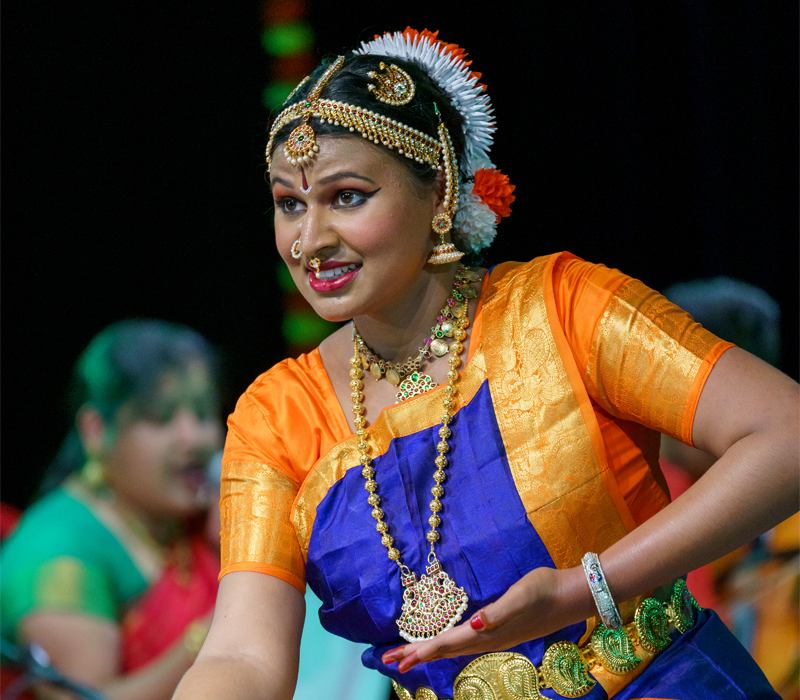
Photo: Matthew Arun/Clint Thambi
What has been your biggest challenge with dance?
Getting ready: hair, makeup and costume used to take nearly three hours, though I’ve trimmed that to about two. After that, it’s holding stamina and technique together at once. Some pieces run up to 45 minutes, which takes serious training to sustain.
What is your greatest achievement with dance?
My proudest milestones are my Arangetram (solo debut) and earning my certification with distinction in India, where I topped my college cohort. Alongside this is the character and discipline I built getting there.
Who or what has had the biggest impact on your success in this area?
Two people. My guru, Srimathi Prabhavathi Ravi, my second mother and lifelong teacher, who shaped everything from my posture to my stage presence. And my mum, who carried the weight of it all and did everything to keep me committed.
Tell us something about your involvement with dance that might surprise readers.
Dance quietly made me a serious musician! It sparked a love of Carnatic vocal singing, and I’m on track to earn my certification, trained vocally to the same level as my dance. People are often surprised that classical dance and music are so deeply intertwined.
Why did you decide to study software engineering?
Both my parents work in tech, so they’re my inspiration. I’d also loved my high-school digital technology class, where I made close friends and had the best memories. I hoped to find that same community at uni, which I did.
Does your training as a software engineer bring any advantages to the way you approach singing and performance?
More than I expected, and it runs both ways. Bharatanatyam is deeply mathematical: the rhythmic cycles (talam) work like modular arithmetic counted with your feet. And in reverse, I debug choreography the way I debug code, isolating the tricky passage, drilling it, then reassembling the whole.
How much time do you devote to dance each week?
Around three to six hours, split between gym sessions for stamina and practising routines, since conditioning matters as much as choreography for longer pieces.
Do you have a set routine when you’re getting ready for a performance?
As a classically trained Bharatanatyam dancer, I always perform a Namaskaram before any practice or performance, acknowledging the earth I’m dancing on, my teacher and the audience. It centres me and reminds me of the lineage I’m part of.
What’s next for you?
First, wrapping up my engineering degree and stepping into full-time work! On the artistic side, I've just sat my vocal certification and now I'm focusing on an upcoming production for our music school.
This article was first published in the September 2026 issue of EG magazine.