
28 Sep 2026
Take five with Thomas Loho, Professional Teaching Fellow at the University of Auckland's Faculty of Engineering and Design. Find out how he incorporates AI into his teaching, what his three career highlights are, and why his Engineering New Zealand membership is important for his professional journey.
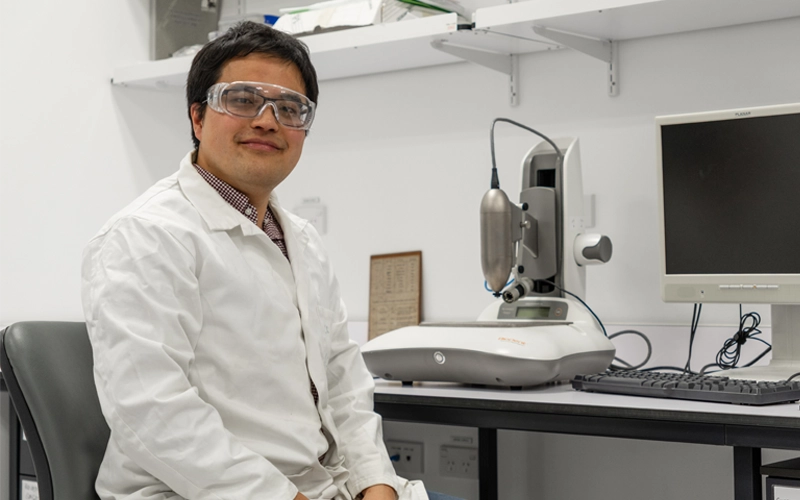
Professional Teaching Fellow Thomas Loho. Photo: supplied
As an educator, I'm less interested in whether AI can produce an answer and more interested in whether students understand the reasoning behind it. I encourage students to use AI as a learning partner rather than a shortcut.
Name: Thomas Loho
Role: Professional Teaching Fellow
Organisation: University of Auckland
Location: Auckland
Favourite chocolate flavour: Whittaker's Rum & Raisin
What does your role entail?
I am a Professional Teaching Fellow in the Department of Chemical and Materials Engineering at the University of Auckland. I teach students from their first year through to postgraduate study across topics ranging from materials science and chemistry to fluid flow and reaction thermodynamics. What I enjoy most is helping students make connections between theory and real engineering practice, and seeing their confidence grow as they develop into professional engineers.
What sparked your interest in engineering?
My dad studied electrical engineering and always instilled in me an appreciation for how engineering combines creativity, problem-solving and real-world impact. As a child, I was fascinated by understanding how things worked and why materials behaved the way they did. That curiosity eventually led me to study Chemical and Materials Engineering at the University of Auckland, where materials engineering concepts are used to solve challenges that affect everyday life. What continues to excite me is how engineering constantly pushes the boundaries of what is possible. Many of the technologies we now take for granted would have seemed like science fiction just a few decades ago.
What are your top three career highlights?
- Being recognised through Faculty Teaching Excellence Awards in 2023 and 2026 has been particularly meaningful to me because it reflects the impact that my teaching has had on students' learning journeys and future careers.
- Leading curriculum transformation within the Chemical and Materials Engineering programme has been extremely rewarding. Working with colleagues to redesign courses and improve programme coherence in line with Washington Accord and IChemE accreditation standards has allowed me to look beyond individual courses and help better prepare graduates for modern engineering practice.
- Seeing former students succeed in industry and postgraduate study is always a highlight. The random emails I receive from alumni telling me that something they learned in my classes helped them solve a problem at work are incredibly rewarding. Knowing that the learning experiences I helped create contributed to their confidence and professional development is one of the most satisfying parts of the job.
How do you incorporate AI in your teaching, and what has the result been?
As an educator, I'm less interested in whether AI can produce an answer and more interested in whether students understand the reasoning behind it. I encourage students to use AI as a learning partner rather than a shortcut. In my courses, we discuss how AI can help explain concepts, generate ideas, and support problem-solving, while also emphasising the importance of critical evaluation and engineering judgement. One example is my use of oral lab reports, where students discuss and defend their interpretation of laboratory data in conversation with me while I have an AI agent open alongside the assessment. At the end of the conversation, I ask the AI agent a completely out-of-the-box question that I do not expect the student to prepare for, and then I ask the student to explain the AI output to me in plain English. I do notice that student sentiments towards AI can be quite polarising. Some think it is the most wonderful thing ever, while others think it is completely useless. I believe the answer is somewhere in the middle, and I aim to get students to be critical of AI and not completely trust or distrust it. Or to summarise with the famous saying from Ronald Reagan, the sentiment should be: Trust, but verify.
How do you explain the Washington Accord to your students?
When students hear the term "Washington Accord", it can sound quite abstract. I usually explain it as a way of ensuring that an engineering degree from New Zealand is recognised and respected internationally. For students, it means the skills they develop here can open doors around the world. It also helps ensure that engineering programmes are built around internationally recognised graduate outcomes rather than short-term trends. More importantly, it focuses on developing graduate attributes such as problem-solving, communication, teamwork, ethics, and lifelong learning. In many ways, it helps ensure that engineering graduates are prepared to work effectively in a global profession.
Why are you a member of Engineering New Zealand?
Engineering New Zealand helps me stay connected to the wider profession and reminds me that engineering is much bigger than the university classroom. Membership gives me opportunities to learn from practising engineers across a wide range of disciplines and helps ensure my teaching reflects current industry expectations. It is also a valuable community of people who care deeply about the future of engineering in New Zealand. I'm currently working towards Chartered status, so being part of Engineering New Zealand is also an important part of my own professional development.
If you could meet any engineer in the world, dead or alive, who would you meet and what would you ask them?
I would choose Margaret Hutchinson Rousseau, the pioneering chemical engineer who became the first woman to earn a PhD in chemical engineering from MIT and played a key role in developing the large-scale production process for penicillin during World War II. Her work demonstrated how engineering can translate scientific discoveries into technologies that save millions of lives. I would ask her how she led the scale-up of the penicillin production process from a scientific breakthrough to an industrial reality, and what advice she would give aspiring engineers about combining technical excellence with perseverance. I think her perspective on innovation, leadership, and overcoming barriers would be just as relevant today as it was then.
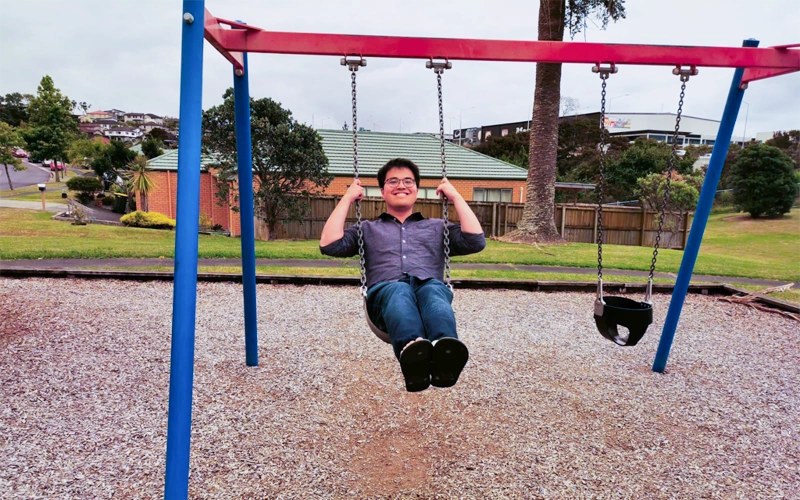
"I show this photo to my class as an example of my "Material matters" assignment, where we learn about an engineering material and they have to take a picture of that material in action. The strength of steel is being demonstrated here!" Photo: supplied
You're cooking up a storm. Do you follow the recipe or create as you go?
I usually start by following the recipe, but once I understand what's happening, the engineer in me starts experimenting. Cooking is actually quite similar to process engineering. You have inputs, processes, variables, and outcomes. Sometimes the experiments are successful, and sometimes they become useful learning experiences (like maybe don’t put cinnamon in my sweet & sour pork next time). In any case, I like to think that both results make me a better cook each time.
Complete the sentence: Life without engineers would be...
... completely different! A lot of the things we take for granted, like clean water when we turn on the tap, are simply not possible without myriad engineers behind the scenes. Most people only notice engineering when something stops working, which is perhaps the greatest compliment to the profession. When everything works seamlessly, it usually means an engineer has done their job well.