
30 Sep 2026
Fifteen minutes. That was all the time I could get with a senior engineer, so I spent days preparing for it. I would arrive with my design, a page of questions and a quiet fear that the whole thing might be complete garbage. Within minutes, the engineer across the table could see what had taken me days to miss.
Those short conversations taught me more than any textbook. I had equations from university. I could produce pages and pages of calculations and build an army of models. What I lacked was the pattern recognition that only comes from watching designs get built, assumptions fail, and projects recover. That is why I joined a leading international consultancy: to sit close to people who had that judgement and absorb as much of it as I could.
I did my share of repetition too, working the same checks by hand until they stuck. But we should not get nostalgic about it. Repetition builds understanding. Doing it by hand was never the point, and it need not be now.
What mattered lived in questions, no calculation could answer. How will this actually be assembled, off-site and on-site? Which sequence will the contractor prefer, given the geography, weather and supply chain? Does the client value opening on time matter more than saving capital cost? A design can meet every standard and still be the wrong design.
Very little of that was ever written down. I picked it up by listening in: to the questions experienced engineers asked, the moments they hesitated, the small details that made them uneasy. When those engineers move on or retire, that judgement leaves with them.
That is the AI opportunity I find most compelling. Not faster emails. Not more polished reports. The chance to capture hard-won judgement before it walks out the door and put it within reach of the next engineer who needs it.
Productivity is useful. It is not the prize.
Most organisations meet AI through a simple promise: save me time. Draft this. Summarise that. Find the clause I cannot locate.
These tools remove friction, and that matters.
But here is the catch. An organisation that stops there will simply produce the same work, faster.
The next wave is already arriving, as agents take on whole workflows with growing autonomy. Yet autonomy amplifies whatever sits underneath it. Give an agent a strong process and trusted knowledge, and it extends what your people can do. Give it fragmented information and unwritten assumptions, and it will execute the wrong thing at impressive speed.
If AI only helps us do yesterday's engineering faster, we will have missed its most valuable contribution.
A folder full of answers, and none of the reasons
Every engineering organisation has a folder full of final answers. Almost none has a folder full of the reasons behind them.
We’re not short of records. Our systems keep every revision, not just the final issue. We can trace the whole version tree of a drawing from the first sketch to the construction issue.
Yet that tree shows us what changed, not why. It rarely records what nearly went wrong, which option was rejected, or which assumption split the room. Some teams do capture this through disciplined lessons learned and change logs. Most do not, and the story behind each revision lives only in people's heads.
This is where AI can help, and where few organisations have yet ventured. It can help structure the logic behind a decision as the work happens, linking each change to the evidence, constraints and trade-offs that drove it. Picture an engineer who can ask not only for the report, but why the team chose this solution, what they discarded and whether they would make the same call today.
That only works if knowledge is treated as an asset rather than a by-product: captured close to the work, validated by people who know the domain, and enriched as outcomes emerge. Skip that discipline and you get a confident interface over an unreliable archive.
What the drawings never tell you
Two designs can satisfy the same code and be worlds apart in practice. One is easier to build. One is safer to maintain. One copes with uncertain ground. Compliance narrows the options. Judgement chooses between them.
And that judgement is strangely fragile. A project closes. A team disperses. An expert retires. The documents stay on the server, but the story of why the team changed direction on a wet Tuesday afternoon vanishes.
There is a trap here, though. Captured experience must never harden into "the way we have always done it.” Materials improve, climate risks shift. A decision that was right ten years ago may be wrong today.
Remember the past. Do not obey it.
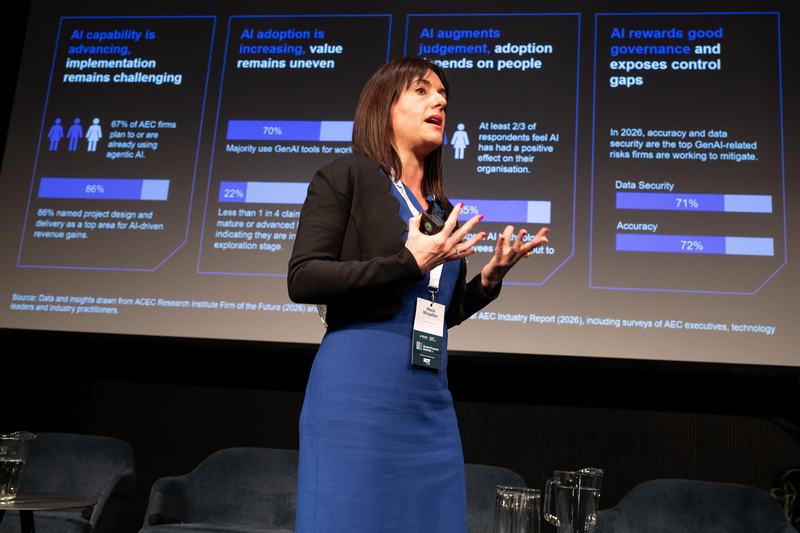
Maria Mingallon presenting at the NZGBC Green Property Summit 2026. Image: provided
What if every graduate could ask the whole organisation?
Think back to those fifteen-minute conversations.
The usual fear is that AI will hand graduates easy answers and rob them of the struggle through which expertise grows. That risk is real. But there is another possibility, and it excites me far more.
Earlier generations of engineers might spend a whole career on a handful of landmark projects. Today, many of us work across several projects in a single year. AI could speed that exposure up again, letting graduates interrogate the validated experience of many projects while they build their own.
So the answer is not to keep AI away from graduates. It is to design its use around better questions. Why was it designed this way? Which assumption is doing the most work? What would a builder or maintainer see that I cannot? And what is the machine missing?
We should not teach emerging engineers merely to prompt AI. We should teach them to interrogate it.
Handled well, AI becomes a sparring partner for critical thinking. And those precious fifteen minutes with a senior engineer can start at a higher level: with ambiguity, competing risks and problems no precedent has been solved. The engineer still decides and still owns the outcome. Accountability does not transfer.
Make every project teach the next one
The ambition is simple to state and hard to build: every project should leave us better equipped for the next. Estimates should meet actual costs. Design choices should meet construction and operational outcomes. Risk calls should be revisited once the uncertainty has played out.
That is a far tougher test of AI maturity than counting licences or hours saved. Those numbers tell us tools are being used. They don’t tell us whether we are getting better.
For leaders, the challenge is not buying smarter tools. It is building the conditions in which human and machine intelligence sharpen each other: experts willing to share how they think, and emerging engineers who never stop asking why.
I still remember walking out of those reviews with a full notebook and a buzzing head. Somewhere right now, a graduate is preparing for theirs.
The real test of AI in engineering is not whether it helps us finish faster. It is whether the next engineer can think better because of what the last engineer learned.
This article was provided by Maria Mingallon, a member of the Engineering New Zealand Te Ao Rangahau AI Advisory Committee. The views expressed are those of the author.