Pat McCook was one of the first women in New Zealand to qualify as a professional engineer. She worked in various engineering roles while studying part-time and completed the Institution of Electrical Engineers qualifying exam in 1955.
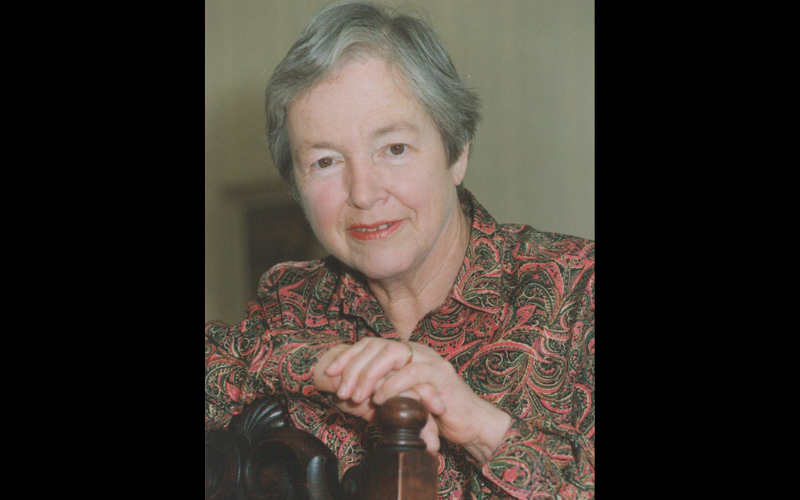
Patricia Joan McCook. Alexander Turnbull Library, PA1-q-1058.
Early years
Patricia Boyd was born on 31 August 1928, the only child of Arthur Hugh Boyd and Ethel neé Cooper. Patricia’s parents were English and her father, Arthur, worked as an import/export agent. At the time of her birth, the family were living in Yokohama, Japan. The family soon returned to England and initially lived in Bradford before moving to Hersham on the outskirts of London. Pat began her secondary schooling in England but, in 1941, came to New Zealand and finished her secondary education at Rangi Ruru Girls’ School, Christchurch.
Work in England
Pat left school in 1945 and returned to England. Knowing that she would be placed in employment upon her return, she began to think about what kind of work she might like to do. An illustrated book on bridges caught her attention and she decided she would like to design these beautiful structures. The employment office, acknowledging her interest in engineering, placed her in a role at the Hackbridge Electric Construction Company, in Walton-on-Thames, near to where the family lived. The Company built transformers, and Pat was placed in the drawing office.
A colleague who was a senior engineer lent her a book on physics, and she recalled being hooked. Pat credits her interest in bridges and the experience she got at Hackbridge, in setting her on the path to an engineering career. The further she went the more interesting she found it. Wishing to continue learning, she took evening classes in intermediate physics at the nearby Kingston Technical College. Still wishing to pursue civil engineering and her love of bridges, Pat applied to become a student member of the Institution of Civil Engineers. They refused her on the grounds that she was working for an electrical firm. She tried the Institution of Mechanical Engineers and was met with the same response, so she became a student member of the Institution of Electrical Engineers.
Return to New Zealand
In 1947, Pat and her mother, Ethel, who had been widowed since 1941, came to make a life in New Zealand. Pat’s great uncle had recently become a widower and suggested that Ethel and Pat come to live with him in New Zealand and keep house for him. Ethel accepted the offer and they came to live in Christchurch.
Christchurch Tramway Board
In New Zealand, Pat got a job at the Christchurch Tramway Board. Knowing she was leaving for New Zealand, a New Zealand engineer at the Hackbridge Electric Company gave her a letter of introduction to John Fardell, General Manager of the Tramway Board. On her arrival in Christchurch, Pat went to see him and was offered a job in the engineers’ office. At this time, the tramway was in poor condition following years of deferred maintenance, and Pat’s work included assessing the condition of tramway infrastructure.
Engineering education
While working at the Tramway Board, Pat began part-time study towards an engineering qualification. Still wanting to be a civil engineer, she looked at what study options were available to her. At that time, a common path to engineering qualification and registration was through the professional institutions. Pat tried again to join as a student member of the Institution of Civil Engineers (UK) with the aim of studying towards the qualifying exam. She wrote to the New Zealand representative of the Institution and received a refusal on the grounds that it was unlikely she would be able to get proper practical work. She then wrote to the New Zealand representative of the Institution of Mechanical Engineers and received a similar response. The New Zealand representative of the Institution of Electrical Engineers (IEE), however, where she was already a student member, had no problem in accepting her into the cohort of students working towards the IEE qualifying exam. At the end of her workday at the Tramway Board, Pat would rush to get to the 5pm maths lecture at Canterbury University College School of Engineering and slip in quietly at the back.
Pat also attended classes for IEE students at Christchurch Technical College. She found the lecturers and students at both University College and Tech to be helpful and kind. She reflected that she must have been a bit of a curiosity and that this likely contributed to the extra attention and offers of help which she received. There was a rifle club at university, but she didn’t join despite having been part of a similar club back in England as she felt it would be too masculine to do both rifle shooting and engineering. Instead, she joined the table tennis club but was disappointed to find herself the club’s only female member.
Heard testing
In 1949, following a bad car accident, Pat decided she’d like to take a break from work at the Tramway Board and do something different for a while. So, for a short time, she went heard testing. This work involved visiting dairy farms and taking milk samples which she then analysed to determine the percentage of butterfat in each sample. She described the work as physically strenuous but mentally relaxing, and that she certainly learnt a lot about cows.
Canterbury University College Industrial Development Department
In 1950, J.K Scott, one of Pat’s teachers at Christchurch Technical College, was working at the Canterbury University College Industrial Development Department (UCIDD) and offered her a job there. This worked out well for Pat as the work was flexible and she was able to take an hour off here and there during the day to attend lecturers. In this way she was able to fund herself through study.
Pat’s first jobs at UCIDD were in drafting, as she had prior experience in this, but she was soon offered training and experience to grow her skills. Projects she was involved in included temperature measurement for brickworks and factories; and measuring the composition of different gas blends for rabbit extermination.
Qualified engineer
After many years of part-time study, Pat sat the IEE exams and qualified as an electrical engineer in 1955. She was one of the first women in New Zealand to achieve a professional engineering qualification. Pat became a Corporate Member of the IEE in 1972.
Marriage and family life
In 1954 Pat married architect Albert Frederick (Fred) McCook. Fred was supportive of Pat’s career and took on an extra share of household chores to give her time to complete her studies. The couple had two children: Helen, born in 1957 and William, born in 1960. In line with social expectation of the day, Pat gave up her job before the birth of her first child. She recalled that she was happy to stop work at this time and looked forward to being a mother.
Consumers’ Institute Test Laboratory
In 1966, soon after her second child started school, Pat was approached by her old boss from UCIDD, Tom Pollard. Tom was setting up a test laboratory for the Consumers’ Institute and asked if she would be interested in working for him. Pat was keen to rejoin the workforce, and Tom offered her part-time hours and flexible time off for school holidays and whenever else she needed it. The team was small: just Tom Pollard; Dick Withers, who had retired as Assistant General Manager of the New Zealand Electricity Department; and Pat. Pat recalled that although both men were vastly more experienced than herself, they treated her as a peer and valued her opinion.
At that time, consumer testing was a new field in New Zealand. The team started out testing small household appliances such as irons, electric jugs, vacuum cleaners, electric blankets and portable heaters. Safety testing was paramount, but they also carried out performance and endurance tests, often of their own devising, as New Zealand Standards were limited and the pace of technology outstripped their development.
Retirement
Pat retired from the Consumers’ Institute in 1988. The work of the testing laboratory was, at that time, being absorbed into the Department of Scientific and Industrial Research (DSIR) and the Consumers’ Institute lab closed. Pat’s husband had not long retired, and with the closure of the laboratory in its current form, Pat thought it would be a good time for her to retire too. In their retirement the couple enjoyed travelling around the country in their campervan, fishing and gardening.
References
“Awards for female engineers,” Press, 16 December 1993, p4.
Oral history at Christchurch City Libraries Archive, 1990, archive reference: Arch 1233/18.
“Retirement closes further chapter in laboratory’s history”, Press, 19 December 1987, p23.
“Woman qualifies as electrical engineer”, Press, 12 February 1955, p2.
“Women scientists in engineering, food technology, home science and clothing research,” Manuscript held at Alexander Turnbull Library, MS-Papers-7617-09.
Page last updated 17 August 2026