Chemical engineer Mary Earle was a pioneer in food technology and product development who led the development of these programmes at Massey University. She was a much-respected teacher and mentor to many, both nationally and internationally and has been described as a distinguished and pioneering academic and a true scholar.
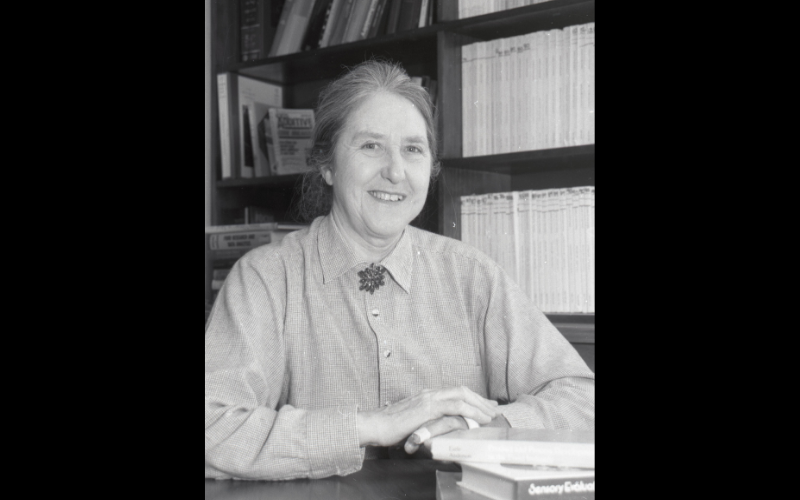
Mary Earle in 1992. Massey University Archives, L-1-4-1.92-650-05.
Early life and education
Mary Davidson Earle (née Cameron) (OBE) was born at Banavie, in the West Highlands of Scotland. She completed the later years of her schooling in Glasgow and put her entry into engineering down to the strongly science-based education she received there. Having studied chemistry, physics and mathematics, engineering was an obvious choice for Mary. She chose chemical engineering because “one of [her] sisters had two chemical engineering boyfriends who seemed to have interesting lives”. She knew she did not want to do mechanical or civil engineering as they seemed too masculine, nor electrical engineering as she “could not stand high voltage electricity.”
Mary graduated with a B.Sc. in Applied Science from the Royal Technical College Glasgow in 1951. She then completed a PhD in Food Science at the University of Glasgow and at M.I.T. Boston where she declined an invitation to join their Sc.D. programme to return to her mother in Glasgow. Her doctoral thesis, The purification of soya lipoxidase, was published in 1957.
Early career and move to New Zealand
In 1953, Mary met her future husband, New Zealander, Richard (Dick) Earle who was completing a PhD in Chemical Engineering at University of Glasgow. Dick returned to New Zealand in 1956 to take up the role of Senior Engineer at the newly formed Meat Industry Research Institute, in Hamilton while Mary began her career in product development in the United Kingdom’s food industry, working at Unilever Research, Colworth, and at Cerebos, Edinburgh.
Mary came to New Zealand in 1961 and joined Dick at the Meat Industry Research Institute, where she worked as a research chemist in Product Development. She was always most interested in building technology and people; publication in itself was totally unimportant.
Massey University
In 1965, Mary and Dick both joined the staff of Massey University; Mary, in the role of Senior Lecturer in Food Technology. At this time, the Food Technology programme was in its infancy. There were few written resources, so Mary and Dick developed their own and published Unit Operations in Food Processing in 1966. During her time at Massey, Mary developed the university’s food technology and product development programmes, making the university a leader in these fields.
Mary was committed to developing a highly applied programme built on strong relationships with industry. She took the lead in developing the university’s Food Technology Research Centre, where industry could bring their issues to the University for expert help. The centre, established in 1970, provided research on a contract basis to New Zealand’s food industries and was the first of its kind in New Zealand. Mary was always fundamental to its operation as it grew to a staff of 25 and a building of its own all funded by industry. She was for a time formal Director of the Research Centre 1977 – 1984. During her time there she grew the centre to a highly successful operation with strong ties across a wide range of food industries right throughout New Zealand including fruit, pork, dairy, meat and fish.
Mary was also instrumental in designing and developing Massey’s Product Development degree. She first introduced product development courses into the Food Technology degree and later worked with the university to launch Massey’s product development degree programme, the first in New Zealand.
Universities in Thailand wanting to establish their own food technology programmes looked to Massey for advice and support. Over the years, Mary built strong connections with these universities, advising there, and hosting Thai postgraduate students at Massey, and ultimately helped to establish food technology and product development degrees at five Thai universities. Mary was known for her generous pastoral care of students and visitors. Colleagues and students remembered Mary as an inspiring mentor who opened doors for women in engineering and technology.
In 1992, Mary was promoted to Professor and awarded a Personal Chair. It was a rare honour that recognised her outstanding career and was the first Personal Chair in the Faculty of Technology.
As well as her work at Massey, Mary contributed her expertise to boards and advisory panels including the Crop and Food Research Institute Board, and ministerial advisory groups on research, science and technology policy issues.
Retirement activities and philanthropy
Mary retired from Massey in 1994. In the late 1990s, Mary and Dick were working from home as Professors Emeritus, writing separately and jointly, bringing their unique, integrated approach to food product and process development.
The couple also devoted their time to philanthropic activities, establishing scholarships and grants in technology, engineering and the arts.
Awards and recognition
Mary’s achievements were widely recognised by both academia and industry. Mary was an Honorary Fellow of the Institute of Food Science and Technology, and recipient of the Institute’s J C Andrews Award (1979). In 1993, she was awarded Honorary Fellowship of Engineering New Zealand in recognition of her innovative approach to technology and her dedication to the advancement of her profession. She received an Honorary Doctorate from Khon Kaen University in Thailand in 1991, and an Honorary Doctor of Science from Massey University in 2018. She was made an Officer of the Order of the British Empire in 1993 for services to food technology.
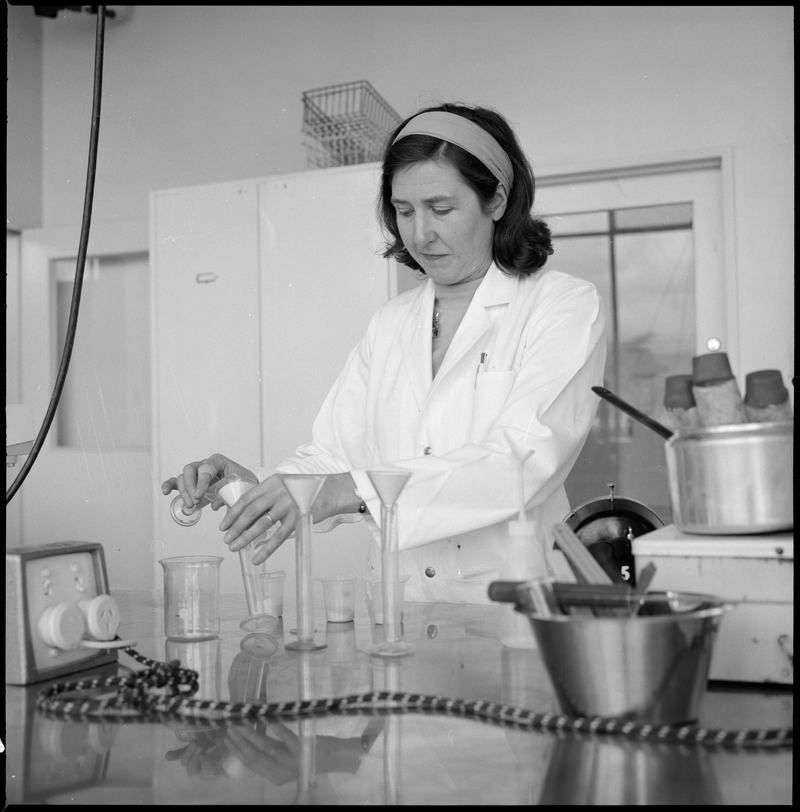
Mary Earle at work in 1970. Massey University Archives, L-1-4-1.70-60-04.
Select publications
Earle, Mary. Creating New Foods: The Product Developer's Guide. New Zealand Institute of Food Science & Technology, 2009.
Earle, Richard, and Mary Earle. Fundamentals of Food Reaction Technology. Royal Society of Chemistry, 2003.
Earle, Mary, Richard Earle and Allan Anderson. Food product development. Woodhead, 2001.
Earle, Mary, and Richard Earle. Building the future on new products. Leatherhead Food, 2000.
Further reading
“A History of Food technology at Massey University. The first 10 years.” Version 2.1. 2017.
Belgrave, Michael. From Empire’s Servant to Global Citizen: A history of Massey University. Auckland: Massey University Press, 2016, p248-251.
“Food technology forerunners honoured”, Massey University News, 15 May 2018.
“Mary Davidson Earle”, Tāmiro Massey University Library.
“Pioneering technologist granted Personal Chair”, MU Campus News, issue 21, 27 July–3 August 1992, p1.
“Women in Engineering – a celebration.” New Zealand Engineering, December 1993, 19–22.
“Women scientists in engineering, food technology, home science and clothing research,” Manuscript held at Alexander Turnbull Library, MS-Papers-7617-09, natlib.govt.nz/records/23155934.
Page last updated 13 August 2026