
22 Jun 2026
The steady roll out of water metering across New Zealand is going to put an even greater focus on the rising costs of mains water.
Historically, rainwater harvesting was often viewed as a rural necessity or an eco-conscious luxury. Today, it is a financial and environmental imperative. For structural, civil, and architectural engineers, this means a big change in how we need to approach residential design.
Incorporating rainwater tanks into every single new build or major renovation project, regardless of scale, is one of the most impactful ways we can future-proof buildings and lower the lifetime operational costs for homeowners.
We can no longer just ‘rely on the mains supply’
As infrastructure costs rise nationally, cost pressures are increasingly being passed through to end users. Relying solely on the mains supply therefore for non-potable demands is becoming an expensive design flaw.
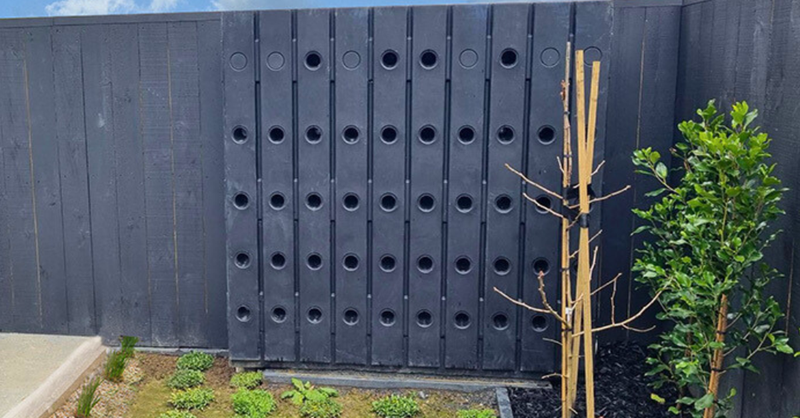
Black FenceTank. Image: supplied
By integrating rainwater harvesting into standard residential layouts, we can achieve two major goals:
- Direct cost mitigation.
Homeowners significantly reduce their dependency on treated mains water for high-volume, low-grade uses like toilet flushing, laundry, and garden irrigation. - Stormwater peak-flow management
On-site retention and detention assist with council compliance (such as the Auckland Unitary Plan requirements), mitigating downstream infrastructure strain during extreme rainfall events.
Whether you are working on a high-density urban townhouse with tight boundary constraints or a sprawling lifestyle renovation, a right-sized tank system adds measurable, long-term asset value.
Overcoming spatial and structural constraints
As engineers, you know the common objections to site-wide water harvesting. Perhaps you have heard things like – ‘we don’t have the footprint’, ‘it clashes with the landscape design’, or ‘the structural loads are too complex for the proposed retaining’.
Every site has unique constraints, but these shouldn't act as a barrier to sustainable design. Rainwater systems have evolved far beyond the traditional, obtrusive, and, often ugly, concrete or plastic round tanks.
Modern solutions include:
- Slimline tanks - which are designed to hug boundary fences or structural walls, occupying dead space within side setbacks. These tanks offer a more aesthetically pleasing option as well as taking up minimal space.
- Integrated detention/retention systems - dual-purpose tanks that manage both council stormwater attenuation and household reuse simultaneously. In slab tanks can be hidden under the building, decks, and even lawns.
More resilient homes with zero-cost design support
Navigating hydraulics, pump curves, retention-to-detention ratios, and specific local council engineering standards can add administrative hours to a project. The good news is that you don’t have to worry about any of that!
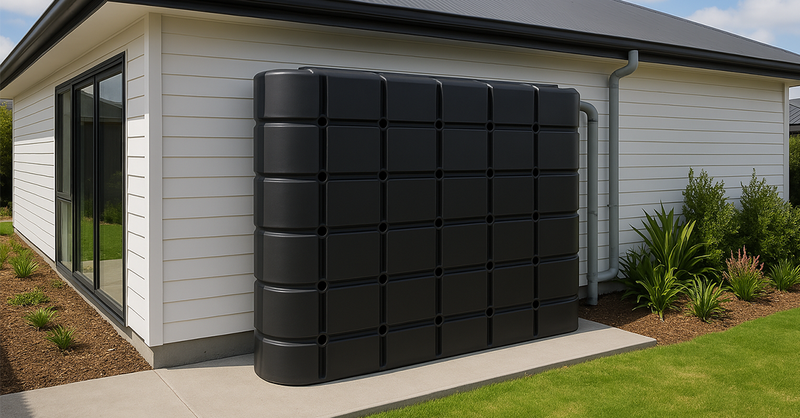
Slim City Tank. Image: supplied
To help drive the adoption of resilient water systems across New Zealand, Watersmart’s design services for these tank systems are completely free of charge.
We’ll give you tailored engineering support and assist you with the design and specification of the ideal rainwater harvesting tank and pump system to match your site plan.
By collaborating with us early in your concept or developed design phase, you can seamlessly integrate high-performance rainwater harvesting into your plans without blowing out your design budget or timeline.
Reach out to the WaterSmart team today to spec a rainwater harvesting system for your next project.
This article was supplied by Watersmart, one of our partners. While we are pleased to share insights from our partners, Engineering New Zealand does not verify all claims and does not endorse specific products or services.