
14 Aug 2026
What if the greatest hurdle in New Zealand’s stormwater challenge isn’t the volume of water we need to deal with, but our approach to managing it?
This critical question took centre stage at a member event hosted at the WaterSmart Innovation Hub in June. The evening brought together a diverse group of engineers, urban designers, planners, and asset management professionals to share their views on the future of flood resilience across Aotearoa.
The session highlighted cutting-edge research from Massey University PhD candidate Umar Farooq on the viability of Sponge City frameworks in New Zealand. This academic perspective was paired with practical, real-world industry insights from WaterSmart, focusing on how catchment-scale planning and permeable infrastructure can fortify urban environments against accelerating climate challenges.
Moving beyond isolated engineering fixes
Mitigating flood risk is no longer just a localised engineering issue. Rather it is a complex systems challenge.
Through audience feedback we identified several systemic barriers currently slowing progress, including:
- Fluctuating funding models and deferred maintenance.
- Fragmented inter-agency coordination.
- Rapidly aging legacy infrastructure.
- Restrictive regulatory frameworks.
- Short-term political and economic decision-making.
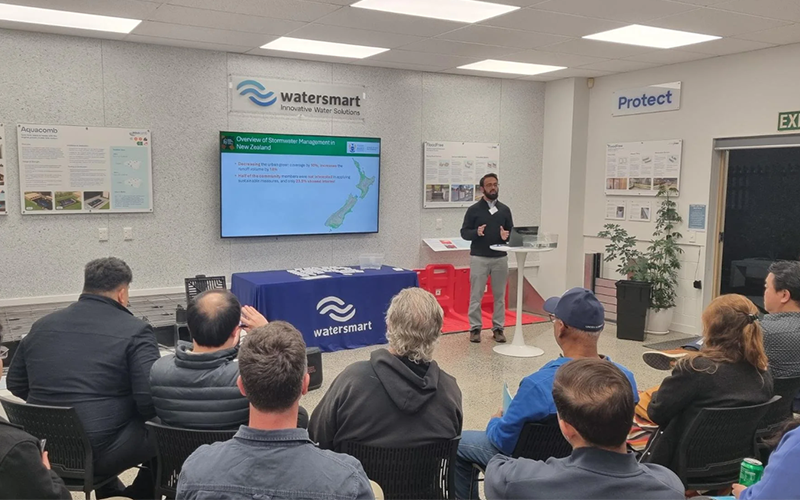
WaterSmart's June event, Designing Sponge Cities for New Zealand, was hosted at their Innovation Hub. Image: Watersmart
The Sponge City paradigm shift
The Sponge City philosophy offers a proactive alternative to traditional ‘pipe and channel’ methods. Rather than treating stormwater as a hazard to be collected and drained away as rapidly as possible, a Sponge City treats water as a resource. The goal is to absorb, store, infiltrate, and slowly release rainfall back into the environment.
Achieving this requires a seamless blend of green and grey infrastructure, utilising tools such as:
- Permeable pavements and porous surfaces.
- Engineered rain gardens.
- Constructed wetlands.
- Green roofs and living walls.
- Decentralised rainwater harvesting and subsurface storage.
Interactive discussion during the event revealed strong optimism from the engineering community. Many participants agreed that Sponge City principles are highly viable for modern urban developments in New Zealand. In fact, practitioners noted they are already actively specifying or designing elements like permeable paving, retention tanks, and wetlands into current projects.
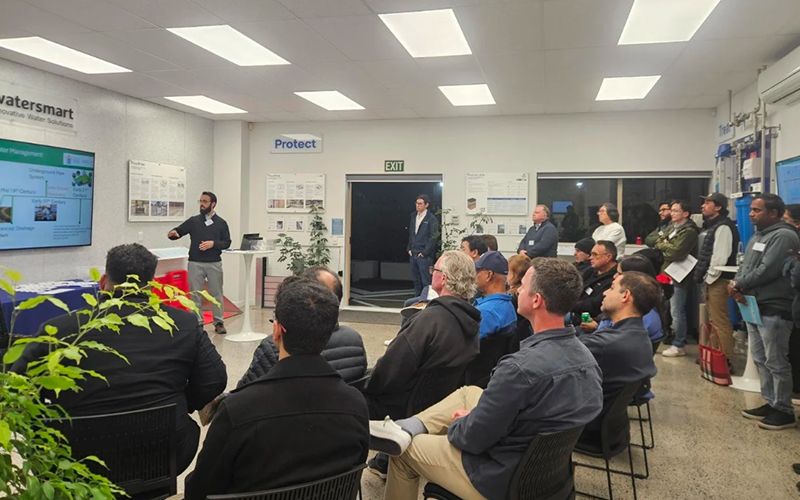
WaterSmart's June event. Image: Watersmart
Integrating green and grey
True urban resilience does not require choosing between traditional grey infrastructure and newer green alternatives, instead it demands the intelligent integration of both.
Data and catchment-based modelling from recent implementations across Australia and New Zealand demonstrate that nature-based solutions significantly alleviate pressure on aging pipe networks while delivering broader environmental, ecological, and economic dividends.
The technical expertise, modelling software, and localised case studies already exist. Moving forward, the true challenge lies in fostering stronger cross-industry leadership, collaborative governance, and a unified vision.
Watersmart is proud to be helping lead this conversation, alongside developing solutions to help us better manage our stormwater challenges.
This article was supplied by WaterSmart, one of our partners. While we are pleased to share insights from our partners, Engineering New Zealand does not verify all claims and does not endorse specific products or services.