

2 Sep 2026
When I completed my Master of Construction Management at the Auckland University of Technology, I thought the next step into the New Zealand engineering sector might be relatively smooth. I have many years of experience in civil infrastructure, including highways, bridges, 3 water, municipal works and PPP projects in China, Pakistan and Africa.
However, the reality was much harder than I expected.
Like many immigrant engineers, I received many polite rejection emails. The wording was always professional, but the message was often the same: I had strong experience, but the company preferred someone with local experience.
At the beginning, this was frustrating. I had brought my family to New Zealand, and I sincerely wanted to continue my engineering career here. But gradually, I started to look at the situation from the employer’s point of view. They did not know me. They did not know whether my overseas experience could be transferred to the New Zealand working environment. They were also unsure whether I understood local safety requirements, communication styles and construction practices. For me, the change started when I learned to put myself in their position.
So, I changed the way I approached my job search. I stopped only asking, “Why does no one give me a chance?” Instead, I started asking myself: what would an employer need to see before they felt comfortable giving me an opportunity?
I began preparing a set of supporting documents to go with my CV and cover letter. These included my work visa, qualification certificates, Engineering New Zealand qualification assessment, Site Safe Foundation Passport, First Aid certificate, driver’s licence, FWTR endorsement, translated professional certificates, awards and project photos. Preparing all these supporting documents took a lot of time and effort.
This was not to make my application look heavy. It was to help employers see the real person behind the CV, and to make my profile more complete in their minds. I also gradually realised that the way documents are presented is also important. I renamed all my files clearly and kept the format consistent, for example:
Jason Soong – CV
Jason Soong – Cover Letter
Jason Soong – Support Documents
For walk-ins and interviews, I also prepared a physical folder. I printed the key documents in colour and arranged them in a clear order. This helped me explain my background more clearly during conversations, while also giving employers real supporting evidence to look through as we talked.
Online applications are certainly important, but for someone without local experience, they can also be easily overlooked or filtered out.
Once, when I was volunteering at my son’s school, I spoke with a Kiwi father and an Indian father about my job search. They both gave me similar advice: if there are companies you really want to work for, do not apply only online. You can visit them in person, introduce yourself politely, and let them see the real person behind the application.
This advice helped me a lot.
I started by building a list of target companies. With my background mainly in civil infrastructure and project delivery, I focused first on local civil contractors. Before each application, I adjusted the professional summary in my CV and tailored my cover letter to the specific role. I did not change the facts; I simply changed the emphasis to match the position.
After applying online, I sometimes visited the company in person, usually in the late morning or early afternoon. Most of the time, I only met the receptionist. Sometimes they gave me an email address; sometimes I did not receive any response. That is normal. No one owes us a job. What we can do is keep improving the way we present our skills, experience and attitude.
For me, job hunting was not only about CVs and interviews. It was also about confidence.
During my study, my wife, my son and I started going to a local church every Sunday. We went there to practise English, meet local people and understand the community better. Slowly, I became more confident in daily conversations. This helped me a lot in later interviews.
Many immigrant engineers have strong technical skills. But if we cannot explain our experience clearly, other people may not truly see our value.
I also joined Engineering New Zealand and the Project Management Institute of New Zealand (PMINZ). By attending events, I started to understand the local engineering sector better and also met some people in the industry. One important event for me was organised by the Special Interest Group for Immigrant Engineers. I drove from Auckland to Hamilton because I had missed a similar event in Auckland.
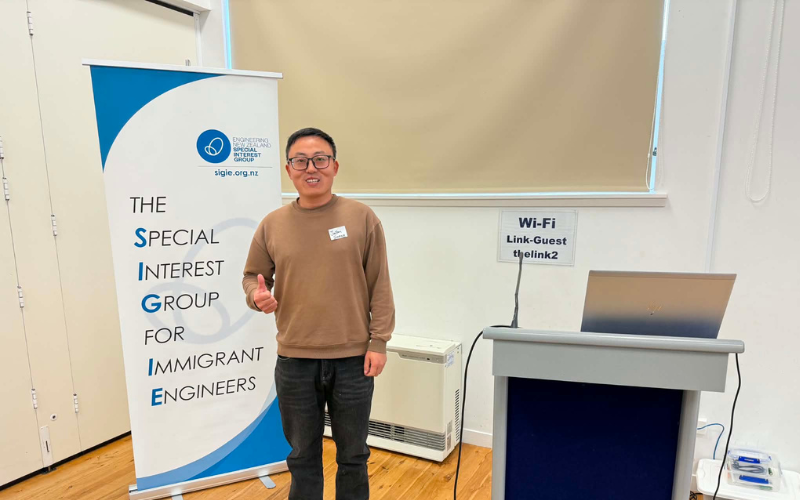
Jason at a Special Interest Group for Immigrant Engineers event
After the event, I spoke with Ken Hu. I told him that I had applied for many roles but had received very few positive responses. He encouraged me to keep attending events, keep meeting people in the industry, and keep believing in myself.
That encouragement was very important to me. Sometimes what we need is not only technical advice. We also need to know that we are not alone.
My first local opportunity came unexpectedly.
One night, after finishing my part-time work, I came home at around 10.30 pm. Near my home, a contractor was still working on traffic signals and footpath works. This company was already on my target company list.
I went home, changed into PPE, printed my CV and cover letter, and then walked to the site. I introduced myself to the site supervisor and gave him my documents. More than a week passed, and I heard nothing. Later, on a Saturday morning, I saw one of the company’s vehicles with a recruitment message and phone number on it. I called the number, introduced myself, and sent my CV again to the correct email address.
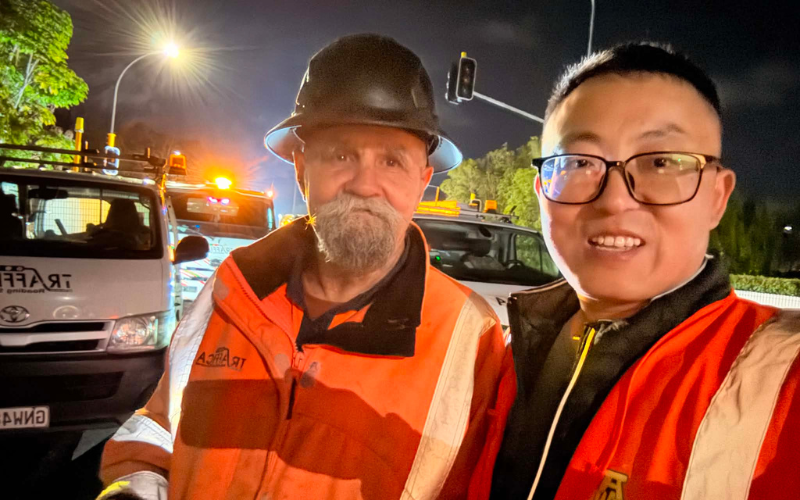
Jason – Traffica Roading Services
On Monday, the Director invited me for an interview. During the interview, he gave me a small set of drawings and asked me to prepare a quantity take-off. I originally thought it would take one or two hours, but in the end it took about five hours, because I needed to check local standards and specifications.
After completing the quantity take-off, I also prepared a short project presentation. I used the company’s colours and logo based on the company’s website and prepared it as if I were already part of the team reporting to a client.
That afternoon, I received a call. The company needed a quantity surveyor at that time. I accepted the opportunity. This was the first door for me to enter the New Zealand civil construction industry. Later, I also had the opportunity to join WSP as a Construction Manager in Gisborne.
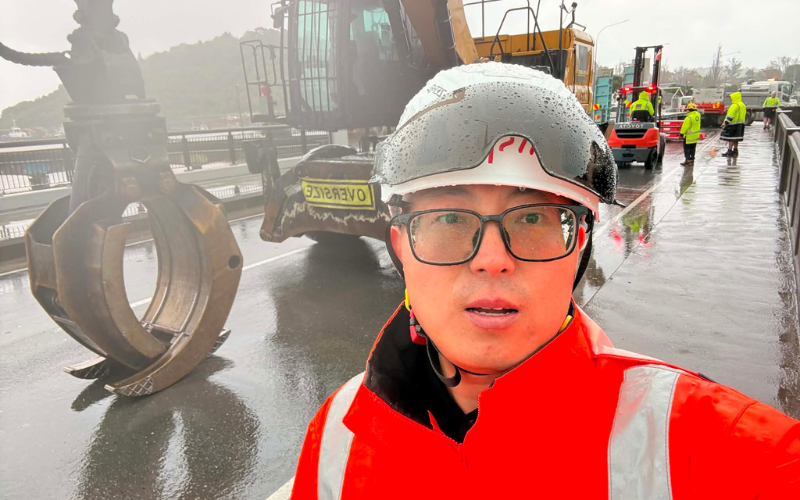
Jason working for WSP: Rain event inspection
Everyone’s journey is different, but my suggestions are simple: be clear about your target companies and roles; prepare documents that can support your background and capability; tailor your CV and cover letter for the role; meet people through Engineering New Zealand, PMINZ and community activities; practise English in real situations; and ask people for advice, not directly for job opportunities at the beginning.
Most importantly, make sure you leave time every week for your professional job search. Some immigrant engineers may need to take another job first to support their family, and this is completely understandable. But if that job takes all your time and energy, and you stop applying for engineering roles, it will become harder to return to your professional pathway.
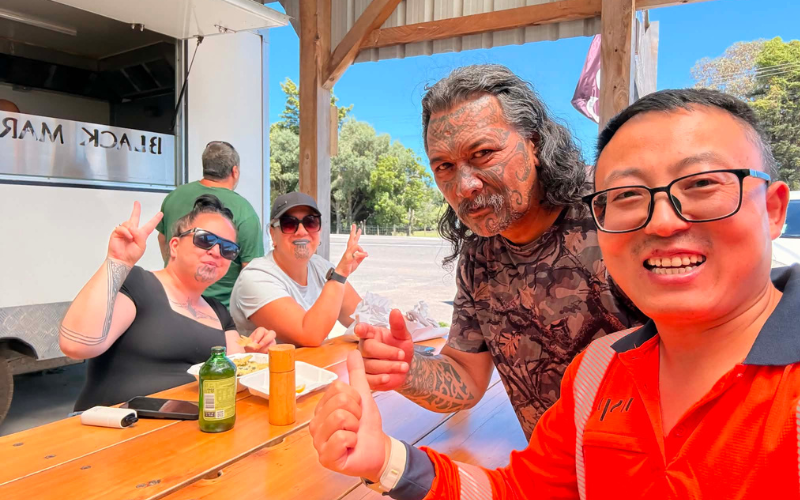
Jason working for WSP: catching up with locals
The current market is not easy, and many companies are cautious. However, immigrant engineers bring valuable experience, resilience, and diverse problem-solving approaches. Our task is to transfer this value into the New Zealand context so that local employers can understand and trust it.
Be prepared, be honest, respect others, keep learning, and keep meeting people in the industry.
When the right door opens, you need to be ready.
This article was written by Jason Soong, a member of the Special Interest Group for Immigrant Engineers (SIGIE) and Engineering New Zealand. The views expressed are those of the author.