
3 Sep 2026
It’s unlikely that many people have taken such a tumultuous path into engineering as Bariz Shah. A devout Muslim, civil engineer, community builder, filmmaker, keynote speaker and civic award recipient, his journey has been shaped by upheaval, hard lessons, incarceration and transformation.
Arriving in Aotearoa New Zealand as an Afghani child refugee from Pakistan in 2001, Bariz Shah faced the challenge of growing up in an unfamiliar culture, marred by suspicion.
“Upon my move to Auckland I found I was visibly different. My name didn’t fit easily on a roll call and the world after 9/11 had decided what people who looked like me were,” he says.
He began seeking acceptance on the streets, spiralling into crime and becoming involved in drug dealing and robbing local dairies.
Bariz’s first turning point came on a trip back to Afghanistan in 2012.
“I realised I no longer wanted to play the victim. I came across multiple scenarios where I was faced with the reality that people have it so much harder than us here in New Zealand. I realised how lucky I was.”
His lowest point, however, was yet to come, as on his return and just 18 years old, he was implicated in an aggravated robbery and sentenced to prison. There, he says, he was able to cut out the noise, gain self-control and rediscover his faith.
“In Islam we call it fitrah, your innate disposition. I realised I wanted to reconnect with my true self, be a good person and contribute to society, reconnect with my Creator.”
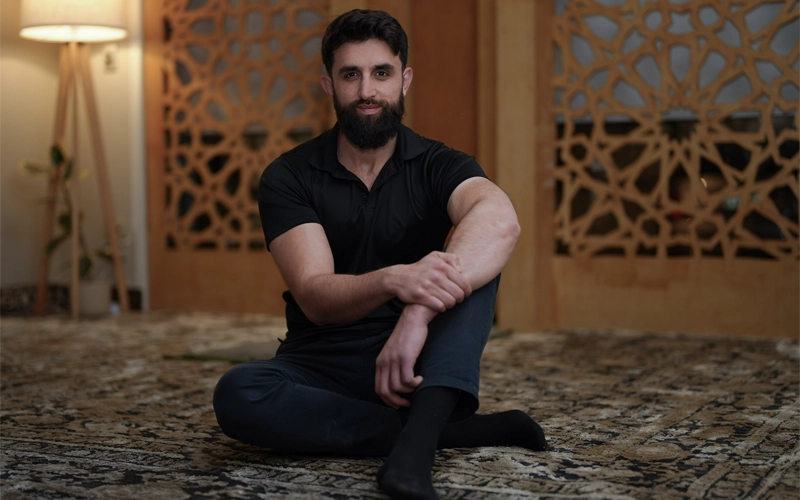
Photo: Saba Afra
Within those walls he also realised he wanted to pursue a career in engineering.
“This path came into focus slowly. It was the opposite of what I’d been doing. It was about structure, about things that hold, about being trusted to do work that other people depend on. My father was a civil engineer and so I knew the path was possible.”
Bariz continues: “After years of breaking things, including myself, building became a kind of repair.”
After foundational studies, Bariz completed a Bachelor in Civil Engineering and a Global Diploma in Humanitarian Engineering at the University of Canterbury.
Following the terrorist attacks in Christchurch on 15 March 2019, Bariz, then President of the University of Canterbury Muslim Students Association, was driven by grief and a determination to turn tragedy into something positive. Alongside his wife, Saba Afrasyabi, he raised $20,000 to microfinance 51 businesses in Afghanistan, honouring the 51 lives lost.
Bariz has received multiple accolades for this work, including the Christchurch Civic Award in 2020 and Muslim New Zealander of the Year in 2021. He and Saba also captured the mission and their journey to Afghanistan in Project FiftyOne, an acclaimed documentary released in 2025, with which they host special screenings for companies looking to inspire their staff.
Bariz says his humanitarian engineering diploma helped with this project.
“It informed me to engage with the different people and micro businesses in the correct way, with honour.”
Now a civil engineer at Brian Perry Civil, Bariz says he's grateful to the company for giving him a chance.
“They gave me the opportunity knowing that I had a record. When, a year and a half into my role, I became a finalist for the CCNZ [Civil Contractors New Zealand] Emerging Leader Award, there was a sigh of relief from my hiring manager,” he smiles.
Bariz is currently working on the Second Ashburton Bridge project in Canterbury.
“I’m really enjoying it because it’s delivering infrastructure that will help in times of crisis. If there’s a flood, this region gets blocked off – there’s currently only one bridge over the Hakatere River. Knowing that you are contributing to something like this, which will hopefully be here long after I’m gone, is a very comforting thing to know.”
He is also an advisor to the Department of Corrections, part of a reference group that endeavours to improve the rehabilitation process of incarcerated Muslims.
He recently returned to the same prison and unit where he spent almost a year of his life.
“But this time, I was with the Commissioner of the Department of Corrections. It was a humbling experience, but I was disappointed because the conditions are a lot worse. Anyone locked inside there now would have a much more difficult time finding their way.”
Bariz, who is also Executive Director of Asturlab, a Christchurch-based community organisation, says faith is central to how he and other Muslim engineers approach their work.
“When you see a colleague stepping out briefly to pray or fasting through a long site day in Ramadan, you’re not seeing someone whose faith is in the way of their engineering: it’s the engine behind it. Once you understand that, working together gets a lot easier and richer.”
In future, Bariz says he may travel to help war-torn countries rebuild, but that such work must be led by local engineers wherever possible.
“Outside expertise has its place, but durable rebuilding happens when the people who know the language, the terrain and the social fabric are the ones holding the pen.”
He says infrastructure is dignity.
“When a road exists, a child can get to school. When a bridge exists, a market can function. When a water system works, a hospital can treat people without rationing.
“In places that have been broken – torn by war – engineering isn’t just technical reconstruction, it’s the slow, physical re-establishment of normal life.”
But for now, he’s staying put.
“New Zealand is home. I didn’t feel like this before – since my two sons were born I have developed a deep connection to this land. I’m really focused on how I can serve in New Zealand.”
This article was first published in the September 2026 issue of EG magazine.