
5 Aug 2026
In an era when engineering lecture halls were overwhelmingly male and opportunities for women in technical fields were few and hard‑won, this engineer stepped into the profession with a resolve that would define her life’s work.
With an already impressive collection of accolades and achievements, biochemical engineer-turned-academic Janis Swan ONZM DistFEngNZ was recently awarded Engineering New Zealand’s MacLean Citation, recognising her exceptional service to the profession. Raised in Levin and the eldest of four siblings, Janis says that her mother was an Italian war bride whom her father met in Europe during World War II.
“She’d only had three years of primary education and arrived here without a word of English.”
After finishing school, Janis spent a year working as a technician for the Department of Agriculture. At the same time, she studied for a New Zealand Certificate in Science by correspondence, which was “hard slog”. She knew she wanted to study at university but had no financial support.
“I won a scholarship from the local dairy company, which was enough to pay for my fees and my board for first year.” She entered Massey University in 1965 and achieved a Bachelor and then a Master of Technology in Biotechnology. Upon graduating, Janis worked in a couple of food-production roles, but after getting a degree when gender didn’t seem to matter, it seemed the industry wasn’t ready to have women engineers, she says.
“When applying for one job at a local dairy company, the manager said, ‘well I don’t think I’ll be able to train you in running a spray dryer’. He obviously was unsure about how to have women engineers in his workforce.”
With encouragement from then professors Dick and Mary Earle at Massey, Janis applied for scholarships to do a PhD abroad.
“Everyone went to England, Australia was too close, and so I went to the University of Waterloo in Canada. It turned out to be like Palmerston North, but bigger.”
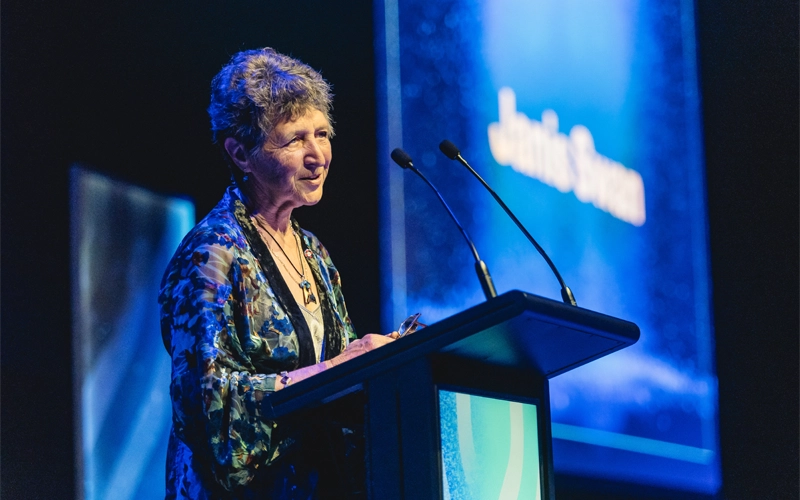
Photo: Brady Dyer/Engineering New Zealand
She obtained a PhD in Chemical Engineering in 1977, on modelling the operation of small-scale airlify fermenters for growing fungi on cellulose pulp. On returning to New Zealand she completed a three-year National Research Advisory Council postdoctoral fellowship at the then Ruakura Agricultural Research Centre.
In 1970s New Zealand, there was a strong focus on food processing, particularly dairy and meat, Janis says.
“There was an understanding that because we grow food and export it, we had to add value.” She says there have been many innovations in this area in New Zealand, and the country has been at the forefront of meat processing.
Janis spent the next 16 years at what was then Meat Industry Research Institute of New Zealand (MIRINZ) in Hamilton, in leadership roles, researching and developing meat by-product processes, and meat products for export markets.
“I really enjoyed working in the meat industry,” says Janis. “You knew who the client was, you could focus on engineering, you had problems to solve – often in short timeframes – and you had a budget to work with.”
Nearing the end of the 1990s, however, her career trajectory took a radical turn.
“I’d never seen myself as a teacher, but when a position to head the technology department at the University of Waikato was advertised, my neighbour and MIRINZ colleague bought it to my attention. I thought it might be an interesting challenge for the last 10 years of my career, although I ended up staying for 20.”
Starting as the head of the Department of Technology, which became the Department of Materials and Process Engineering, Janis applied her experience in management and research to helping develop University of Waikato’s Bachelor of Engineering with Honours programmes. From 2005–2015, as Associate Dean of Engineering, she led the expansion of the engineering school, growing the student body from six graduates in 2002 to more than 600 undergraduate students, counting this as one of her most significant achievements.
“It involved a combination of good team effort, many challenges and a lot of opposition, but it’s been so exciting to see where the graduates have gone.”
In 2015 and 2016, she acted as Dean of Engineering, becoming the first woman in Aotearoa to lead an engineering school. She retired in 2018 and the university bestowed upon her the title of Emeritus Professor.
Janis continues to contribute to engineering and engineering education through work on accreditation panels in New Zealand and overseas. She’s on the Hong Kong Engineering Board and recently chaired the International Engineering Alliance review of Taiwan’s engineering accreditation process.
Throughout her career, she has held several national research and education governance roles, including the New Zealand Council of Engineering Deans, the Marsden Council, and the Ministry of Business, Innovation and Employment’s Science Board. After half a century in the profession, she still radiates passion for engineering and engineering education.
“What I love most about engineering is its diversity. Scientists will focus on the detail of something small, while engineers will look at the big picture. How do we solve this problem? How do we extract this resource and produce the least waste?”
But she believes engineering faculties are making students specialise too early in highly specific fields.
“Engineers can have many jobs during a career. Having a broad foundation opens up lots of opportunities, whereas specialising too early can lead to dead ends. “Universities are developing a plethora of programmes, rather than options within programmes. They often want enrolments rather than considering the profession as a whole.”
Throughout her career Janis has supported women entering the profession and STEM fields in general. She sees some of her her greatest successes as being a role model, convincing women that engineering is not that hard, and helping them find employment opportunities.
“I think most bright female students are steered towards the ‘caring’ programmes such medicine or law. But as one female student said to me, as an engineer you can end up helping lots of people rather than just a few.”
Even in the mid-2020s, it’s difficult to get young women to study mathematics and sciences in high school and to think they can do engineering, she says.
“We need to better publicise to careers advisors and young women that engineering is an option.” She continues: “Once women believe they can be engineers, they can make a tremendous contribution to the profession and to society.”
A career in engineering certainly took hold in the women in Janis’ family. One of her sisters, Elena Trout, is a past President and Distinguished Fellow of Engineering New Zealand. “We joke that we are the only two sisters who are also distinguished fellows.”
This article was first published in the June 2026 issue of EG magazine.