
24 Sep 2026
Why the underlying message of a new soakage design guide is relevant for all engineers.
For years, the design of stormwater soakage systems has lived somewhere between compliance and convenience. While the New Zealand Building Code (NZBC) Clause E1 and E1/VM1 have provided a clear baseline of minimum compliance, in practice that baseline has often been treated as a complete solution, resulting in a wide range of outcomes. However, minimum compliance is not the same as good design.
Engineering New Zealand’s Soakage Design Guide, due to be released at the end of 2026, introduces an important shift in mindset. It reinforces engineering principles that extend well beyond stormwater design: that compliance should be a starting point not an endpoint, and that meeting minimum requirements does not automatically produce a robust system.
The Soakage Design Guide does not replace the NZBC, Verification Methods, Acceptable Solutions, district or regional plan provisions, or conditions of consent. Instead it is intended to support these documents, summarising good practice and promoting a more consistent approach to design.
Why consistency matters
The Soakage Design Guide is the combined effort of an industry working group and Engineering New Zealand Te Ao Rangahau. The guide was developed through engagement with industry, councils, designers, consultants and installers. This process identified several recurring themes:
- practice is inconsistent
- documentation is sometimes unclear or inconsistent
- testing methods are varied and test results are often optimistic
- local conditions can be highly variable
- geotechnical and hydraulic considerations are often overlooked
- system overflow and failure modes are often ignored or treated as an afterthought.
Start with feasibility before design
The guide doesn’t begin with calculations. Instead, it asks the question: should soakage even be considered in the first place?
This may seem like an obvious starting point, but it represents a key departure from past practice where the focus has often been on sizing a system before fully understanding whether it is appropriate.
By encouraging an early feasibility assessment, the guidance prompts designers to think about ground conditions, groundwater levels, spatial constraints, secondary flow paths and the consequences of failure before committing to a solution. This should result in a more honest design process, where the answer may not always be “yes, we can make this work” but occasionally may be “no, we really shouldn’t consider soakage here”.
Process flow and decision pathway
The flow chart opposite, taken from the Soakage Design Guide, presents a consolidated process flow diagram that aligns concept-stage collaboration, feasibility screening, risk assessment, investigation, design development construction and ongoing maintenance.
A key feature of the process is the inclusion of formal decision points, including the go/no-go screening step. Rather than assuming soakage is always the preferred solution, the process encourages designers to assess suitability before progressing to detailed investigation and design.
The process flow also illustrates how investigation, sizing, overflow design, documentation, construction and maintenance are connected, reinforcing that design decisions made early in the project influence outcomes throughout the life of the asset.
Understanding uncertainty
Ground conditions vary considerably across Aotearoa, testing methods are inherently imperfect, and stormwater behaviour differs from design assumptions.
Where soakage is considered appropriate, the guidance places strong emphasis on the quality of testing and interpretation. Historically, this has been one of the weaker aspects of practice. Tests have sometimes been too few in numbers, too short, non-representative or undertaken without adequate pre-soaking, resulting in over-optimistic interpretation of results.
The guidance reinforces that pre-soaking is essential, that short-duration tests rarely reflect long-term performance, and that simply averaging results can be misleading.
The guidance also highlights the issue of scale, noting that a small test hole performing exceptionally well does not guarantee that a full-scale soakage device will behave the same way.
Consider how systems behave in reality
Traditionally, many designs have relied on a single short-duration storm event. The guidance instead recommends assessing a range of storm durations, recognising that short storms generally control peak inflows while longer storms generally control total volume.
Systems should be assessed across the range of conditions they are likely to experience, rather than being optimised for a single design scenario.
Design for failure, not just success
The guide also focuses on overflow and secondary flow paths. Historically, this has been the part of soakage design that receives the least attention, often reduced to a brief comment that excess water will discharge to a safe location. While reassuring, this is not a design strategy. The guidance asks for the design to consider defining overflow paths, discharge points, consequence of blockages and failures, and protecting neighbouring properties.
The guide acknowledges the reality that every soakage system will eventually fail and/or overflow. The question is not whether it happens, but where the water goes when it does.
Good design does not rely on avoiding exceedance, it relies on managing it. In this sense, the guide brings soakage design more closely in line with broader engineering practice, where resilience and failure modes are treated as integral components rather than afterthoughts.
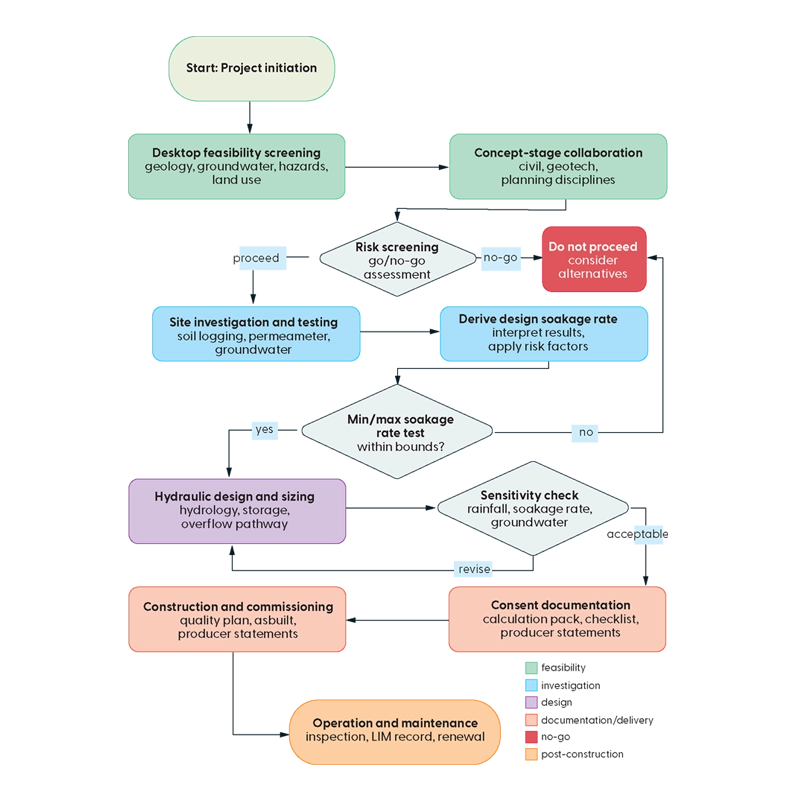
Soakage design process flow diagram
Think beyond construction
Even the most carefully developed system can fail if it is poorly built or inadequately maintained. Compaction effects can reduce permeability, sediment ingress can clog infiltration surfaces, and systems that were designed to drain within 24 hours can progressively lose that capability over time.
The guide also highlights the importance of regular inspections, sediment management, maintenance access and clearly defined owner responsibilities.
By emphasising construction quality and maintenance, the guide acknowledges that design does not end at consent or construction. It must also consider the intended design life and long-term performance of the system.
The Soakage Design Guide does not introduce new concepts. Instead, it consolidates existing good practice in a structured framework that reduces ambiguity, encourages transparency and raises expectation for design.
It is not a replacement to NZBC Clause E1 and E1/VM1, or to local authority requirements, but a supporting document that summarises good practice.
Its underlying message is relevant to all engineers. The intent is a shift away from optimistic design and towards evidence-based design, and a shift away from assumptions and towards understanding.
Soakage design should not become more complicated as a result of the guide. Rather, it should become more robust, more transparent, and ultimately harder to get wrong.
This article was written by Matt Packard CMEngNZ CPEng of ENGEO in conjunction with Siobhan Lilley MEngNZ, Project Engineer at Te Ao Rangahau, and the Soakage Design Working Group.
This article was first published in the September 2026 issue of EG magazine.