Date: |
09 Feb 2026, 5.00PM – 7.30PM |
duration: |
2 hrs 30 mins |
Venue: |
Engineering New Zealand |
Address: |
Level 6/40 Taranaki Street Wellington |
Cost: |
Free event |
The methodology of studies according to the second-generation Eurocode requires successively the acquisition of data, the establishment of a terrain model, and then the calculation and definition of the level of uncertainty of the design. For this, a proper structural model and geomechanical parameters are needed.
Thus, we will discuss:
1. Geometry at the project scale (structural analysis) and at the joint scale (roughness and undulations)
2. Mechanisms of failure
3. Geomechanical parameters
4. Synthesis of all these elements into a field model (calculation, design and sizing approaches)
Presenter Bio - Muriel Gasc-Barbier
Muriel Gasc-Barbier is a senior scientist in the research team GeoCOD (Geomaterials and Geomechanics: couplings and dynamics for geotechnical structures and risks) at the Cerema which is a French public board dedicated to risks, environment, and territory development. She graduated as a geophysical and geotechnical Engineer in Paris in 1996 and obtained a Ph.D. in Geosciences, at Paris Sorbonne University in 2002. Her PhD thesis was focused mainly on experimental aspects of the chemo-hydro mechanical behavior of claystones and their creep behavior. Since 2003, and appointment to Cerema, she works on the mechanical behavior of fractured rock masses developing experimental and theoretical approaches, working on the analysis and modeling of fracturing, its geometric distribution, and the study of induced biases, all applied in tunnels, large cuttings, or rock foundations. In the last 10 years she became deeply involved in rockslides, landslides and the influence of the climate on the instabilities with a special interest in thermal fatigue. Most of her research is based on site investigations and expertise. she has written about 30 scientific papers, more than 70 reports, and participated to several national and European Inter Regional projects. She’s teaching rock mechanics in Sorbonne University, in Paris for 13 years and, 6 years ago, published a book in French, for master or engineering school students dedicated to “rock mechanics for civil engineering.” She has been member of the ISRM since 1999, member of the Board of the French group since 2012, and, now, its President. She is also ISRM Vice President for Europe.
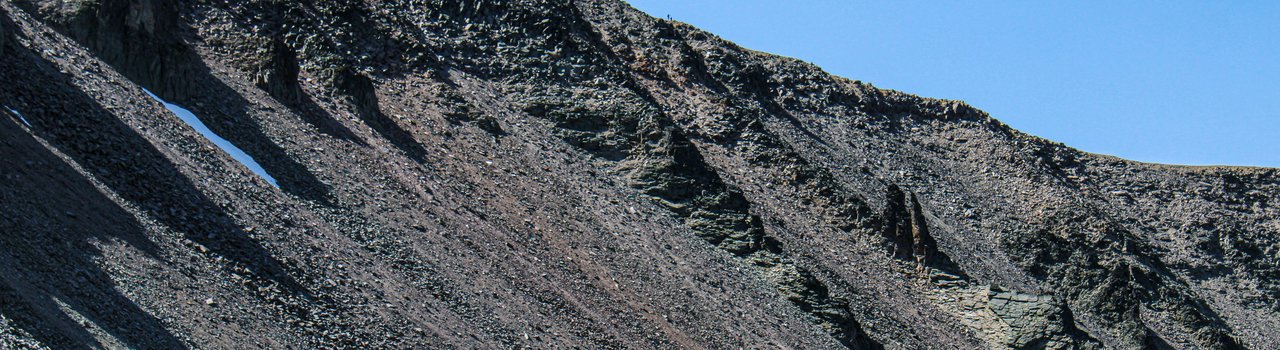
This lecture will focus on stability studies of medium-height rock slopes (a few dozen meters). We will focus on slides or wedges in rock slopes, insisting on the importance of correct field analyses to point out the characteristic of joints sets, as well as the importance of laboratory test results to characterize the mechanical properties of rock joints. Networking will start at 5pm, follow by presentation.
The methodology of studies according to the second-generation Eurocode requires successively the acquisition of data, the establishment of a terrain model, and then the calculation and definition of the level of uncertainty of the design. For this, a proper structural model and geomechanical parameters are needed.
Thus, we will discuss:
1. Geometry at the project scale (structural analysis) and at the joint scale (roughness and undulations)
2. Mechanisms of failure
3. Geomechanical parameters
4. Synthesis of all these elements into a field model (calculation, design and sizing approaches)
Presenter Bio - Muriel Gasc-Barbier
Muriel Gasc-Barbier is a senior scientist in the research team GeoCOD (Geomaterials and Geomechanics: couplings and dynamics for geotechnical structures and risks) at the Cerema which is a French public board dedicated to risks, environment, and territory development. She graduated as a geophysical and geotechnical Engineer in Paris in 1996 and obtained a Ph.D. in Geosciences, at Paris Sorbonne University in 2002. Her PhD thesis was focused mainly on experimental aspects of the chemo-hydro mechanical behavior of claystones and their creep behavior. Since 2003, and appointment to Cerema, she works on the mechanical behavior of fractured rock masses developing experimental and theoretical approaches, working on the analysis and modeling of fracturing, its geometric distribution, and the study of induced biases, all applied in tunnels, large cuttings, or rock foundations. In the last 10 years she became deeply involved in rockslides, landslides and the influence of the climate on the instabilities with a special interest in thermal fatigue. Most of her research is based on site investigations and expertise. she has written about 30 scientific papers, more than 70 reports, and participated to several national and European Inter Regional projects. She’s teaching rock mechanics in Sorbonne University, in Paris for 13 years and, 6 years ago, published a book in French, for master or engineering school students dedicated to “rock mechanics for civil engineering.” She has been member of the ISRM since 1999, member of the Board of the French group since 2012, and, now, its President. She is also ISRM Vice President for Europe.