State Highway 12 traverses the Waipoua Forest. Specially designed raised sections of the highway carry traffic just above the ground, protecting the sensitive kauri tree roots below. These kauri root bridges were completed in 1996.
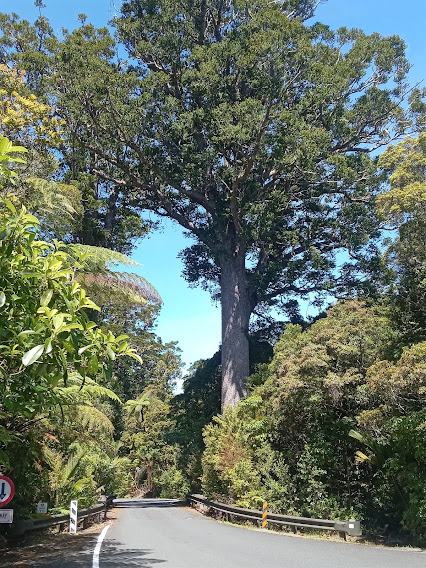
Kauri root bridge between the Darby and Joan Kauri. Photo: Ted Malan, 2025.
Waipoua Forest
Waipoua Forest in Northland contains outstanding examples of unique native New Zealand flora, and is of considerable environmental, spiritual and historical significance. The forest is home to the kauri tree Tane Mahuta, estimated to be 2,000 years old, as well as several other significant kauri including the Joseph Ward kauri and the two kauri known as Darby and Joan. Along with kauri, over 450 plant species are found in the Waipoua Forest. About 200 of them are on the road edge or in the road reserve.
State Highway 12 runs up the west coast of Northland between Dargaville and the Hokianga Harbour. The route was first surveyed, and a path cut through the Waipoua Forest, in the early 1920s. Some upgrades were made to the highway in the 1970s, but the steep and winding section through the Waipoua Forest remained unsealed.
Road improvement plans
In the late 1980s a management plan was established for maintaining the road. This included realignment and sealing of the Waipoua Forest section. In 1985 Transit New Zealand formed the Waipoua Forest Road Management Committee, made up of representatives of Te Iwi O Te Roroa, the Department of Conservation, the Royal Forest and Bird Protection Society and other interested groups. The committee was to plan and oversee all proposals for the future development of the road to ensure that any works in the forest would have minimal impact on this important national heritage area.
Planning for the upgrade work began with extensive public consultation, carried out between 1985 and 1988. Consultation with Te Iwi O Te Roroa, the Department of Conservation, environmental experts and other interested groups continued throughout the design process. Transit New Zealand also engaged forest ecology expert, Stephen King, to supervise all environmental aspects of the work. Decisions on the road alignment, particularly in the vicinity of large kauri and rata trees, were made based on this independent expert advice. Designation and Resource consents were approved in 1994 with no objections to the applications.
Protection measures
Before the design work for the project started, the road itself and all major trees near it were surveyed so that the large trees could be protected either by moving the road or protecting and restoring the roots. Most trees have feeding and support roots that extend out from the trunk of the tree about the same distance as the canopy. In most native trees, these roots are particularly close to the surface, and the health of the trees can be affected by pressure on them from smothering or from trampling through foot or vehicle traffic, or from changes in ground water levels. Water and nutrients essential to the tree are drawn up through these roots, which are usually covered by a deep layer of leaves and branches dropped by the kauri as it grows.
In the past, the road had been built straight over the roots, and many trees in the forest had died as a result. One significant tree, which survived the effects of road traffic running past it, was the Joseph Ward kauri, although it did suffer some ill effects from its exposure. To protect this tree, the road was realigned well away. To achieve that move, another kauri tree had to be removed. Studies found that this tree was deteriorating anyway and had only a limited future, and its removal was approved by Stephen King and Te Iwi O Te Roroa. Wood from the tree was given to Te Iwi O Te Roroa for their use. Its removal cleared the way for the road to be shifted well away from the Joseph Ward kauri, significantly lessening the impact of traffic on the tree and allowing it to recover its long-term health and ensure its longevity. Vegetation removed during the project was mulched and returned to the forest, while logs larger than 150ml (six inches) in diameter were given to Iwi.
The root bridges
In several places where it was not possible to move the highway, Transit New Zealand built special, raised platforms to carry traffic just above the ground over the top of the sensitive roots.
The root bridge structure is a series of concrete piles with a reinforced concrete ring beam and a deck built off that. The concrete piles were specially placed to avoid large tree roots. The bridge deck is punctuated with holes (approximately 50mm diameter at 500mm centres) to allow rainwater to penetrate from the road into the ground below. Before the decks were placed on the root bridges, excess road metal was replaced with a layer of topsoil to enable new feeding roots to grow. Each bridge has a crawl space beneath to allow for maintenance. The bridge that carries traffic between the Darby and Joan trees is 17.4m long and one lane wide. Other root bridges are two lanes. The root bridges have a design life of 100 years.
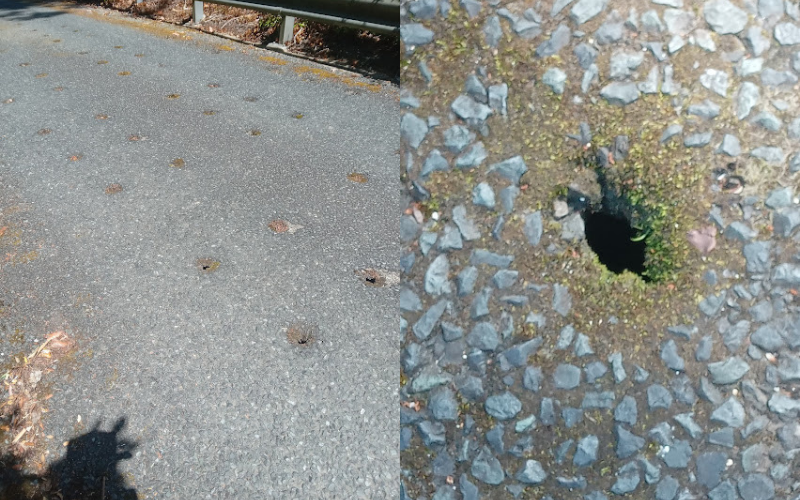
Root bridge aeration holes. Photo: Ted Malan, 2025.
Awards
The project was awarded the New Zealand Tourism Service to the Environment Award, 1996; the environmental section of the IPENZ (now Engineering New Zealand) Engineering Excellence Award, 1997; and the International Road Federation Inaugural 200 Global Road Achievement Award for Environmental Mitigation presented in Miami, Florida, USA, December 2000.
Transit chief executive, Dr Robin Dunlop was responsible for these major achievements along with Regional Manager Terry Brown.
References
Transit New Zealand, entry submission to the 2000 International Road Federation Inaugural 200 Global Road Achievement Award for Environmental Mitigation presented in Miami, Florida, USA, December 2000.
Transit New Zealand, Extract from Options Report - Northland One Lane Bridges Replacement, May 2015, pp 37-40.
Ted Malan, site inspection 3 November 2025.
Location
Darby and Joan kauri trees, Waipoua Forest, Northland.
Entry by Ted Malan
Page last updated 14 July 2026