Auckland now boasts a world-class rail passenger transit system, but for many years the potential of rail to play a major role in meeting the public transport needs of Auckland was neglected.
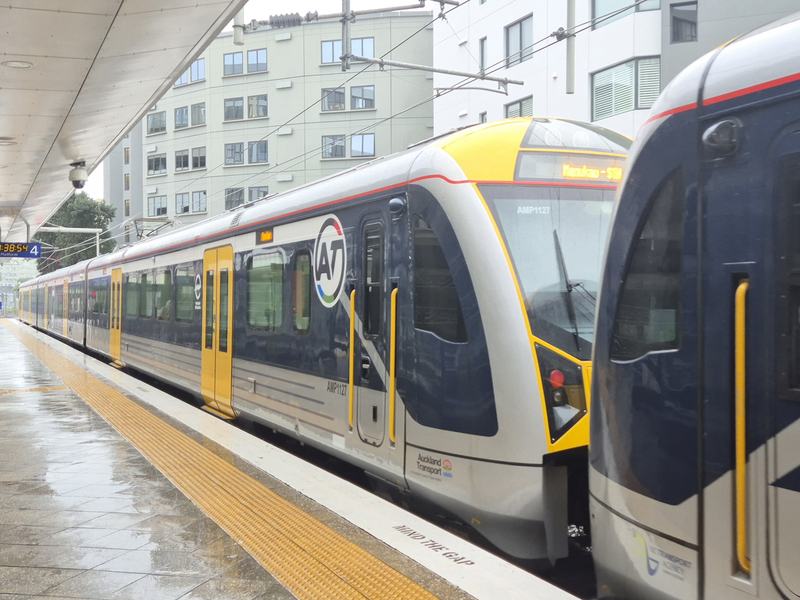
AM1127 at Newmarket Train Station, 2025. By Jtransport - Own work, CC BY-SA 4.0, https://commons.wikimedia.org/w/index.php?curid=169620636
Rail decline in the 1930s
The rail passenger decline began in 1930 when the old station at the bottom of Queen Street was closed, and activities moved to a new Beach Road site over a mile from the CBD. Part of the old site had been assigned by the government of the day, over the protestations of the Railways Department, for the construction of a new Chief Post Office. A New Zealand Herald newspaper editorial at the time the Post Office proposal was announced in 1903 deplored the move and forecast that the day would come when rail would come back to the city downtown and the new Post Office would again become a railway station. It was 100 years before this prophesy came true. Out of sight was out of mind and the linkages between the Beach Road station and CBD, initially by tram and later bus services, never helped encourage the use of suburban rail. The Auckland Morningside deviation proposed in 1930, that would have given an underground route through the city centre and would have required the electrification of the whole route, was considered too expensive and was never implemented. Suburban rail travel languished.
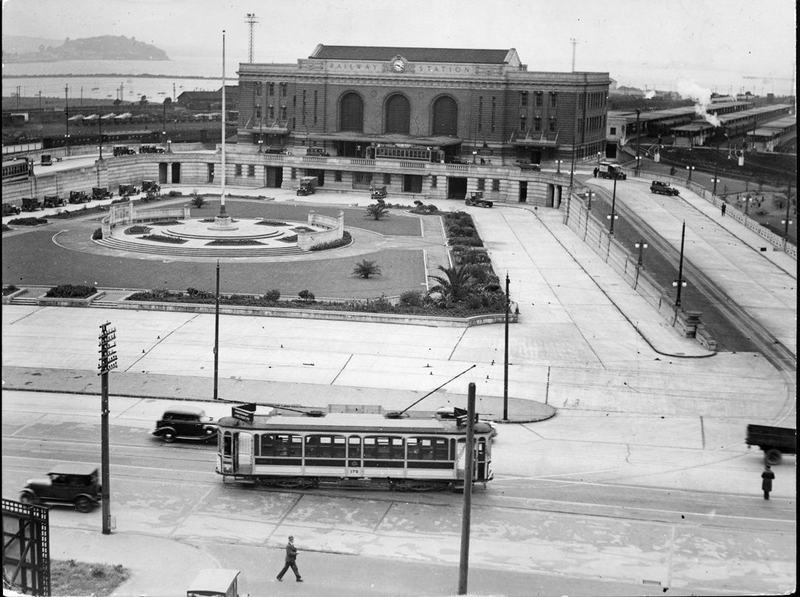
Auckland Railway Station at Beech Road, circa 1935. Ref: PAColl-7171-52. Alexander Turnbull Library, Wellington, New Zealand. /records/22841834
Auckland Rapid Transit proposal in the 1970s
In the early 1970s a joint project team was established with Government support to develop plans for an Auckland Rapid Transit scheme. Comprising staff seconded from Ministry of Works, Railways and Auckland Regional Authority, a comprehensive rapid rail proposal was developed and submitted to government with strong support from Auckland Council and Mayor, Dove-Myer Robinson. The proposal fell on deaf ears and the continued construction of motorways proceeded. Rail passenger use continued to decline.
Slow revival from the 1990s
From the point of imminent closure, the acquisition of modern passenger equipment demonstrated that with the right equipment and more frequent timetables, passenger demand could be stimulated. The development of short-term solutions to meet the passenger growth, and the commissioning of a very impressive downtown railway station that included the former Chief Post Office continued the growth trend. Infrastructure improvements delivered by Project Dart (Developing Auckland's Rail Transport), such as the double tracking of the Western line, were implemented to allow more services and better timetables. A programme of new stations at interchange points with integrated bus services continued the growth. With increasing traffic, it became apparent that system electrification and new rolling stock were justified and implementation commenced.
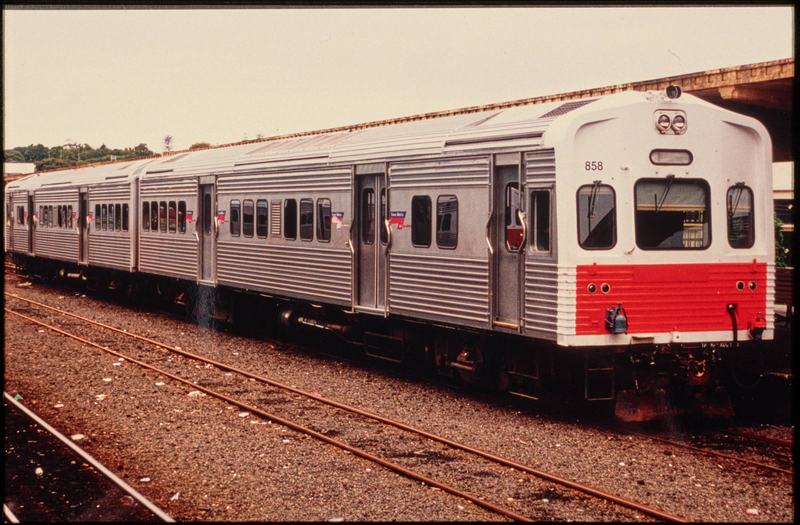
Auckland suburban train, 1990s. These carriages are second-hand diesel multiple units (DMU) from Perth, Australia. Auckland Libraries Heritage Collections 1108-064.
City Rail Link 2010-2020s
The City Rail Link (CRL) was first proposed in 2010 and arose from the realisation that Britomart as a terminal station was approaching its capacity limit. Each train took time to ready for turnround, and with only five tracks the capacity was limited. Turning Britomart into a through station would immediately increase the number of trains that could pass through and lift the capacity of the whole system. Further, the provision of central city stations would better distribute passengers and make the system more accessible to more people. Auckland Transport negotiations with the Minister of Transport took time but design work was begun. The CRL comprises twin 3.45km tunnels, two new underground stations and the redevelopment of exiting stations. The new stations are Te Waihorotui, under the Wellesley-Albert Street intersection, and Karanga-a-hape, under the Karangahape Road- Pitt Street-Mercury Lane area. Mt Eden station was renamed Maungawhau and entirely rebuilt with three sets of platforms covering the North Auckland Line. Britomart station has been renamed Waitemata. Construction started in 2015 with enabling works and tunnel construction in 2018. It is to open in 2026.
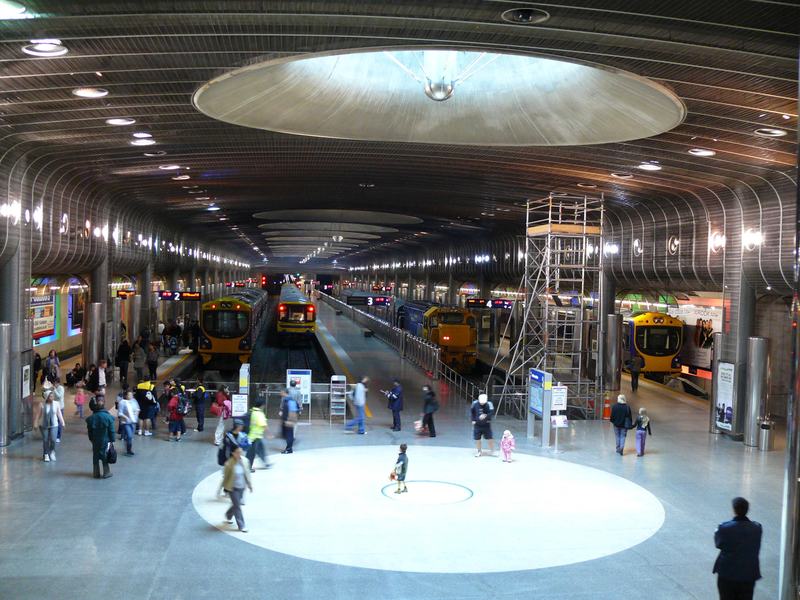
Britomart Railway Station, 2008. Auckland Libraries Heritage Collections 1477-0584
Heritage railway station buildings and infrastructure
A number of heritage station buildings have been preserved during this major system upgrade.
- A significant part of the original Papakura building has been relocated within the precinct by Auckland Transport to become a ticketing facility and help point. The old station signal panel is displayed with the building.
- Auckland Transport restored the Otahuhu Station building and incorporated the 1912 vintage signal box, relocated within the site as a visual feature. There is no public access to the station building.
- The original 1908 Newmarket Station building, designed by Alexander Troup, was placed on the site of the new Parnell Station about 2km north of the original position in 2017 and restored to its original appearance. It is providing veranda platform shelter for the eastern platform and as the station for the Auckland Domain and War Memorial Museum a short walk away. The building is intended to be tenanted. There is no public access.
- The railway viaduct at the bottom of Parnell Rise is a Heritage New Zealand Category 2 Listed structure. It was originally built in 1885-86 and modified in 1890. Its attractive stone piers and abutments are still visible.
- The Beach Road Station is a Heritage New Zealand Category 1 Listed building. There is no public access to the building.
Five other station buildings have been preserved by private initiatives as the stations became surplus to requirements for railway purposes.
- The original Papatoetoe station building, dating in part from 1875, was donated to the Papatoetoe Station Preservation Trust and has been repositioned on railway land adjacent to the railway but on the top of the cutting. The building has been restored and now serves as a public meeting facility and clubrooms.
- The Remuera Railway Station and Signal Box were designed by Alexander Troup in 1908 and are Category 1 Listed structures. In 1995, the buildings were leased by NZ Rail Ltd to the Remuera Railway Station Preservation Trust. Later, the buildings were acquired by Auckland Transport for use as part of the updated network. Auckland Transport raised both buildings by approximately 40cm and relevelled the platforms to the required height for the new trains. As of 2026, Auckland Transport has assumed external maintenance liability for these listed heritage structures.
- The former Wiri station building was acquired by Papatoetoe Trust, but the Trust was unable to complete the work required to restore the building, nor find a suitable site for it. In 2025, the Trust donated the building to the Museum of Transport and Technology (MOTAT) where, once restored, it will become part of the museum’s rail complex.
- The former Glen Eden Station building was constructed in 1880 and modified in 1928 and again in 1940. It is a Category 2 Listed structure. The station is the terminus for mourners visiting the Waikumiti Cemetery. Although designed as a single-track station building, it was modified to have a platform added to the other side with a veranda over a siding to accommodate cortege trains. The building has been relocated several times and is now on the opposite side of the track from its original position. It is occupied by a café.
- The original Avondale Station building was built in 1879. In 1993, the Swanson Railway Station Trust formed to buy and restore the dilapidated building. It was relocated to Swanson; and opened as a café and meeting room in 1998.
More Information
Further reading
John Webley, The Auckland Rail Renaissance, New Zealand Railway Observer, Apr/May 2022; n.372: p.25-34.
Graham Bush, From Survival to Revival: Auckland's public transport since 1860, Wellington: Grantham House, 2014.
“Remuera restoration: historic train station gets critical restoration funding”, Our Auckland, Auckland City Council, 10 March 2026.
"Auckland's City Rail Link is coming - but what else lies underground?", RNZ, The Detail, 20 June 2026.
Related Heritage Record entry
Parnell Rise railway bridge and viaduct
Heritage New Zealand Listings
Remuera Railway Station and Signal Box
Entry by John Webley
Page last updated 05 June 2026