Alec Aitken’s career with the Public Works Department was full of notable achievements. He will be remembered particularly for his involvement with roading and motorway construction. Despite the nature of this work, he was always a conservationist and concerned to see that the environment was carefully considered despite pressure to do otherwise.
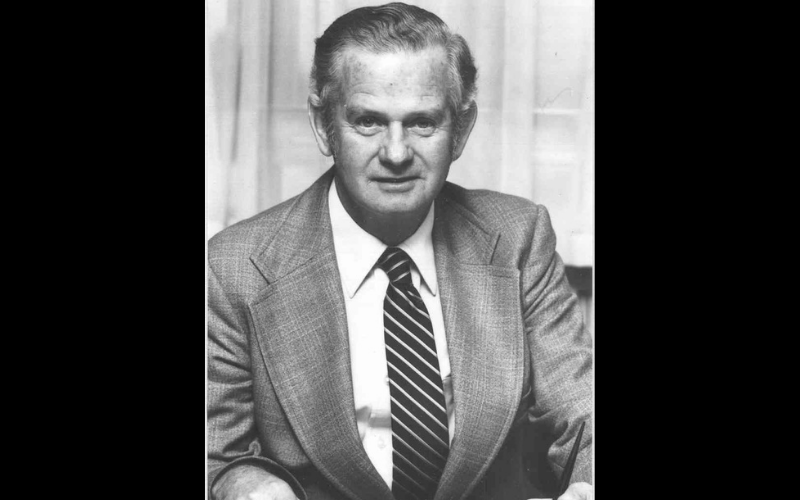
Alec Aitken
Early training and war service
Alec Aitken was born and grew up in Auckland and attended Auckland Grammar School. He started work in the Public Works Department in 1938. He had joined the Department as a clerical cadet with the hope of being transferred to an engineering cadetship, but the second world war intervened. Alec joined the RNZAF as a flight mechanic and had two tours of duty in the Pacific which included a spell on Guadalcanal in 1943.
Career with the Ministry of Works
On his return home to New Zealand Alec was granted a Rehab bursary to study at Auckland University where he completed a BE (Civil) degree in 1950. His first posting, in 1951, in what was then the Ministry of Works (MOW), was to the construction of the rail line from Putaruru to Kinleith. He was then posted to Wellington for two years in Porirua housing development, followed by a year in the head office Civil Design office. During this time in Wellington he met and married Joan Bull.
In 1953 Alec and his new wife were off to Mangakino hydro construction on the Waikato. Alec was involved there for eight years, first on tunnelling and earth dam construction for Whakamaru, and then to Waipapa power station where he became the engineer in charge until its completion in 1961.
Alec then spent two years in Rotorua in the role of Construction Engineer, before being posted to Whangarei as Resident Engineer in 1963. During his time in Whangarei Alec was involved in an all-out effort to bring its state highways in line with roads in the rest of the country. His work in Whangarei also included involvement with the development of the Marsden Point oil refinery and with an Historic Places Trust restoration programme. At this time, the MOW had a role in maintenance and restoration of Historic Places Trust properties. Alec believed strongly in the importance of heritage and supported the work of John Stacpoole, employed by the MOW as conservation architect. Significant heritage properties that Alec oversaw work on included Te Waimate Mission House, and later, Mansion House on Kawau Island.
In 1967 Alec was promoted to District Civil Engineer in Wellington MOW District. Projects he had responsibility for included the design and construction of the Inner-City Motorway from Thorndon to the Terrace Tunnel; the Ngauranga Gorge reconstruction; the Hutt Motorway extension; and the extension of Wellington Airport. His area of responsibility also covered the Nelson, Marlborough, Porirua and Wairarapa Residencies. While in Wellington Alec served several years on the New Zealand Institution of Engineers (NZIE) Council and was the founding chair of the NZIE Welfare Committee.
In 1973 Alec was appointed District Commissioner of Works in Auckland, of what was then the Ministry of Works and Development (MWD), with responsibility for all the MWD activities from Mercer up to the North Cape. There was an active motorway programme at this time and, during his tenure, Alec oversaw the connection of the southern motorway through to Nelson Street in Central Auckland in 1977; connection to the Harbour Bridge the following year; the connection to the Northwestern motorway built from the city out to Western Springs; and the southern motorway extended past Drury.
Alec’s interests extended well beyond transport, and he enjoyed watching the work done by MWD on heritage buildings. His position as District Commissioner of Works included chairship of the district road councils and government representative on the Auckland Regional Authority planning transportation committees and the regional water board. He was also the founding chair of the Auckland Public Expenditure Committee.
An active retirement
Alec retired from the MWD in 1981 after 43 years of service. He then worked until 1984 as a consultant with Murray-North Partners on the gas pipeline from Marsden Point to Auckland.
In retirement, Alec became involved with engineering heritage though IPENZ. He was an active member of the Auckland Heritage Chapter and contributed to projects including the development of Auckland Engineering Heritage walks and the publication of the book Evolving Auckland: the city’s engineering heritage. He served as chair of the IPENZ National Engineering Heritage Committee for 11 years.
Alec was also actively involved in the care and management of two of his local reserves on Auckland’s North Shore, where he undertook volunteer conservation work and served on the reserve committees. Alec served on the board of Northbridge Retirement Village for over 20 years, before becoming a resident there. Northbridge was established in 1972 and, in contrast to most other retirement villages, operates as a Charitable Trust.
Alec was a keen golfer and enjoyed travel. His other interests included the creative arts and nature and a commitment to advancing equity issues.
More information
Engineering New Zealand recorded an oral history with Alec in 2007.
Biography by Rob Aspden, December 2017
Page last updated 21 April 2026