The Tasman pulp and paper mill at Kawerau opened in 1955. In the 1960s it was the largest industrial plant in New Zealand.
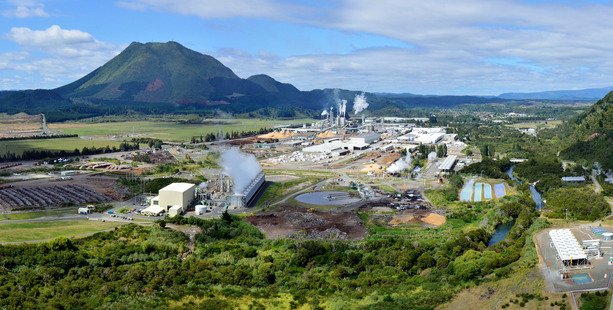
Tasman mill, Kawerau. Photo courtesy Norske Skog Australasia.
Kaingaroa State Forest
From 1925 the pine plantations on the Kaingaroa Plains were the basis of New Zealand’s pulp and paper industries. Early plantings around Waiotapu, using prison labour from 1901 to 1912, were planted at a rate of 300 – 500 acres (120 – 200 hectares) per year. But in 1917 a camp was established for returned servicemen and planting rates increased to an average of 1500 acres (607 hectares) per year. In 1924 the State Forest Service invited British engineering pulp and paper machinery consultants, Walmsleys (Bury) Ltd to advise on uses for the Kaingaroa Plains. They sent William Anderson who recommended large scale plantings of pine trees that could create a pulp and paper industry capable of competing in world markets. State Forest Service Director, Leon MacIntosh Ellis could see that the country would face a timber shortage by the 1960s and proposed a 10-year programme to plant 300,000 acres (121,406 hectares). From 1928 to 1936 up to 1500 unemployed men from the depression years were engaged in planting, in addition to forest service workers. Planting on the scrub land was relatively easy and the rapidly growing radiata pine was easily germinated. By 1935 the Kaingaroa State Forest was 259,147 acres (104,873 hectares), one of the largest man-made forests in the world. It produced the world’s largest wood growth of 23 million cubic feet (622,970 m3) per year.
Establishment of the mill
After extensive testing and trials by the forest service it was determined that New Zealand-grown pine could make pulp equal to that of Canada or Scandinavia. By 1951 the government was ready to offer timber from the Kaingaroa Forest for sale by tender. It was J C Fletcher (later Sir James), second son of the first Sir James Fletcher, who decided that Fletchers should be involved in the pulp and paper industry, even though there was opposition from the government. The only proposal for a pulp and paper mill submitted by the due date in November 1951 was Fletcher’s, with a total estimated cost of £14,800,000 against the New Zealand Forest Service estimate of £13,340,000. The government had offered to contribute £450,000 (15% of the capital) and Fletchers proposed £700,000, leaving £1,850,000 to be raised from public and private investors. The original proposal was for the mill to be built at Te Puke on the Kaituna River rather than the government’s preferred site at Murupara. The government had already let tenders for the earthworks to construct a railway from Edgecumbe to Murupara and it was a condition of the Fletcher contract that the government would construct a new wharf at Mt Maunganui. The government was not happy with the Te Puke site and recommended a new site with geothermal steam near Te Teko, which became Kawerau.
Although there was urgency for the mill to be built because of the maturing Kaingaroa Forest, there were many delays caused by disagreements between the government representatives and Tasman Pulp and Paper Ltd, the new company formed by Fletchers. It was not until July 1953 that the mill site was surveyed and foundation work commenced. The first paper was produced in October 1955, a substantial feat considering the complexity and scale of the plant, which had the largest capacity of any in the world at the time.
There were many processes involved:
- Logs arrived by train or logging truck. Over 1 million tonnes of logs were handled each year.
- Smaller logs were de-barked by a rotating drum de-barker and larger logs by high pressure water jets. Logs were sorted, some going to the sawmill and others chipped or ground for pulp. Bark was burnt in boilers to produce steam.
- Logs selected for kraft chemical pulp are chipped through a knife chipper and fed to a digester where chips are reduced to fibres when mixed with NaOH and Na2S heated to 150-165 degrees under pressure.
- Logs selected for mechanical pulp are cut into baulks and ground by massive grinders. Mechanical pulp was treated in a similar way to the chemical pulp.
- The Tasman mill making kraft pulp first had a capacity of approximately 300,000 tonnes per annum of bleached and unbleached pulps used by manufacturers of high-quality paper, tissue and building products.
- A sawmill producing domestic building grades was an integrated part of the complex.
Infrastructure built to support the mill included the Murupara-Kawerau railway, Mt Maunganui deepwater wharf, electricity supply to the plant, roading and Kawerau township.
Skilled workers were recruited from overseas to staff the plant in its foundational years. A prominent engineer in the early operation was Arthur Western, seconded from A E Reed UK, who were an early equity partner in Tasman. He was initially Chief Engineer then Mill Manager.
Kraft production
When the mill opened, process digestion was by the No. 1 plant. This was the original plant on site and ran a batch process. The No. 2 plant, added in 1973, was a continuous process plant and allowed for the addition of a third paper machine. The No. 3 plant, commissioned in 1987, was also continuous, and was at the time the largest industrial construction project in New Zealand. Its installation allowed the decommissioning of the original No. 1 plant. Production of ground wood was ended in 1997 meaning paper after that date was entirely from kraft.
Paper machine expansion
The mill began its operations in 1955 with one paper machine. It added another in 1962 and a third in 1975. The machines were modified considerably during their lives, in particular to facilitate the thinner stronger paper that the market required.
Energy
The mill is powered by a combination of energy sources. Some energy is created from the combustion of waste from timber processing and combustion of digester liquor. Geothermal energy, from the adjacent Kawerau Geothermal System, is also used. From the beginning of the mill's operation, some geothermal energy was taken from wells to direct heat applications in the plant and direct to open cycle turbine generation. From 1966 on, binary cycle electricity generation was undertaken for use in the plant.
In 2008, Mighty River Power opened the Kawerau Geothermal Power Station. This station has a capacity of 100 MW and, alongside other local geothermal plants, supplies electricity to the mill and the wider Bay of Plenty area.
Some process heat applications of geothermal energy have continued at the site.
Environment
The location of the mill was, in part, chosen for its proximity to the Tarawera River. The Tasman Pulp and Paper Company Enabling Act 1954 authorised the mill to take water from, and to discharge its waste into, the river. Later, resource consents continued to allow the discharge of waste. In 1997, the river was reported to be in a very poor state of health and unable to support aquatic life.
Changing mill production processes to reduce environmental impact has seen an improvement in water quality. Consent for waste discharge into the river, renewed, despite opposition, in 2009, runs until the early 2030s.
In the Ngāti Tuwharetoa (Bay of Plenty) Claims Settlement Act 2005, the Crown acknowledged that the pollution and degradation of the Tarawera River were a grievance to the iwi.
Edgecumbe earthquake
The 1987 earthquake damaged many parts of the plant. Some production was restarted within a month, but full recovery took four months.
Ownership changes and newsprint decline
The original mill was owned by Tasman Pulp and Paper Ltd., a company established by Fletchers. In 1981, Tasman Pulp and Paper became a division of Fletcher Challenge.
In 2000 the mill was sold to Norske Skogindustrier ASA of Norway, and in 2001 it passed ownership of its kraft operations and business on to Carter Holt Harvey Ltd. In 2005 Rank Group Investments Ltd, controlled by New Zealand's richest man, Graeme Hart, took ownership of the Tasman mill's Carter Holt Harvey asset, along with the Kinleith paper mill. Norske Skog retained the mechanical pulp mill and newsprint machines. Carter Holt Harvey retained the sawmill on the Tasman site. There were now three separate businesses operating on the site.
In 2014, the Carter Holt Harvey, Tasman mill kraft, Kinleith and Penrose paper mills were sold to Japanese company Oji Fibre Solutions, one of the largest paper manufacturers in the world.
Fewer markets and declining prices for newsprint had led to the closure of one of the three paper machines in 2004, and in 2021, Norske Skog decided to cease newsprint production altogether. Oji Fibre Solutions took over the operational assets it needed from Norske Skog in 2023.
The local entity, Norske Skog Tasman Ltd, was put into liquidation in 2024, with it still holding a liability for a toxic landfill at the site.
As of 2025, Oji Fibre Solutions manufacture unbleached kraft pulp at the Tasman Plant. The adjacent Essity plant, producing domestic paper products, can utilise this source, as do other Oji manufacturing plants elsewhere in New Zealand. It is also exported. Carter Holt Harvey operate the sawmill.
The Kaingaroa forest is primarily owned by the Kaingaroa Timberlands Partnership, which holds the Crown Forestry Licences over the land. The underlying land is owned by various iwi and other entities. Operational management is carried out by Timberlands Limited.
More information
Related Record and oral history entries.
Access
The site is not open to visitors but can be viewed from Kawerau Rd (SH34) or Fletcher Ave.
References
Barry Ashwin. Tasman Pulp and Paper: the first fifty years (B. Ashwin: Kawerau, 2010).
Megan Cook, "Pulp and paper, aluminium and steel industries – The pulp and paper boom," Te Ara – the Encyclopedia of New Zealand, accessed 17 October 2025, https://teara.govt.nz/en/pulp-and-paper-aluminium-and-steel-industries/page-2
Brian Easton, "Economic history – Industrialisation," Te Ara – the Encyclopedia of New Zealand, accessed 17 October 2025, https://teara.govt.nz/en/photograph/24349/tasman-pulp-and-paper-mill-kawerau.
"Tasman Pulp & Paper Co Ltd," The Fletcher Trust Archives, accessed October 2025, https://collection.fletcherarchives.co.nz/persons/1003/tasman-pulp-paper-co-ltd.
Jack Smith, No job too hard: a history of Fletcher Construction Volume II: 1940-1965, Wellington, Steele Roberts, 2014.
"The Pulp and Paper Industry," in "The Forestry Industry," Chemical Processes in New Zealand, New Zealand Institute of Chemistry, 1998 2nd Ed, section IV, accessed Nov 2015, https://nzic.org.nz/book-chempronz
‘The Story of Kawerau,’ Te Ao Hou National Library of NZ No 10 April 1955, accessed Nov 2015.
Location
The site is located 2km outside the town of Kawerau, Bay of Plenty, off State Highway 34.
Page last updated 11 December 2025