Basalt piers astride Parnell Rise in central Auckland, constructed in 1865-1866, tell the story of the city’s first and much beleaguered rail project.
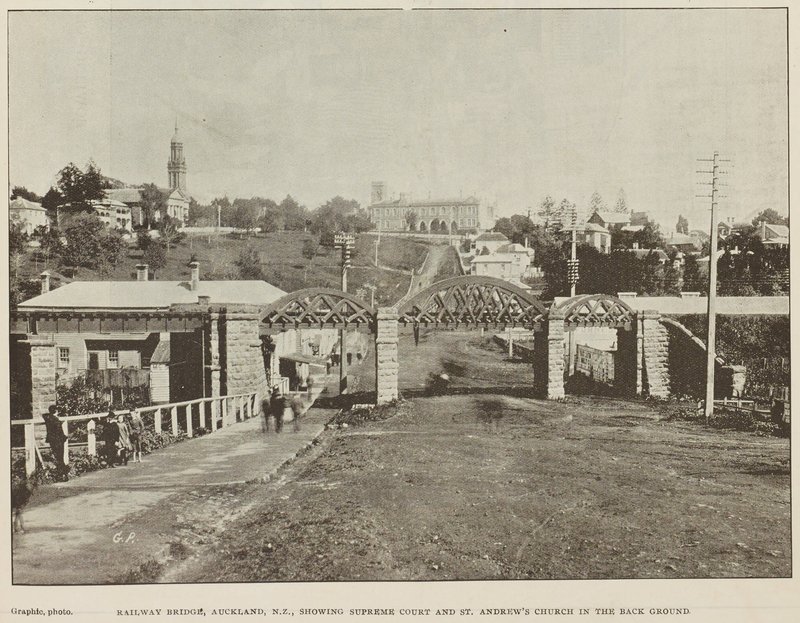
Parnell Rise Railway Bridge and Viaduct, 1896. Visible on the hill behind, are St Andrew's Presbyterian Church (left) and Auckland High court (right). Auckland Libraries Heritage Collections NZG-18961114-0033-01.
Planning Auckland’s first rail line
In the early 1860s, Auckland Provincial Council began to plan an ambitious rail project that would connect central Auckland with Drury, 35km to the south, and include a branch line across the isthmus to the port at Onehunga. The railway would bring coal from mines in Drury, needed for the development of industry in Auckland, and provide transportation for troops and supplies to facilitate the invasion of the Waikato.
In 1862, engineers James Stewart and Samuel Harding surveyed the route and prepared plans and sections. The first section of the chosen route went from Auckland’s port at Mechanics Bay to Newmarket. This section included steep hills that were to be navigated with a bridge and viaduct over the foot of Parnell Rise, and a tunnel to Newmarket under the ridge at the upper entrance to the Auckland Domain.
The project was to be funded through loans and managed by a Railway Commission. The Commission, led by Provincial Council member, Thomas Cheeseman, was appointed at the beginning of 1864 and authorised a budget of £100,000. Stewart and Harding were jointly appointed as engineers. Throughout 1864 the project was beset with delays. There was difficulty obtaining finance and delay caused by landowners unwilling to sell land for the project. Letting of tenders for the work also proved challenging.
By 1864 the Waikato War was effectively over, and the Commission decided to focus on the Auckland to Onehunga section of the project and to break this into four contracts. The Mechanics Bay to Newmarket contract was let to Peter Grace in February 1865 and the first sod turned that same month.
Work on the project begins
The project ran into challenges almost straight away. A landslip at the Domian tunnel portal and rain which turned the area to mud made progress slow. Unexpected volcanic rock on the rail route led to increased cost, as did the need to line the tunnel in full when some unlined length had been budgeted.
Plans for the bridge and viaduct over Parnell Rise were complete by May 1865 and construction work began in the latter part of the year. The structure consisted of a triple-span bowstring truss bridge and an adjacent viaduct to the south. The bowstring arches were lamellated from 12 by 2-inch kauri slabs. The piers were faced in mortar-bonded ashlar masonry using basalt. The interior was scoria rubble.
By the beginning of 1866, the rail project had already faced considerable cost overruns. A Commission of Enquiry was held; the Auckland Provincial Council took over management of the project and halted as much of the work as possible. By May 1866, the bridge and viaduct were near completion. The Provincial Superintendent authorised work on the structure to continue and the bridge and viaduct were likely finished in October 1866.
By mid-1867, with all work on the rail line halted and the project cancelled, the bridge and viaduct were left abandoned and unconnected to any part of the rail formation that had been completed.
Public recriminations over the failed project were loud. Commissioners, engineers, contractors and labour all faced accusations of blame. The project had proved beyond the financial capacity of the Province to fund and poor governance appears to have been an issue.
Second life
In the early 1870s, rail was given a boost of funding from central government under Colonial Treasurer Julius Vogel’s ambitious public works scheme. Many rail projects were planned around the country, including a railway from Auckland to Mercer, with a branch line to Onehunga. After almost five years, Auckland province’s abandoned rail project was given a second life and work recommenced in the summer of 1871-1872.
The Domain Tunnel was completed in 1873. Spoil from Parnell and the removal of Point Britomart was used to reclaim land in Mechanics Bay and to build an embankment to the bridge and viaduct. The Auckland terminus, a modest wooden building, was near the present intersection of Anzac Avenue and Beach Road. Passenger stock was purchased from A & G Price of Thames.
The first train to Onehunga ran in December 1873. It was the first section of line to be completed under Vogel’s rail programme. By 1875 the railway was complete as far as Mercer.
The Onehunga terminus developed as a railways-owned wharf. From there, goods and passengers travelled by sea to Wellington. In 1886, the Wellington – New Plymouth rail link opened, and this then became the preferred route. The 1908 opening of the North Island Main Trunk line ended its dominance. Today, the Onehunga branch is a commuter rail line.
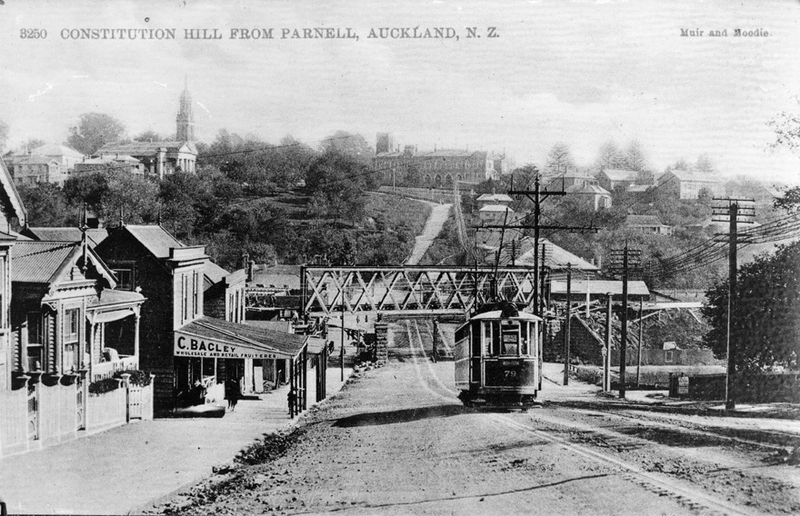
Parnell Railway Bridge c.1910 showing the new single span steel Warren truss. Auckland Libraries Heritage Collections 1836-011.
What remains of Auckland’s first rail project
The Parnell bridge and viaduct are still in use today and trains run along the route daily.
The bridge underwent slight modification in the 1890s when some of the piers were raised in height. More extensive modifications were carried out in 1908-1909 – the three-span wooden bowstring truss was replaced with a single span steel Warren truss; two of the piers on either side of Parnell Rise were removed to allow the road to be widened; the remaining piers and abutments were widened to allow the installation of a double track line. Comparatively little has been altered since then, leaving the piers as a visible example of early rail bridge engineering.
The tunnel still exists but is closed off. In 1914-15, the tunnel was by-passed by a parallel double track tunnel on a lesser grade. The old tunnel remained in use for some time afterwards. It is the second oldest railway tunnel in New Zealand, after the Lyttelton Tunnel.
The subsequent history of the tunnel includes use as an air raid shelter in 1942 and a route for a temporary power supply to central Auckland overcoming the cable failure crisis of 1998.
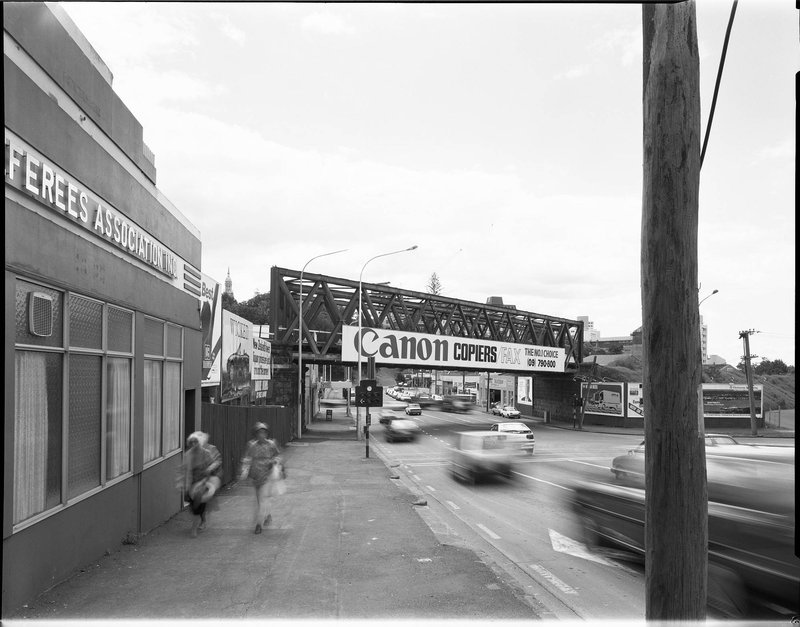
Parnell Railway Bridge, Parnell Rise, 1989. Auckland Libraries Heritage Collections 273-MAT125, photographer Christopher Matthews.
More Information
Heritage Recognition
The Railway Bridge and Viaduct at Parnell Rise, Mechanics Bay, Auckland has been recognised by Heritage New Zealand as a Category 2 historic place (List no. 7585), Railway Bridge and Viaduct: New Zealand Heritage List/Rarangi Korero information.
New Zealand Archaeological Association
The bridge is in the New Zealand Archaeological Association Site Records as site R11/2738. The tunnel is site R11/2512. See ARCHSITE
Access
The Parnell bridge abutments and viaduct are accessible.
The original Parnell tunnel can be seen at a distance from Cowie Street.
References
G W A Bush. From Survival to Revival, Auckland’s Public Transport Since 1860. Grantham House, 2014.
R. S. Fletcher. Single Track. Collins, 1978.
D Lowe. Tracks Across the Isthmus. Lodestar Press.
R. Thomas. “A Brief History of Auckland’s Railways,” in J. La Roche. Ed. Evolving Auckland, The City’s Engineering Heritage. IPENZ, 2011.
G W Walker. The Auckland Railway Stations, A History. Ed. J F Webley. Privately published, 2004.
For biographies of William Weaver, Samuel Harding and James Stewart see: F W Furkert. Early New Zealand Engineers. A H and A W Reed, 1953.
Location
Parnell Rise Railway Bridge and Viaduct
Page last updated 05 February 2026