
3 Feb 2026
Across engineering, sustainability is moving from being a “nice to have” to a baseline expectation, and engineers are well-placed to champion the move.
Whether it’s designing infrastructure, modelling transport systems, developing software or working in manufacturing, the decisions engineers make every day ripple far beyond their immediate project outcomes, shaping communities, ecosystems and economies for generations. The Sustainability Society’s (TSS) work is focused on building the skills, networks and conversations that will help engineers of all disciplines embed sustainability and regenerative thinking into their practice.
Globally, we are seeing inspiring examples of regenerative design in the built environment, where nature, technology and community seamlessly intersect. An example is Singapore’s Supertree Grove at Gardens by the Bay. These vertical gardens, soaring up to 50m tall, are more than just aesthetic. They integrate solar panels and rainwater harvesting, and act as air exhaust systems for nearby conservatories. The Supertrees also support a diverse range of plant species, creating vertical biodiversity corridors within a dense urban setting.
In Aotearoa, we’re making progress. Our building and infrastructure sectors are moving towards low-carbon design, with policies like the Carbon Neutral Government Programme setting the direction. We are also starting to see kaupapa Māori worldviews and values of kaitiakitanga inform how projects are framed, such as the recent example of Ngā Mokopuna building at Victoria University of Wellington which aspires to Living Building™ certification. But there are still some gaps. We lag in scaling up circular economy approaches to construction waste, in embedding biodiversity goals in urban development, and in long-term resilience planning. Too often, short-term economic decisions override long-term environmental outcomes.
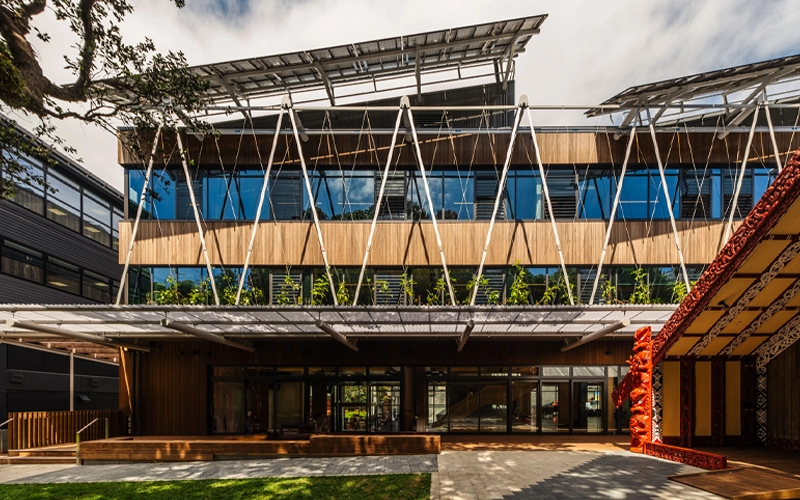
Victoria University of Wellington’s Ngā Mokopuna, designed by engineering firm Dunning Thornton and architects Tennent Brown. Photo: Victoria University of Wellington
Recognising these challenges, TSS has refreshed its focus. Our mission is to be a cross-disciplinary connector, creating spaces where engineers, planners, architects, ecologists and communities can learn from each other and work collaboratively. This refresh is in response to a fast-changing professional landscape. Engineers are being asked not only to deliver technical solutions, but also to engage with complex societal and environmental systems. TSS provides the forums, tools and networks to build that capability.
A great example of our refreshed approach is the Future Forward Sustainability Hackathon, co-hosted with our organisational member Tonkin + Taylor and the University of Auckland’s Engineering for Sustainable Development student group. This one-day event brought together students from multiple disciplines to tackle pressing challenges like preventing wastewater overflows, mitigating biodiversity loss in urban environments, and reducing emissions. With guidance from industry mentors, students developed bold, practical solutions that reimagined how engineering can directly address sustainability issues.
An exciting development is the creation of our Emerging Professional and Student Sub-Committee. Student engineers are passionate about sustainability, but often unsure how to translate that into real-world influence. At the same time, many younger professionals are eager for mentoring and platforms to contribute. With a formal voice within TSS, we create pathways for leadership, fresh perspectives and stronger intergenerational dialogue. Today’s students are tomorrow’s decision-makers, and engaging them early helps embed sustainability as second nature in their practice.
Of all our work, perhaps the greatest impact comes from shifting mindsets. Tools and technologies are important, but it is engineers’ values choices, and willingness to challenge “business as usual” that will drive change.
All engineers, regardless of their discipline, can help by asking sustainability questions at every project stage, championing long-term value over short-term cost savings, supporting cross-disciplinary collaboration, and getting involved with TSS events and initiatives.
Sarah Skillen is Manager of The Sustainability Society.
This article was first published in the December 2025 issue of EG magazine.