
12 Jan 2026
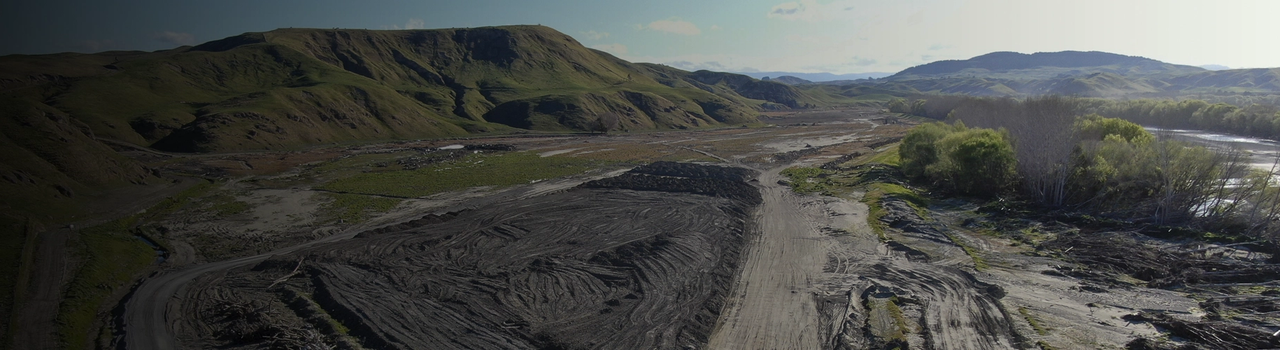
A staggering engineering challenge was left behind after Cyclone Gabrielle devastated the Hawke’s Bay region in February 2023: multi-million cubic metres of silt and debris, scattered across 7,000 hectares of residential and once-productive land. What followed was a large-scale clean up and recovery that restored not just land, but hope.
After just nine days into a new role with Beca, Darren de Klerk, Business Director – Water, was thrust into responding to Cyclone Gabrielle. He worked in the local Civil Defence team in Central Hawke’s Bay for three weeks before being seconded to Hastings District Council and Hawke’s Bay Regional Council as Silt and Debris Recovery Leader. By May 2023, working with regional leaders, Councils had secured government funding for a Sediment and Debris Recovery Taskforce.
“You had to ground yourself in the scale of what was going on,” Darren says, having experienced first-hand slips at his family home in Havelock North. “My motivation was to be involved, and influence a positive outcome. There were people far worse off than me.”
So how do you start moving such vast amounts of material? Darren says: “In peacetime, if you had to establish this, you’d go through a process to establish appropriate sites like landfills to deal with the material. This in itself is a large engineering task, in terms of site assessment, hydrology, consenting and environmental considerations around management and monitoring.”
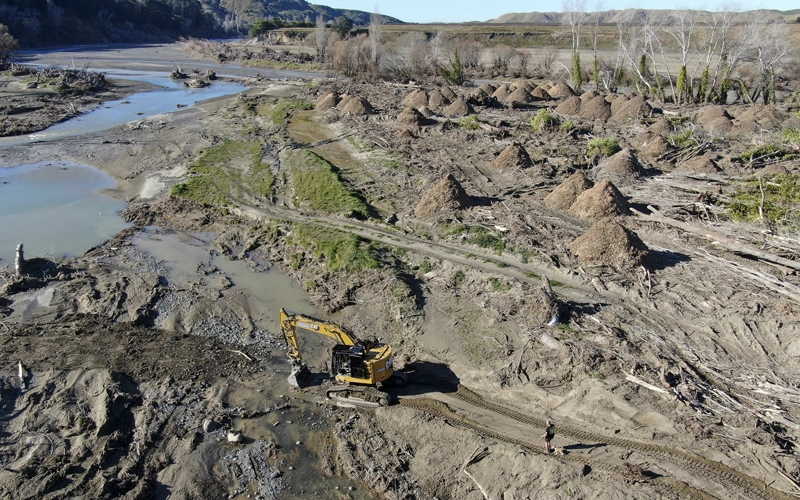
Early stages of clean up along the Mangaone River in the Hastings District after Cyclone Gabrielle in 2023. Photo: Hastings District Council
But time was of the essence, and each landowner’s situation was unique.
The Taskforce divided Hawke’s Bay into six zones, each with its own contracting team, project managers and community liaison officers. The multidisciplinary Taskforce included civil and geotechnical engineers, hydraulic modellers, surveyors, contaminated land specialists, GIS analysts and civil contractors. Daily stand-up meetings ensured coordination and momentum, meaning those involved could quickly adapt to changing community needs, Darren says.
The emergency solution was to set up 15 cleanfill sites across the six zones, and two processing sites equipped with screening equipment. An 0800 number and online job request system for landowners was integrated into the Regional Council website. GIS data was merged from multiple agencies, giving “real-time visibility of jobs”. Regular drone surveys conducted volume monitoring, and testing was carried out regularly to benchmark soil quality and contamination risks.
When dust became an issue during the first summer, the Taskforce partnered with Te Whatu Ora, Environmental Science and Research and NIWA for air quality monitoring.
“A lot of what we did was forward-thinking, trying to pre-empt the issues.”
Other challenges included managing the volume of trucks on the road and contending with the weather.
Darren says that a community-first approach was the priority. “Every property owner had their own set of circumstances and hence the Taskforce worked hard to connect with every landowner,” says Darren. “Our objective was to find the best outcomes for them and with them, rather than placing problem solving on them.”
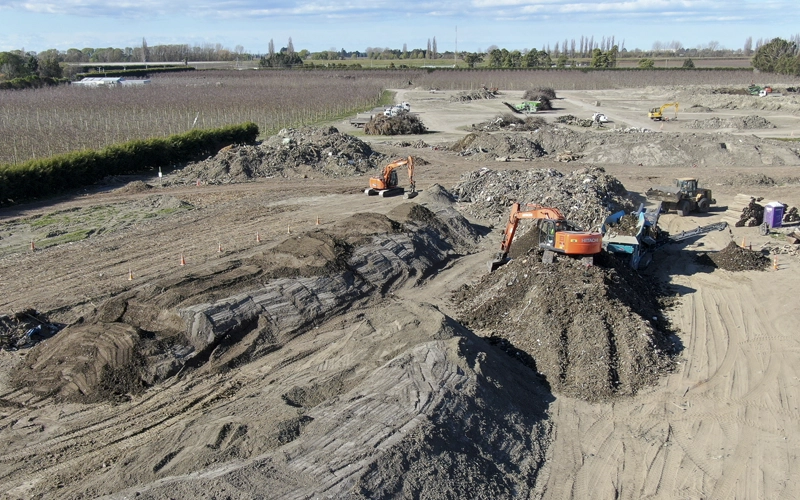
Salvaged timber posts and screening operations at the Pakowhai silt and debris processing site. Photo: James Douglas, Sitrep Projects
Landowners were encouraged to keep suitable silt on their properties, where feasible. Agricultural consultants assessed whether the silt would benefit the soil productivity, rather than require removal.
“This way, best possible choices to recover the land were balanced with sustainable and pragmatic needs,” says Darren. “Where possible, silt was repurposed for land levelling and local projects.”
Recycling and repurposing the silt and debris became a high priority. Treated orchard posts that had been scattered across land in the floods were repurposed as fencing posts through the work of Nelson-based company Repost and Federated Farmers. Concrete was crushed and used for road stabilisation. Green waste was transformed into mulch and compost for community giveaways, or as a way of getting sites fertile again. Of the 4.5 million tonnes of total material collected and processed, just less than 100,000 tonnes reached landfill – roughly two percent.
Darren’s work won him recognition as a finalist in the 2025 Engineering New Zealand ENVI Awards. He says the project was about more than just moving silt. “It was about rebuilding lives, restoring confidence and making progress in a time of crisis.”
He and his team continue to share their learnings with the Nelson/Tasman, Waikato and Gisborne regions.
“Taking my own reflections of those early days around what to do and how to do it, and how overwhelming that can be, I am a staunch advocate of sharing lessons and not reinventing the wheel or having to learn the lessons we had to.”
Darren now works for Hastings District Council in a leadership role focused on infrastructure delivery.
Lessons learnt
Following the devastating one-in-100-year flood event in the Motueka Valley, Nelson-Tasman District Council has implemented a silt management system in Riwaka. The site has already received 2,500m3 of “relatively clean silt” with approximately 13,000m3 still requiring removal, says Richard Kirby FEngNZ, Tasman District Council Group Manager – Community Infrastructure.
Nelson-Tasman’s approach is more bespoke than Hawke’s Bay’s.
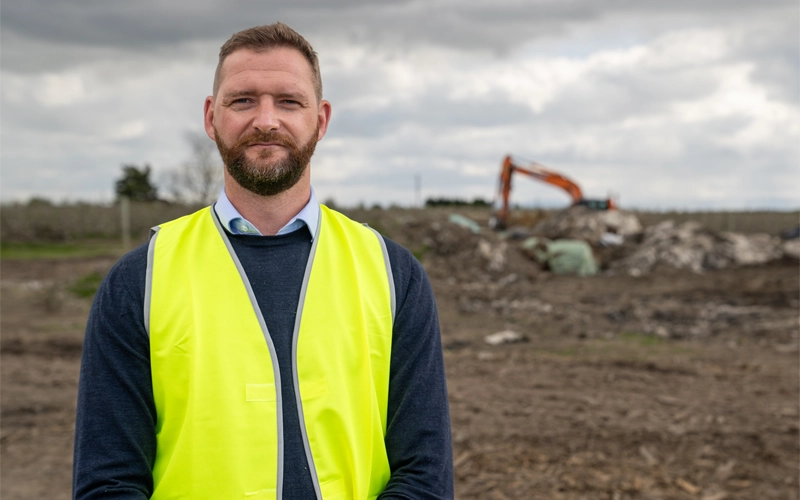
Darren de Klerk at the Pakowhai silt and debris processing site. Photo: Mark Henderson, HDC
“The scale of their operation is orders of magnitude greater than what we are dealing with,” says Richard. “But we did have early discussions with them. Our engineering response involves geotechnical and biotechnical assessments to ensure the silt quality, and mechanical raking systems to remove debris during layered placement of the silt in its new location.”
Cross-regional knowledge sharing has taken place, and looking ahead Richard recognises the need for pre-identified disposal sites.
“We will always live with natural hazards...”
Ben Exton CMEngNZ CPEng IntPE(NZ) knows a thing or two about silt. When the devastating Christchurch earthquake struck on 21 February 2011, claiming 185 lives, Ben was a Year 11 student. He became one of the thousands of people who helped clear liquefaction silt from Christchurch streets.
The Student Volunteer Army (and many other groups) mobilised 13–15,000 volunteers who contributed more than 75,000 working hours helping clear 360,000 tonnes of silt. Ben was part of the broad volunteer effort that included countless professionals in engineering, response and medical sectors whose expertise often went unacknowledged during the highly visible silt-shovelling operations.
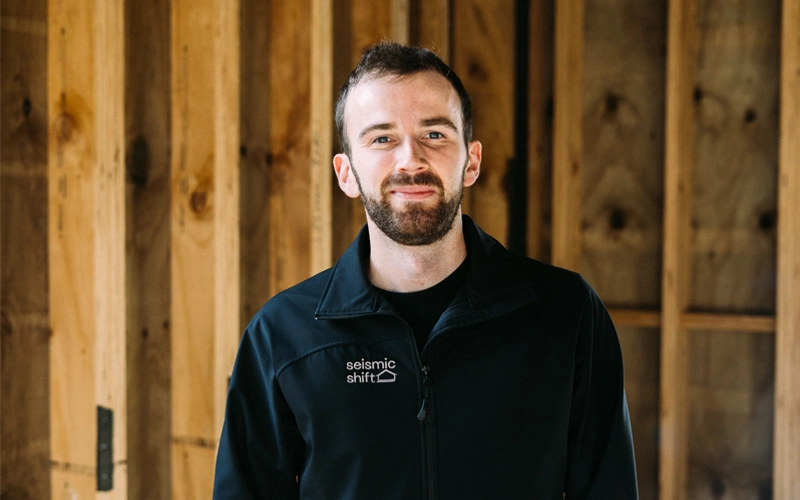
Photo: Supplied
Now aged 31, Ben remembers that experience as one that would shape his career in earthquake damage reduction.
His strongest memory is of his elderly great uncle in tears over his award-winning garden destroyed by liquefaction. He says: “We will always live with natural hazards, but there are a lot of things we can do to avoid them becoming natural disasters.” After studying engineering and working in engineering consultancies, he helped establish Seismic Shift in 2022, an earthquake resilience research and development company.
Fifteen years later, in the same week as the anniversary of the September 2010 Canterbury earthquake, his team celebrated installing their first FrontFoot base dissipation technology – an earthquake damage-reduction system. The technology addresses horizontal shaking damage, complementing existing foundation settlement solutions.
This article was first published in the December 2025 issue of EG magazine.