
22 Jan 2026
New Zealand’s stormwater networks, urban tree assets and climate resilience strategies are under increasing pressure from more intense rainfall events, rising surface temperatures and ageing impermeable infrastructure. At the same time, more than 7.75 million tyres reach the end of their service life annually, creating approximately 73,700 tonnes of difficult-to-recover waste.
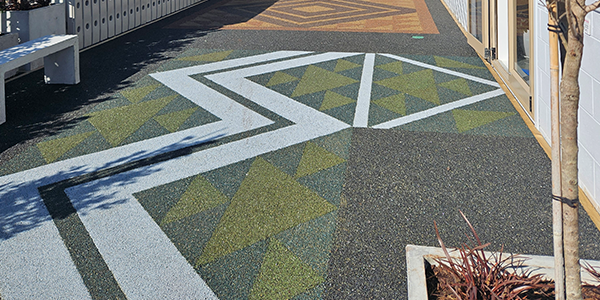
A permeable pavement system now entering wider commercial use is addressing both challenges in parallel. Porous Lane is manufactured in New Zealand using recycled end-of-life tyres and is being deployed as stormwater-active surface infrastructure across footpaths, civic spaces, tree pits and laneways.
Developed in collaboration with the University of Melbourne and introduced to New Zealand by water-infrastructure specialist Watersmart, as the local distributor, Porous Lane is designed as a fully permeable, semi-flexible pavement system that allows water to infiltrate vertically through the surface rather than shedding laterally into traditional drainage networks.
Porous Lane Hub
The system contains up to 60 percent recycled tyre rubber by composition, with each square metre diverting up to three tyres from landfill. National delivery is supported through partnerships with various accredited installers, Treadlite as rubber suppliers, Tyrewise as the national tyre recovery stewardship body, and engineering specialists.
Manufactured on site using a proprietary formulation, Porous Lane can be applied across a wide range of infrastructure settings, from car parks and light-duty driveways to footpaths, tree surrounds and cycleways.
Alongside its structural performance, the system delivers significant environmental gains, with up to 79 percent less embodied carbon than concrete and up to 45 percent less than asphalt, while offering a 25-year design life. Its permeable structure mitigates many of the issues associated with traditional asphalt, including localised surface flooding, by allowing water to soak directly through the pavement into the subgrade – easing pressure on stormwater networks while supporting healthier soils and tree root systems.
"Porous Lane was designed specifically for the environments where conventional rigid pavements struggle, especially areas with heavy root pressure, heat issues, or high foot traffic," said Watersmart Co-Founder Elliot Olsen.
"Unlike standard concrete or asphalt, the structure allows stormwater to drain straight through to the ground. But the real difference is the flexibility. It accommodates thermal expansion and root movement without the brittle cracking you see in rigid materials. That combination of permeability and movement is its biggest advantage in urban projects."
The system delivers high slip resistance and maintains surface stability under pedestrian loading while also facilitating oxygen and moisture transfer into underlying soils and root zones. This dual structural–ecological function has made Porous Lane particularly attractive for tree-protection applications, where traditional pavements often conflict with long-term canopy health and asset durability.
Treadlite a nationwide tyre collection and recycling company provides the rubber granules which are the basis for the Porous Lane product. “New Zealand now has a comprehensive collection and recycling system, but we have a shortage of domestic applications for those products”, said Treadlite director Blake Richardson.
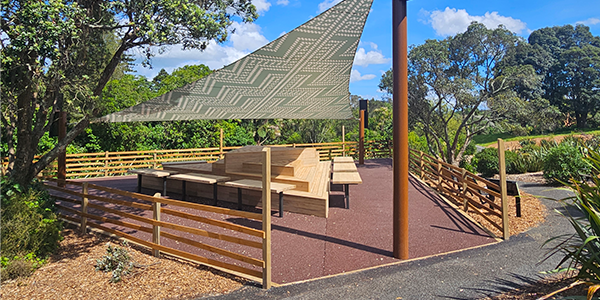
Te Whare Pora within the Auckland Botanic Gardens, featuring a 150-square-metre coloured Porous Lane pavement.
“Porous Lane allows us to take tyre rubber that would otherwise be exported and turn it into something that delivers genuine environmental and social value. This is recycling that is directly engineered into public works outcomes.”
Recent Auckland installations provide early performance evidence across a range of technical scenarios.
At Te Whare Pora within the Auckland Botanic Gardens, a 150-square-metre coloured Porous Lane pavement was specified by CLC Consulting for a high-visitor environment requiring durability, permeability and low maintenance. The surface integrates permeability with cultural and ecological narratives while delivering load-bearing pedestrian performance. The installation also contributes directly to Auckland Council’s Zero Waste and carbon reduction targets through verified tyre diversion.
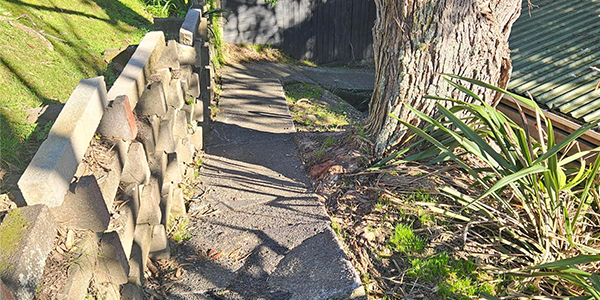
Devonport’s Blair Park Reserve prior to Porous Lane installation.
In Devonport’s Blair Park Reserve, Porous Lane was specified to resolve a common failure mode in urban footpaths: root uplift beneath mature pōhutukawa trees. A steep concrete path had become unsafe due to repeated cracking and displacement. Rather than excavating the root system or constructing a raised boardwalk, Porous Lane was installed directly over the roots. Its permeability allows water and oxygen to reach the tree, while the semi-flexible pavement accommodates future growth movement without reflective cracking. The 22-square-metre installation provides a compact test case for tree–infrastructure coexistence in constrained corridors.
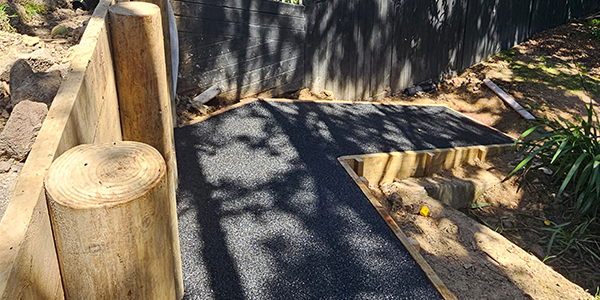
Devonport’s Blair Park Reserve after Porous Lane installation.
In Auckland’s city centre, Porous Lane is also being used as tree-pit surrounds on Mayoral Drive under continuous pedestrian traffic loading. Here, the system must deliver structural stability, slip resistance, abrasion performance and visual integration with surrounding asphalt finishes. Black Porous Lane has been selected to maintain streetscape continuity while enabling moisture and nutrient transfer to tree roots below. The installation supports canopy resilience and moderates surface heat accumulation in a high-radiation urban corridor.
Looking ahead, Watersmart is working with multiple councils and engineering stakeholders to transition Porous Lane from project-by-project specification into standard design toolkits.
"We’re rapidly moving past the 'early adopter' phase now," Olsen added.
"Engineers aren't just looking at this as a standalone product, they’re asking how it fits into the wider stormwater and public system. Over the next few years, we’re going to see Porous Lane become a standard part of streetscape renewals, transport corridors, and tree retrofits."
This article was supplied by Watersmart, one of our partners. While we are pleased to share insights from our partners, Engineering New Zealand does not verify all claims and does not endorse specific products or services.