
6 Mar 2026
Engineers are key players in the ongoing quest to find better ways of producing food and reducing waste in the sector.
Necessity is supposedly the mother of invention, but waste isn’t a bad catalyst for innovation either, particularly when it comes to food. Take the example of Auckland upcycling business Rescued Kitchen. Responding to the fact that 10 percent of all bread is wasted, the founders devised a solution to transform surplus loaves into bread flour, for use in baking mix, cakes and biscuits. Or consider the work of University of Auckland researchers to tackle horticultural byproducts. Led by Professor of Food Science Siew-Young Quek, the team, which includes researchers from Massey University and Malaghan Institute, hopes to transform unwanted fruit byproduct into bacterial cellulose, which can then be used to create new food products.
It’s not only about tackling waste. Fonterra, for instance, which is already one of the world’s most efficient dairy manufacturers, has embraced AI, robotics and automation to maintain its position.
As producers here and around the world grapple with the need to become more sustainable, efficient and productive, clever engineering solutions will only become more valuable.
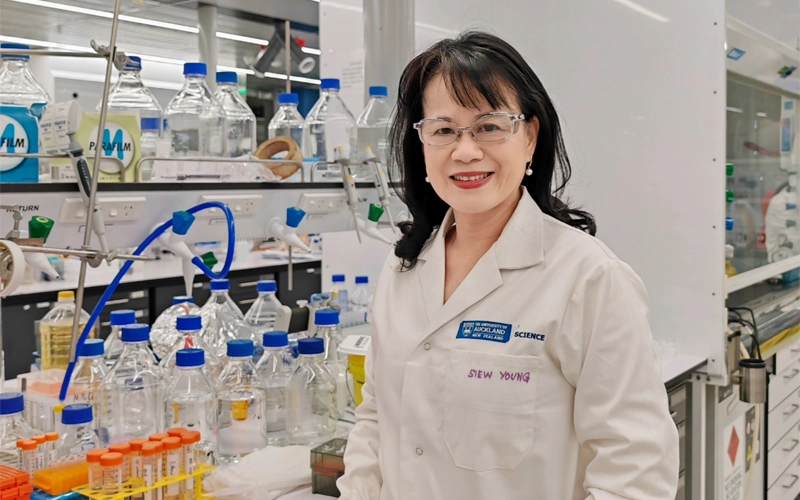
Professor Siew-Young Quek, Founding Director of the Future Food Research Centre. Photo: Fonterra Co-operative Group Limited
Siew-Young, who has a PhD in Chemical Engineering, is Founding Director of the University of Auckland’s Future Food Research Centre. A multidisciplinary body focused on “critical challenges in the future food space”, its research areas include bioactive and novel food ingredients, byproduct utilisation, and food processing and quality.
The latest is the abovementioned project involving horticultural byproducts. Funded by a three-year, $3 million grant from the Ministry of Business, Innovation and Employment, it includes a collaboration with colleagues at the Singapore Institute of Technology, and A*STAR, who are looking to develop novel high-value, nutrient-rich products from mushroom biomass. The New Zealand researchers, meanwhile, are focused on transforming unwanted byproducts from juice and wine industries into healthy new food products and nutrition-boosting ingredients to add to existing foods.
Siew-Young says sustainability is a pressing global issue and has received immense attention including in New Zealand, noting that 48 percent of our greenhouse gases come from agriculture. Reducing that carbon footprint must involve attacking agricultural byproducts. According to a Ministry for the Environment report, New Zealanders annually throw away or waste 1.2 million tonnes of food, 18 percent of which ends up in landfill, where it creates yet more methane. In the case of fruit and wine pomace or solid residue, 100,000 tonnes are thrown away each year, overburdening landfills, adding to emissions and polluting waters.
“We wanted to see how we could create value from that byproduct,” says Siew-Young, who is also Editor-in-Chief of Dutch publisher Elsevier’s Future Foods journal. The idea is to turn selected horticultural byproduct into bacterial cellulose, which can then be used to create new foods or food ingredients. In Singapore, meanwhile, the team is focused on using mushroom mycelium to create high-value food products. In both cases, the researchers are working with industry partners “… who can take our prototype in the lab and scale it up in their facilities”, says Siew-Young, who sees a crucial role for engineers in the future of food.
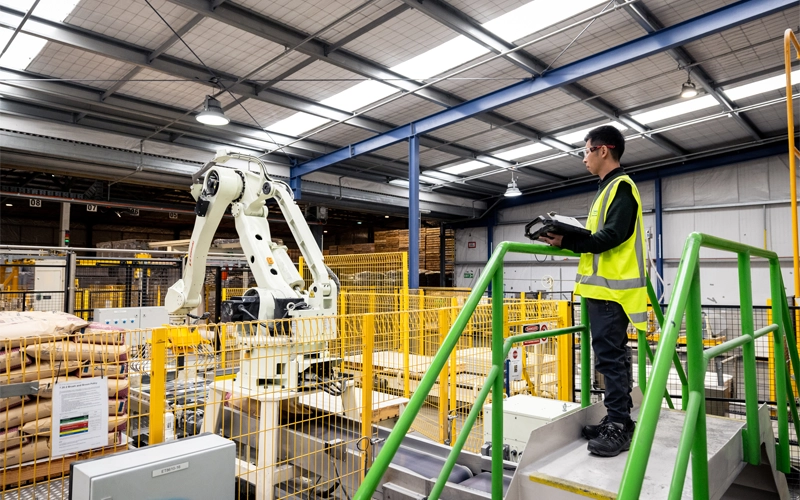
Fonterra’s manufacturing sites are highly automated. Photo: Fonterra Co-operative Group Limited
“For example, process engineers are involved in transforming byproduct into high-value ingredients via various processing methods. Mechatronic engineers can help in horticulture and food manufacturing through robotics and environmental engineers can design smart irrigation systems.
“Energy is another area where engineers can contribute to decarbonising the food sector. Engineers can do a whole lot.”
We use machine learning vision systems to inspect 66 million milk powder bags, reducing waste and downtime and maintaining product quality.
You’ll get no argument from Aaron Goldsbury MEngNZ, Chief Engineer for Fonterra.
“One of our key strategies is to be a leader in innovation, using technology to solve challenges and build on our competitive advantage,” he says, adding that clever engineering has been central to this. The farmer-owned Co-operative has been using robotics for more than 20 years. Fonterra’s 27 manufacturing sites around Aotearoa are highly automated, with advanced process controls that use machine learning to optimise product yield while remaining within product specifications. Aaron refers to Fonterra’s Eltham site, where cheese is processed on an automated high-speed slicing line. Elsewhere, the Co-operative operates the world’s largest milk powder driers, delivering the efficiencies of scale that give it a marketplace edge.
Fonterra has also embraced AI and related technologies. “We use machine learning vision systems to inspect 66 million milk powder bags, reducing waste and downtime and maintaining product quality,” says Aaron. He adds that Fonterra also uses AI to streamline digital processes across the Co-operative and its supply chain.
The innovation he’s most excited about, however, is Fonterra’s new Digital Maintenance Programme, which he says is cutting edge. “AI looks at the data that’s generated from our 650,000 assets. It brings together maintenance data, process data and engineering data to standardise and optimise what maintenance we do... It also looks at our maintenance information for those assets, such as planned maintenance activity and breakdown-type activity. It is constantly looking to improve how often and what kind of maintenance we do, and to predict failures before they can happen.”
And regarding energy efficiency, he says, “We’re using innovation to help achieve our decarbonisation strategy and reduce the amount of energy we use.” The Co-operative recently upgraded one of its refrigeration plants in Taranaki, installing an industrial-scale heat recovery unit.
Another food producer with engineering smarts is Canterbury’s Leaft Foods. Leaft’s hero ingredient is Rubisco, a highly concentrated protein extracted from lucerne that it sells as Leaft Blade, a liquid fuel shot for athletes. The company’s other major product is Rubisco protein isolate. An impressively functional ingredient, it foams, gels and emulsifies much like eggs or whey but with no allergens, making it potentially valuable for bakery products and the plant-based food sector. In 2025, the company announced a partnership with food ingredient import giant Lacto Japan, opening a door to the highly innovative Japanese food manufacturing sector. Leaft co-founder Maury Leyland is an Engineering New Zealand Fellow. CEO Ross Milne is a chemical and process engineer. The team includes a dozen engineers, and Leaft employs chemical and process interns during the summer.

Creamy emulsion of Rubisco protein isolate. Photo: Leaft
“We have a really strong engineering theme in the company,” says Maury. “We’ve always had that mindset of ‘how can we produce Rubisco in a way that is truly scaleable?’ In a lot of our early testing and innovation, for example, we pushed ourselves to use off-the-shelf equipment. Constraining ourselves to processes that can be scaled has been an enormous strength.”
The Lacto deal is a potential gamechanger for Leaft. It currently manufactures in a 30,000 square foot factory in Rolleston and has 100 hectares of crops grown for it by arable farmers in Southbridge.
“We’re looking ahead to building our next factory, which would be a big step up.”
First, however, there’s work to do. “For us, the job is to build up a pipeline of customers via Lacto, and in the US and New Zealand, working through the product development cycle with them and getting product into their hands,” Maury says. She notes that we are talking here about high-value exports.
“If you’re a truly functional protein, then you’re at a price point well above basic proteins. And that’s the key – to compete at the price point of eggs.”
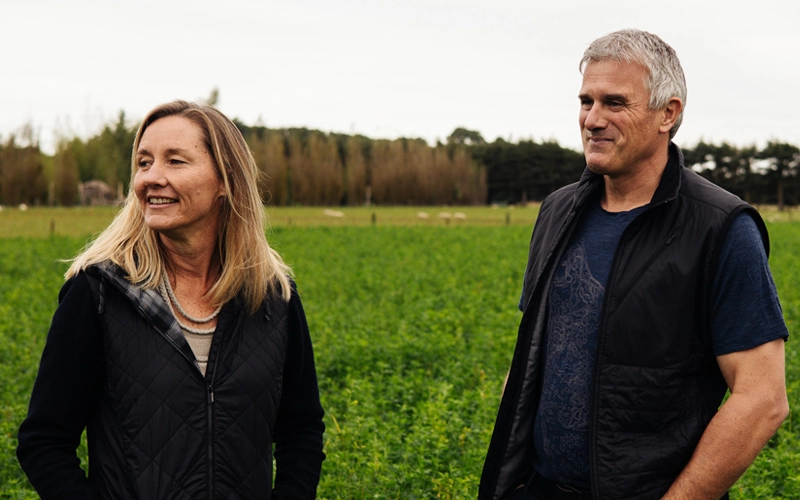
Leaft co-founders Maury Leyland and John Penno. Photo: Leaft
Fostering food innovation at school
To continue shaping the future of food, Aotearoa needs a strong, diverse science, technology, engineering and maths (STEM) pipeline. That’s why Fonterra has teamed up with Engineering New Zealand’s Wonder Project to co-found and sponsor its newest challenge for schools: the Ice Cream Challenge. It aims to inspire young Kiwis with the wonders of food science and encourage them to become the next generation of changemakers in the industry. In the Ice Cream Challenge, ākonga (students) discover the science behind this popular sweet treat. Across a school term, they experiment with flavour, texture and techniques, using dairy or alternative ingredients to create their own ice cream. Each school is given everything it needs to run the challenge, including an ice cream kit, ākonga activities, an online learning hub, a detailed challenge guide and a volunteer STEM professional to bring the magic to the classroom – and it’s all free. Following a successful pilot in 2025 across 51 classes, in 2026 the challenge will be released nationwide across 200 classes, promising fun, excitement and delicious ice cream, making STEM learning a little sweeter.
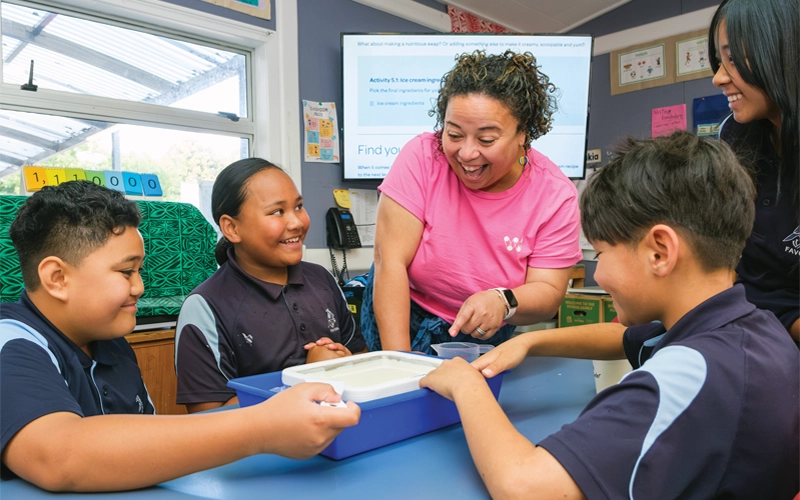
Ākonga at Favona School work with their Wonder Project Ambassador, Lisa Leilua from Fonterra, to create their own ice cream. Photo: Wonder Project
This article was first published in the March 2026 issue of EG magazine.