
19 Mar 2026
Engineering New Zealand Te Ao Rangahau is proud to showcase our newest Distinguished Fellows – engineers whose dedication and hard work have earned them our highest membership class. So how did they celebrate the news, what are their superpowers and what job do they look back on most fondly? EG reveals the person behind the accolade.
Find out more about our new Distinguished Fellows.
Jenny Culliford DistFEngNZ
Based in: Te Whanganui-a-Tara Wellington
Current role: I’m retired but continue to work with Engineering New Zealand as a chair of Disciplinary and Investigating Committees. I am also on the Board of IChemE in New Zealand.
Jenny sums up the work this Distinguished Fellowship recognises: Early in my career I participated in various activities promoting engineering to young women. This exposure led to further recognition and opportunities to contribute to the profession and work with a wide group of people and organisations outside of my consulting engineering job.
I celebrated the news of my Distinguished Fellowship by… making myself a cup of tea after a morning phone call from [Engineering New Zealand President] Jan Evans-Freeman. My husband John and I did share a bottle of good wine that evening.
I couldn’t have got here without… Sister Mary Bernard, the Principal of Sacred Heart College in Lower Hutt. She persuaded Hutt Valley Memorial Technical College to include me in their seventh form maths and additional maths classes after being turned down by two other nearby schools. She even had the nuns occasionally lend me their car, saving me a three-kilometre cycle each way.
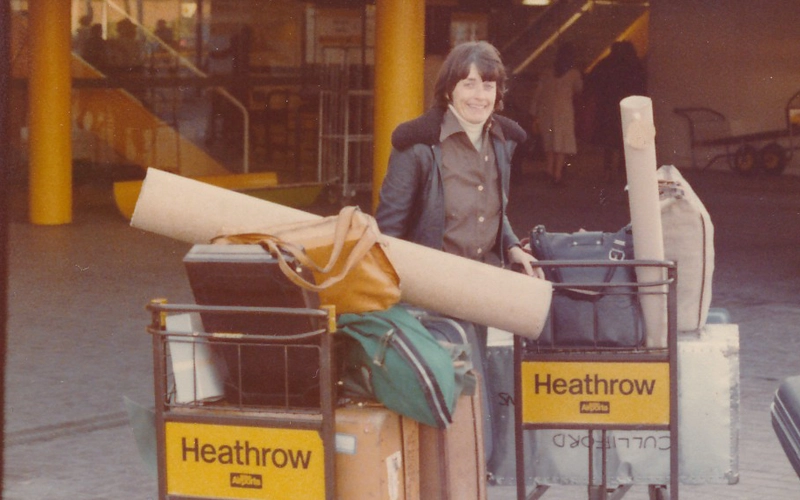
Jenny Culliford at Heathrow Airport in January 1979 after evacuation from Iran at the time of the revolution. Photo: Supplied
My hidden talent as an engineer is… a long-held interest in safety practices that was first kindled in the oilfields of Iran and led to several roles with safety responsibilities, both project- and operations-related, including a global governance role.
My first engineering-related paid job was… 60 days of practical work in the appliances division toolroom at General Motors in Lower Hutt.
The job I look back on most fondly is… being employed as a process engineer on a part-time basis by Morrison Cooper & Partners when we returned to New Zealand from the United Kingdom with two small children. I was later able to increase my hours gradually on my terms – this was unusual back then.
The most significant way my field has changed since I began my career is… in the tools used in design. Slide rules, cumbersome calculators and manual drawings have been replaced by highly sophisticated design tools.
My top piece of advice for early career engineers in 2026 is… be curious and embrace advances in technology. Be open to new opportunities. You have the tools and training to succeed in a rapidly changing world.
Stephen Jenkins DistFEngNZ CPEng IntPE(NZ)
Based in: Te Whanganui-a-Tara Wellington
Current role: Technical Director, Industrial Mechanical, Aurecon
Stephen sums up the work this Distinguished Fellowship recognises: Early in my career I was encouraged by my mentors to join Engineering New Zealand to support the profession. I became involved at a branch level then joined the Council as a seconded young engineer. I progressed through to the ACE New Zealand board and to a committee on the global International Federation of Consulting Engineers (FIDIC), becoming one of their accredited international trainers. Training young people to become professional engineers and competent consultants has been a large and rewarding part of my life – the world is short of good engineers.
I celebrated the news of my Distinguished Fellowship by… taking three deep breaths to recover from the thrill and then sharing the news with my wife.
I couldn’t have got here without… the teams I have worked with in New Zealand and around the world, the people who provided support for the service roles I took on, and role models in the profession who were so generous in their personal example, ethics, wisdom and advice.
My superpower as an engineer is… that the core of my engineering has always been the range of experience, my search for parallel knowledge and the ability to “join the dots of history”. I am a fan of the lesser-known histories of science and technology in areas of civilisation that are ignored or undocumented in standard engineering history.
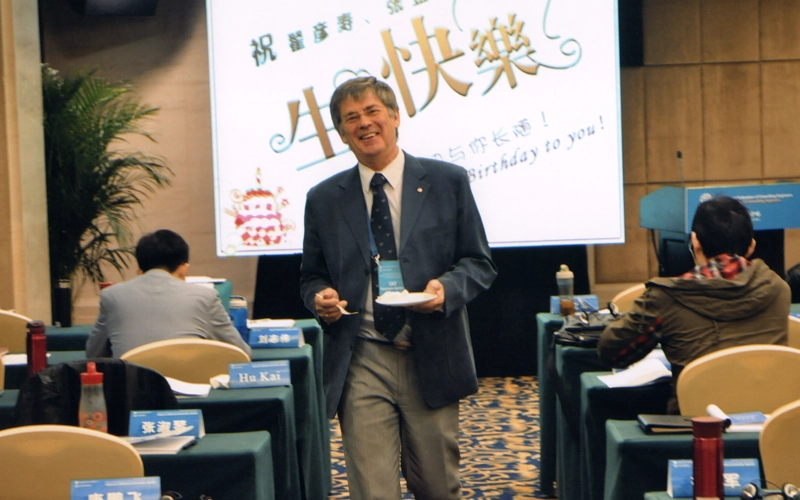
Stephen Jenkins celebrating a student’s birthday during a break in classes in China. Photo: CNAEC
My very first paid job was… washing pots in a commercial kitchen during high school.
The job I look back on most fondly is… not a job but a commission, given I have been at the one organisation professionally. It was presenting training to younger engineers in Korea, China and Papua New Guinea. Their enthusiasm, the friendliness of the people and the astounding contrast between the problems that we encountered as a learning team of tutor and students was the best educational experience of my life.
The most significant way my field has changed since I began my career is… that in my first work in engineering I spent hours learning how to print neatly on tracing paper drawings and to use the new drafting machines that were replacing the T-square and set square. Although I did little drawing, the briefing sketches had to be neat and clear and peak loads meant you were the back-up. Computer-aided design rather than just drawing has now become standard and has the capacity to standardise and make normal engineering somewhat boring in my view.
My top piece of advice for early career engineers in 2026 is… that a range of knowledge and experience is better (and more stimulating) than specialisation.
Mark Hedley DistFEngNZ CPEngNZ IntPE(NZ)
Based in: Tāmaki Makaurau Auckland
Current role: Senior Principal Engineer – Structures & Temporary Works, Downer NZ
Mark sums up the work this Distinguished Fellowship recognises: Temporary works is one of the most challenging but enjoyable fields of structural engineering. It has been very rewarding mentoring many new graduates, coaching them in the disciplines of temporary works and construction engineering, and seeing them prosper and succeed.
I celebrated the news of my Distinguished Fellowship by… experiencing astonishment and disbelief! I feel very privileged to work in a job that I enjoy and certainly wasn’t seeking recognition, but apparently, some of my peers and Engineering New Zealand thought differently and I am very humbled by that.
I couldn’t have got here without… the support of my wife and family – they have shared a large part of me with the engineering community. Also, the support of Downer, who has freely given me the time to lead and support the Temporary Works forum.
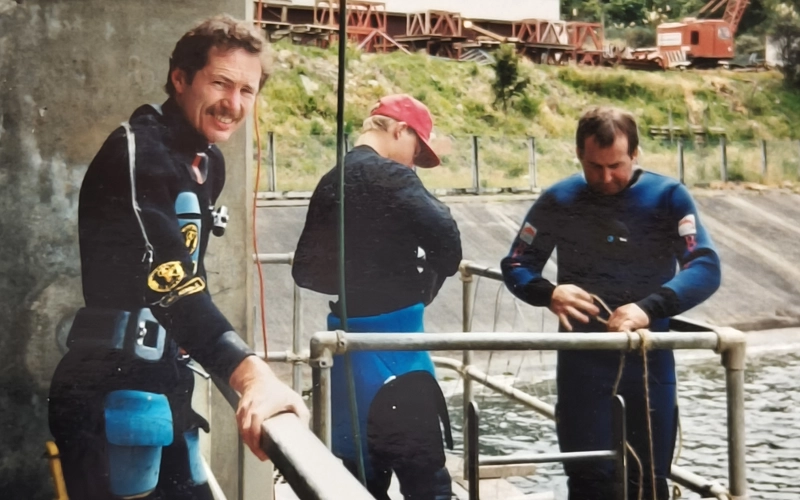
Mark Hedley worked as an engineer-diver from 1983–1998. Photo: Supplied
My superpower as an engineer is… my faith in God. Once I said to God that I would do anything He wanted – be a missionary – anything. His very clear response was: “Be the best engineer you can be, because from now on, you’re working for Me.” He has led me on a rewarding and satisfying path and given me the abilities I needed.
The job I look back on most fondly is… working as an engineer-diver on marine pipelines and hydro power stations for Brian Wilson Consulting Engineer. The upgrade of Tokaanu Power Station in the 1990s gave me the opportunity to both design complex pre-stressed concrete structures and oversee the successful underwater construction.
The most significant way my field has changed since I began my career is… developing good practice for temporary works. They are designed and built under pressure and urgency and it is inconvenient and costly to carry out the proper reviews, inspections and signoffs. The Temporary Works forum has been leading the New Zealand construction industry to a place where these disciplines are becoming normal.
My top piece of advice for early career engineers in 2026 is… Kia mataara – be vigilant. It was the motto from my old secondary school, Wairoa College. The best procedures, rules and check sheets cannot guarantee absolute safety because people, methods and equipment are continually changing. I urge engineers involved in construction to make regular site visits, be vigilant, and find trouble before it finds us.
Lisa Roberts DistFEngNZ CPEng
Based in: Tāmaki Makaurau Auckland
Current role: Independent consultant
Lisa sums up the work this Distinguished Fellowship recognises: I work with infrastructure-based organisations to improve asset management practices – though the title is misleading as it’s about delivering services through assets. I have a special interest in improving the resilience of critical infrastructure systems to disaster.
I celebrated the news of my Distinguished Fellowship by… I haven’t yet as I was too shocked – my mum celebrated more than me!
I couldn’t have got here without… Simonne Eldridge, a friend since university who helped me get into, and during, my first graduate engineering role. Warwick Busch, at (then) Worley-GHD, who gave me the opportunity to manage international, industry-leading asset management projects at a relatively young age. Also, Dave Brunsdon, a friend and mentor through my 25-year career in lifelines infrastructure.
My superpower as an engineer is… working on the edge, where engineering intersects with the rest of the world, and using my ability to bring together different people and experiences to deliver outcomes. One thing that drew me to asset management was that it intertwined engineering with many fields. Similarly, with “lifelines” I enjoy bringing together a wide range of perspectives to lift infrastructure resilience.
My very first paid job was… delivering newspapers. In relation to engineering, i had many labouring jobs on building sites during uni holidays – the job market was dire and proper intern jobs hard to find.
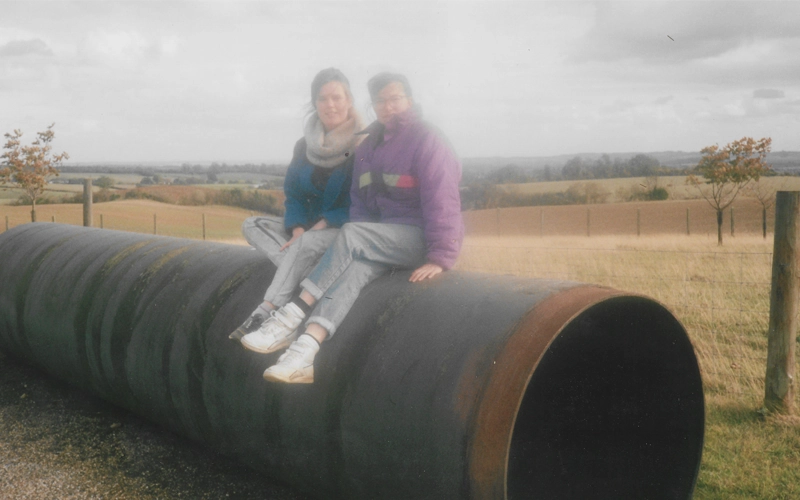
During first graduate job at Binnie and Partners: Ampthill to Sundon pipeline in UK with Simonne Eldridge, 1991. Photo: Supplied
The job I look back on most fondly is… chalet maid in a French Alps ski resort – the beautiful vistas of snowy mountains and the vin chaud to warm you up at a pause on the slopes (I’m blanking out the hours of laundry and cleaning toilets).
The most significant way my field has changed since I began my career is… its size and maturity. When I started out there was a small number of people working passionately to develop practices in this new field of asset management and another handful in lifelines engineering. Now they are mature, multisector industries.
My top piece of advice for early career engineers in 2026 is… don’t panic at the current job market – it will swing back again. If you can, find a graduate programme that gives you a broad grounding across multiple fields so you can find your niche. Engineering is a vast field of opportunity – if you stay curious and adaptable you’ll find your place.
Terry Kayes ONZM DistFEngNZ
Based in: Tāmaki Makaurau Auckland
Current role: Primarily retired, but still actively working with a range of people as a qualified mentor/coach.
Terry sums up the work this Distinguished Fellowship recognises: I’ve been recognised for what has been described by others as an extraordinary contribution to leadership in the engineering profession and for service to the community. I was Managing Director of Tonkin + Taylor for 17 years and have served on a range of engineering, community and local body boards. In my work I have sought to support and to grow others, which has included an extensive history of formal coaching and mentoring.
I celebrated the news of my Distinguished Fellowship by… sharing it with my wife and children.
I couldn’t have got here without… the incredible people I’ve worked with throughout my career. A major influence in my early career was Professor Peter Taylor, who was key to my choosing geotechnical engineering as a focus.
My hidden talent as an engineer is... listening, being curious and taking a genuine interest in others. My not-so-hidden talent is singing, and I was a professional singer as a member of the NZ Opera Chorus for 15 years.
My very first paid job was… as a school student, selling shoes at John Court Ltd in the two weeks prior to Christmas. My first construction job, as an engineering student, was early in the construction of the New North Road/Dominion Road interchange in Auckland. On day one I was assigned the task of digging the pit for the long drop toilet!
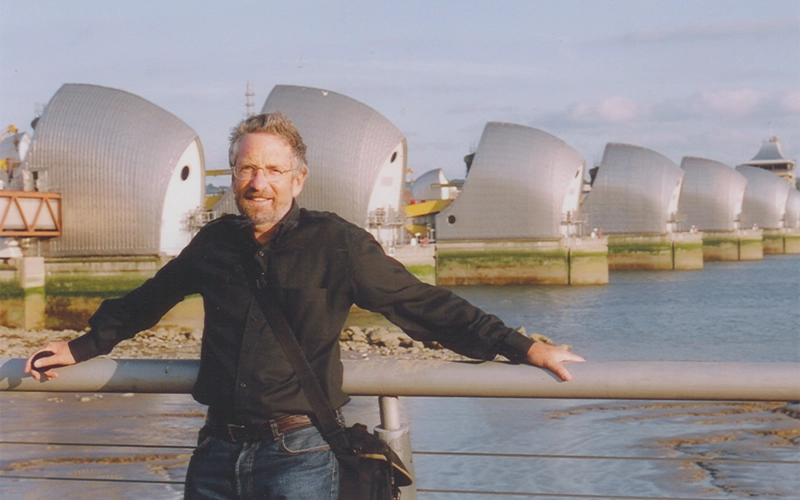
Terry Kayes overlooking the completed Thames Barrier, Woolwich, London. Photo: Supplied
The job I look back on most fondly is… when early in my career (in the early 1970s), I worked in London and was responsible for the site investigation for the Thames Barrier. I remain immensely proud of my contribution to that remarkable structure. Yet the role I remember with the greatest fondness is my time in leadership at Tonkin + Taylor. I learnt an extraordinary amount along the way, supported by others who helped shape both my growth and the culture we built together. At first I struggled to define the role, but I came to realise that conversation is the medium of leadership, and that talking with people – listening, exploring ideas, learning together – is real work. The relationships, the shared purpose and our collective achievements made that period immensely satisfying and deeply enjoyable. In the 1990s I was honoured to be appointed Honorary Consul to Malaysia, a role that came about from work connections in Malaysia
The most significant way my field has changed since I began my career is… the inclusion and contribution of women in the profession. For instance, the Engineering School (Ardmore) in my time was exclusively male – there was no accommodation or provision for women.
My top piece of advice for early career engineers in 2026 is… be curious, and if you are making a decision choose the option where you are likely to learn the most.
This article was first published in the March 2026 issue of EG magazine.