
16 Dec 2025
Engineers and animals cross paths more often – and in more places – than you might think.
While the Millenials and Gen Z might not be rushing to have children, when it comes to fur babies, they’re all in. The generations born between the 1980s and early 2010s are at the forefront of a rise in pet ownership, including in Aotearoa, where nearly two-thirds of households now include at least one pet. They are also spearheading a shift in the way we think about pets, who are increasingly treated as family members, to be fussed over and worried about, monitored and spoiled.
As a result, the global pet care sector is booming, with analysts predicting the current US$259 billion market will top US$427 billion by 2032. Today’s devoted “pet-parents” are spending big on products that didn’t exist until recently, the likes of GPS-enabled wearables and automated feeders with two-way audio and cameras. (Even if you’re at the office, you can still keep tabs on Fido!)
Engineers are involved in all of these innovations, as they are with the development and deployment of technology such as cow collars in the agricultural industry. Likewise, the engineering profession is playing a part in the rollout of more pet-friendly infrastructure around our towns and cities, such as paw-friendly panels installed on a new water pipe bridge in Wellington, making it more comfortable for dogs to walk across. All of which is to say that engineers are more involved in the world of animals than you might imagine.
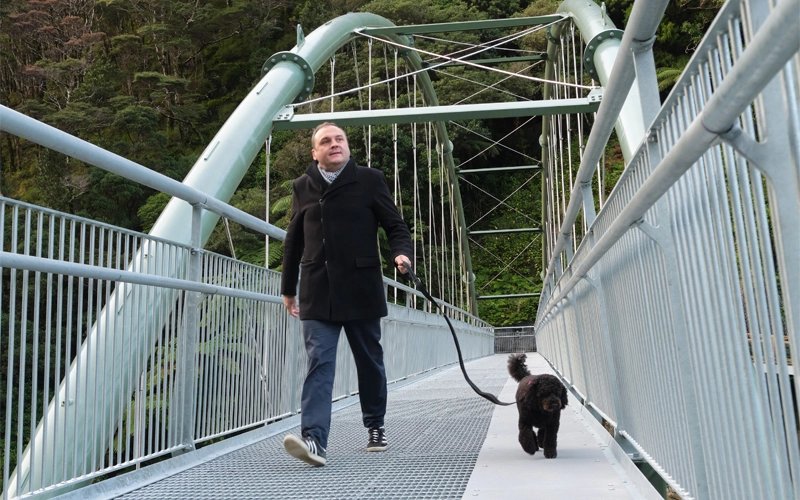
Wellington Water Board Chair Nick Legget and cavoodle Teddy testing the dog-friendly panels on the new Kaitoke water pipe bridge. Photo: Greater Wellington Regional Council
“We think of them as rescuers”
Carl Devereux CMEngNZ is one engineer whose role intersects with the animal world – in his case, very directly. As National Portfolio holder for New Zealand Urban Search and Rescue (USAR) Engineers, Carl and other engineer volunteers work hand-in-glove with the USAR dog handlers and rescue dogs when disaster strikes and buildings have collapsed or are badly damaged.
“We help the rescue teams to figure out the safest way to enter, search, locate and extract victims. We might say: ‘We think there could be someone at this particular location’, and then the search dogs can run over the site and, using their amazing skills and training, pinpoint where people are,” Carl says.
“We think of them as rescuers. And our job is to make sure that we are not going to put them or their handlers into an unsafe environment.
“They’re part of our team, and everybody has to come home safely.”
Carl had first-hand experience of these dogs in action following the February 2011 Christchurch earthquake, when he was part of the search and rescue effort.
“The first day is a blur, but I remember the days afterwards when there were still missing people and the dogs were used to search damaged buildings and collapsed building facades to confirm no one was trapped.”
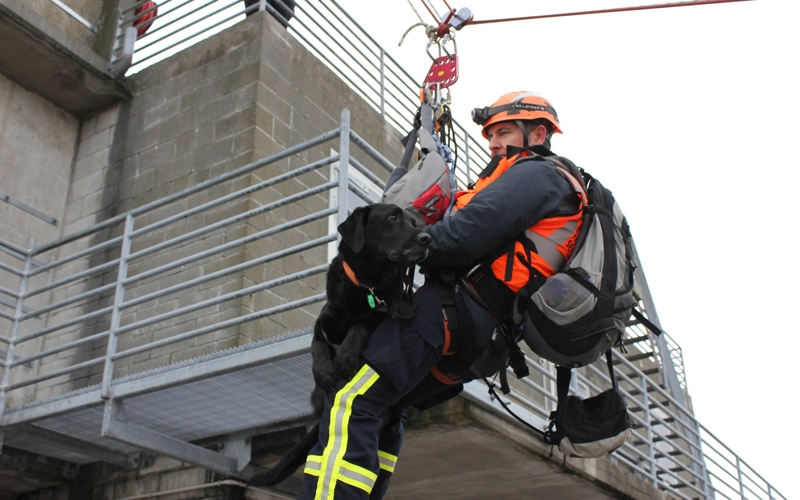
Dog handler John Appleby and retired advanced operational dog Monty abseil down a building during a training session in 2019. Photo: New Zealand USAR Search Dog Association
an amazing environment when you’re working alongside these highly trained rescue dogs. They put a smile on everyone’s faces.
Carl, Director Earth, Environment and Water for WSP, is one of a dozen engineers on the USAR taskforce. Most have a structural or geotechnical engineering background and a wide range of practical experience – 15-plus years is standard – as well as being team players who can operate under pressure. When not responding to disasters, they’re involved in USAR training, including designing “hide structures” and other simulations of disaster zones for rescue dog training.
“At times we’ve had to lower dogs in harnesses down to particular areas, and we also use rope rescue lines to access small spaces. That’s all part of the training, too,” he says, adding that it’s rewarding work.
“It’s an amazing environment when you’re working alongside these highly trained rescue dogs. They put a smile on everyone’s faces.”
Pet project
Putting a smile on everyone’s faces might be a theme when it comes to dogs. Proud pet parent Luke Mainwaring CMEngNZ is based in Tauranga and when he works from home periodically, he’s showered with love and cuddles from Bustah (Rhymes) and Snoop (Dogg). The Design Engineer Manager – Substations and Protection at Powerco was initially planning to get one dog.
“But then after a few months we thought we could benefit with another one, as Bustah was always wanting to play.”
It was an easy decision after seeing photos of Snoop, who was then just a puppy. But the two dogs are quite different.
“Bustah is the perfect model Beagle – his dad is on food packaging. Snoop has one blue eye and a kink in his tail and he’s a bit smaller than your average Beagle. Bustah is the sensible one and Snoop is the rebel!”
Luke says that having dogs at home is a great for reducing stress, going so far as to say it’s “the best investment in my health I could have possibly made”.
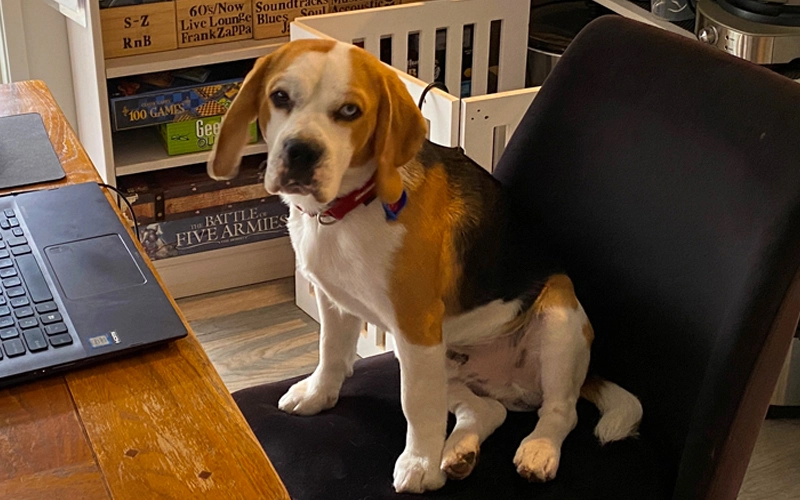
Snoop, one of Powerco engineer Luke Mainwaring's beagles, busy at work. Photo: Supplied
“Whenever you feel a bit down, things are complicated… you’re under pressure to deliver yesterday, you look down at the boys lying at your feet. They look you back in the eye and their little tails (that remind me of white flags) start to wag, and it puts everything into perspective, and you know no matter how things pan out, everything is going to be ok.”Principal Psychologist at Umbrella Wellbeing, Dougal Sutherland, agrees, saying there is good evidence to support the positive benefits of having a pet at home, at least for most people. And dogs, specifically.
“Having a good bond with your dog is linked to an increase in levels of oxytocin – sometimes referred to as the 'love' hormone – the same chemical that gets released when we have a long hug with someone we care about.”
Dougal says people often talk about the companionship that comes from having a dog at home and a reduced sense of loneliness for those who are by themselves during the day, such as remote workers. But fear not if you are a cat lover.
“Recent research showed some of these same benefits from pets of the feline variety!”
When it comes to taking pets to the office, Dougal says other dog lovers will receive a similar positive “hit” from having a dog around.
“And you can often see this when there is a dog in a public area – they are often magnets for people.”
But he does note that as not everyone loves dogs, particularly in an area they may not expect to see them, such as a workplace, it’s advisable to check your workplace policy and let colleagues know if you’re planning to bring in a pet.
Another day at the office
Dr Mark Foo CMEngNZ CPEng is Director of Q DESIGNZ LIMITED in Auckland.
He has two Shar Pei, Xin Xin and Bei Bei, who came into the office daily as young puppies, but nowadays visit once or twice a month.
Mark says the staff of 16 love the dogs and are very receptive to having animals in the workplace.
“Engineers often work under very stressful, tight deadlines and sometimes a funny dog incident at work will crack everyone up laughing.”
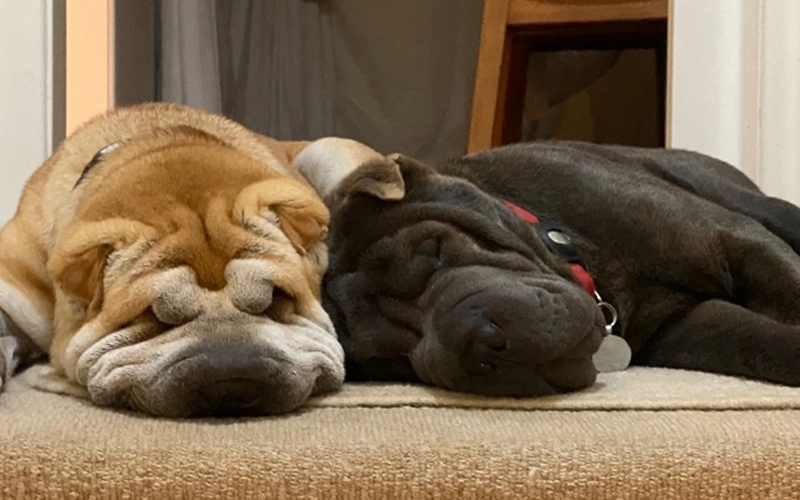
Shar Peis Xin Xin and Bei Bei. Photo: Supplied
Other staff members also bring in pets periodically, including a very young kitten who couldn’t be left home alone.
Mark says staff don’t have to ask permission to bring in pets, but they only do so if the pets need special attention and cannot be left alone at home.
“This culture allows the staff to focus on their work knowing that their pets are taken care of. The pets enjoy the visit and are not stressed being left alone at home.”
This article was first published in the December 2025 issue of EG magazine.