
Read about the inspiring dedication and achievements of Fellowship and Distinguished Fellowship recipients from the last three years.
Fellowship is an honoured class of membership, recognising the most highly experienced professionals who have made a huge impact on engineering in Aotearoa.
2025 Fellows and Distinguished Fellows
Distinguished Fellows
Dean Kimpton
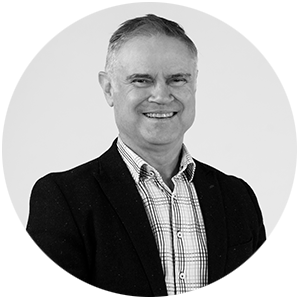
Dean is elected a Distinguished Fellow for his extensive work delivering and managing public-facing infrastructure in highly complex environments, most notably following the significant financial impacts on the public transport system of Auckland following the COVID pandemic.
In his role as Auckland Transport Chief Executive, Dean has focused on network productivity, redesigning AT’s structure to deliver exceptional service and increase Auckland’s trust and confidence in the organisation.
This work has involved tackling unexpected events as well as extending the organisation in directions necessary for collective growth. AT staff and contractors worked hard to repair roads across Tāmaki Makaurau following the 2023 Auckland floods and Cyclone Gabrielle, but also initiated carefully planned improvements to service delivery.
Dean’s approach has included work to strengthen community cohesion and increase belonging, introducing 100% bilingual announcements on the AT network, on buses, trains and ferries. Combined with bilingual wayfinding signage across the entire public transport, pedestrian and cycling network, this ensures te reo Māori is seen, heard, spoken and learnt, signalling the intention to create an inclusive environment for locals and visitors alike. This contribution to revitalising language reflects a continued commitment to a better future for Tamaki Makaurau Auckland, and Aotearoa NZ.
Dean is known for his leadership and organisational skills. He is often sought for director roles on boards, many of which he chairs, including QuakeCore, the Waka Kotahi Speed and Infrastructure Programme, the Auckland Eastern Busway Alliance, the Bay of Plenty Transport System Programme and the MBIE Building Advisory Panel.
Dean has served on the Board of Engineering New Zealand, including as President in 2018-2019. In that role, he championed diversity and was a key supporter of the launch of The Diversity Agenda.
Dean’s outstanding contribution to executive leadership and the wisdom demonstrated during recent challenges, warrants his election as Distinguished Fellow of Te Ao Rangahau, Engineering New Zealand.
Koia ra, e te rangatira!
John Duder
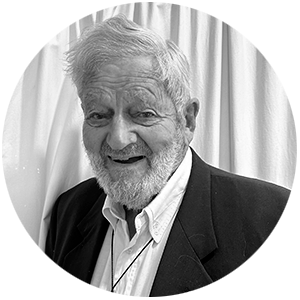
John Duder is elected a Distinguished Fellow for his long and extraordinary contributions to water engineering. John’s consuming passion for rivers, lakes and sea has resulted in a career that has traversed the globe, investigating and designing dams and control structures in some of the world’s most remote rivers and, more recently, work leading the restoration, protection and environmental sustainability of our endangered foreshores.
Following his early career with Sir Alexander Gibb + Partners, which included periods on the massive Mangla and Tarbela dams in Pakistan, and an irrigation project in the Niger River swamps, John returned to New Zealand as Gibb’s designer representative on the Tongariro Power Project. He then joined Tonkin + Taylor Ltd where he was involved in hydroelectric and river works in New Zealand, South East Asia and the Pacific, including the Aniwhenua hydro station in the Bay of Plenty.
In the 1990’s John was at the forefront of engineers responding to environmental change and was instrumental in setting up the NZ Coastal Society which then became a technical group of Engineering New Zealand. He is a life member and was recipient of the President’s Award for the society. He is also a life member of the Engineering New Zealand Sustainability Society. He has published over thirty technical papers, winning three Furkert Awards and three Arthur Mead Environmental awards.
Naturally, John’s other interests are water focused. He has been a Board Member of the Spirit of Adventure Trust and an inaugural Trustee of the R. Tucker (Tall Ships) Sail Training Trust. He has been heavily involved in the restoration and sailing of veteran yachts.
He is passionate about supporting and developing young engineers, having been convenor of the Ardmore Fund for University of Auckland Engineering students, and presenting to the engineering students and secondary schools.
His community activities have been wide reaching, having been Chair of the Devonport Community Board, Trust Board Member of Auckland War Memorial Museum, a Director of Watercare Services Ltd, and a member of the Dental Council Disputes Tribunal. He is a Justice of the Peace and in 2007 was made an Officer of the New Zealand Order of Merit (ONZM).
John has continued to work into his 80’s as a Recognised Engineer Dams and is an extraordinary role model, whose enthusiasm for responsible and sustainable use of our precious water resources is infectious. He is highly deserving of election as a Distinguished Fellow.
Martin Feeney
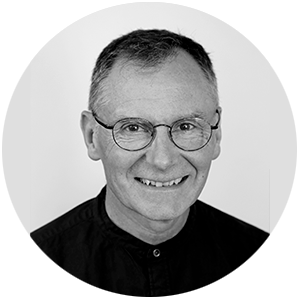
Martin Feeney is elected a Distinguished Fellow for his contribution to furthering fire engineering in New Zealand, both through his engagement in developing the practice and his leadership of ground-breaking projects. His career spans 40 years, most of it with Holmes, where he was a founding member of one of the longest established performance-based fire engineering teams in the world.
While Martin’s name is synonymous with fire engineering, few may realise he commenced practice in 1984 as a structural engineer, where he has also made significant contribution. During a period of secondment to HERA, he co-authored the 1995 Seismic Design of Steel Structures, at the time, one of the most advanced and influential seismic design guides in existence, much of which is still in current use.
During his time at HERA, Martin developed an interest in the performance of structures in fire and went on to complete a Masters in Fire Engineering. From there, he has gone on to become one of Aotearoa’s, and the world’s, acknowledged experts in structural fire engineering. He has written and presented many papers and spent countless hours contributing to the development of standards and guidelines that advance the state of practice. He was instrumental in developing IPENZ Practice Note 22, Documenting Fire Safety, a major step forward in clarifying the often-complex relationship between fire engineering and the other design disciplines. He continues to contribute widely through his roles in the Society of Fire Protection Engineers and other industry bodies.
Martin is a patient and committed mentor and supporter of young fire engineers, constantly called on for both formal and informal technical advice and assistance on all manner of project challenges. While Martin has incredible technical knowledge and decades of experience to draw on, it is his ability to distil technical concepts into readily understandable information that underpins his skills with the next generation of fire professionals. He supports them, challenges their thinking, and encourages them to consider different perspectives to open new options and opportunities. Despite his own commitments, he is always willing to make time to support less experienced engineers.
As a leader of his profession that has contributed selflessly to the advancement of his practice and the development of future leaders, Martin is a thoroughly deserving recipient of the title of Distinguished Fellow.
Peter Spies
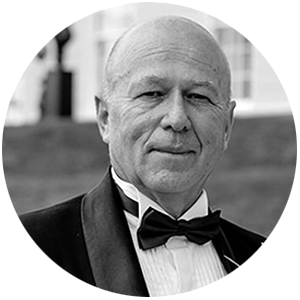
Peter Spies is elected a Distinguished Fellow for his significant leadership in the delivery of many of New Zealand’s largest infrastructure projects through the development of innovative forms of contracting and his role in their governance.
Peter gained his Bachelor of Science in Civil Engineering at the University of Natal in Durban, South Africa in 1985. Since then, he has worked in England and South Africa before reaching the shores of New Zealand around 27 years ago. Since 2009 he has been the Chief Advisor, Engineering at Waka Kotahi, New Zealand Transport Agency, procuring and delivering significant Roading infrastructure projects including Waterview Connection, the North Canterbury Transport Infrastructure Rebuild Alliance (Kaikoura earthquake) and the opening of Transmission Gully.
Peter is deeply respected throughout the industry by contractors, consultants and within his client company. He has an exceptional talent in bringing all parties together in a collaborative way even in particularly challenging situations. Peter is viewed as a calming pair of hands, particularly for projects that are facing complex challenges. Transmission Gully in particular is an example where he was able to move the project forward.
Peter is regarded as the person who transformed NZTA’s procurement style from one of “fixed price” contracts, which constantly resulted in highly litigious conflicts, to one of commercial collaboration through the development of contracting models such as Design & Construction alliances. Peter is a constant appointee to alliance contract boards and is known for his pragmatism, being a safe pair of hands, and his ability to take people with him. There are numerous examples where Peter has applied fairness in the allocation of risk on projects and in the assessment of who should carry that risk when things go bad, avoiding issues that have the potential to significantly delay projects and hike up their cost.
More recently he developed a fair settlement process for contracts frustrated through the COVID pandemic. His COVID contract solution model avoided substantial litigation which would have been costly and time consuming. The process was developed in a way that other key organisations including Watercare, Auckland Transport and numerous local authorities, faced with the same issues, were able to pick it up and immediately implement it, resulting in significant cost savings nationwide.
Peter is an accredited Treasury Gateway reviewer and has also been active on the University of Auckland Advisory Board which helps focus the training of our future engineers to support current and predicted industry needs. He actively mentors a range of engineers including graduates, colleagues, and through his executive management. He has shared his knowledge with major Australian infrastructure providers where his procurement and contracting models have been applied to key infrastructure projects including the Melbourne Level Crossing Removals Programme. Peter is a regular guest lecturer and is frequently recruited onto governance groups.
Peter’s key contribution to engineering is one of tangible value-add to New Zealand through the cost savings resulting from his procurement and contracting models and his ability to influence the governance of projects, resolving major disputes before they have significant impact. He is an excellent role model, he gets results, and he has positively influenced the way infrastructure is delivered; he is entirely worthy of the title of Distinguished fellow.
Fellows
Alexander Batten
Alex Batten has made significant contributions to geothermal engineering, advancing practices in geothermal technology assessment and deployment in New Zealand and internationally. He has also contributed to capacity building in the sector, lecturing at the Geothermal Institute and various NZ MFAT programs. His commitment to growing and diversifying the industry, especially in Southeast Asia, has enhanced the reputation of New Zealand engineering abroad.
Alistair Bennett
Alistair Bennett is a sought-after technical expert on concrete, including its development and design, carbon footprint reduction, and quality management and improvement. He has contributed to major infrastructure projects, such as the Mackays to Peka Peka Expressway, where his novel concrete mix design for high-risk bored piles is becoming widely adopted throughout New Zealand. Alistair has also contributed to advancements in concrete engineering through research, seminars, and involvement with a range of technical groups and committees, including the Concrete NZ Learned Society Council and the Readymix Technical Committee.
Andrew Langbein
With over 35 years of experience, Andrew Langbein has advanced foundation and retaining wall design across numerous commercial and infrastructure projects in New Zealand and the South Pacific. He has built a strong reputation as a reference consultant in piling design. Andrew is also dedicated to mentoring young geotechnical engineers, supporting their technical development through challenging and innovative projects.
Andrew Robinson
Andrew Robinson has extensive experience in business leadership, project development, and infrastructure management across private and public sectors. He has applied his expertise in programme and project governance to drive strategy formulation, infrastructure development, and business improvements, achieving revenue and margin growth through strong leadership and project execution. Andrew is highly skilled in client relationship management, risk management, and programme management systems, building teams with high levels of engagement and retention.
Benjamin Chester
Benjamin Chester has over 34 years of experience in infrastructure and civil works, specializing in the management and design of civil and drainage systems for large-scale infrastructure and transportation projects. Through extensive interdisciplinary project experience he has developed a deep understanding of various procurement methods. Ben’s comprehensive knowledge of process, timing, risk, and constructability has enabled him to navigate complex project challenges effectively.
Bruce Symmans
Bruce Symmans has over 30 years of engineering experience, progressing from geotechnical and water engineering to leading large, multi-disciplinary design teams of up to 400 people on complex infrastructure projects. He has served as design manager on nationally significant projects including the Aras Tunnel, Pukeahu Memorial Park, Chatham Islands Port redevelopment, Peka Peka to Otaki Expressway, Mt Messenger Bypass, and the transport rebuild on the East Coast following Cyclone Gabrielle.
Chantelle Bailey
Chantelle Bailey, whakapapa to Te Rarawa, Ngāpuhi, Ngāti Hāmoa, Lotofaga and Le'auva'a, iwi and villages. Her work is guided by the Samoan Proverb, “O le ala ile pule ole tautua” – the pathway to leadership is through service. She started her career in the RNZAF as a qualified aircraft technician and is now a high-performing governor and structural engineer. Chantelle is recognised for her technical excellence, strong cultural compass, and dedication to advancing social equity within engineering. She serves many communities, including Kāhui Ahumahi, Pacific Fono, and He Rau Aroha, and champions the importance of STEM pathways for underrepresented groups, particularly Māori, Pacific people, and wāhine, creating spaces for them to thrive in technical fields. Chantelle’s work balances technical, environmental, and cultural aspects, driven by her commitment to excellence, community service and the engineering profession. Strong support from her whānau and community, particularly her parents, husband and daughters was fundamental to her success.
Derek Chinn
Derek Chinn is known for balancing practicality and innovation, especially when engineering solutions for alpine environments. Derek has delivered large, complex projects that often require creativity. His most significant contribution has been a new approach to the design of alpine structures by using helicopter-transported panelised sections, simplifying construction and creating structures that are warmer, drier and safer. Derek’s alpine work is now regularly referenced by others, including being shared with Parks Canada. He is committed to the alpine community, undertaking volunteer engineering work for the New Zealand Alpine Club for nearly three decades and as a senior team member of the Queenstown Alpine Cliff Rescue team for sixteen years.
Glen Mitchell
Glen Mitchell is a Mechanical Engineer with 18 years of experience across asset management, maintenance, water infrastructure, mining, and industrial and commercial construction projects. He is recognised for his significant contributions to the engineering profession, particularly through his volunteer roles with Engineering New Zealand and other community groups. Glen is also acknowledged for his leadership in advancing and applying digital technology in the construction, built environment, and asset management sectors.
Glen Prince
Glen Prince has over 30 years of experience in the transport industry, working across both the private and public sectors on large infrastructure projects. As a project manager, he is committed to the health, safety, and wellbeing of the sector and its people and delivering "best for project" outcomes, focusing on quality, timely delivery and value for money. Glen is also dedicated to giving back to the industry, mentoring and coaching emerging engineering professionals. This has included supporting engineers through their professional registration and serving as a Practice Area Assessor.
Graeme Campbell
Graeme has made significant contributions to engineering, particularly in flood risk management, governance, organisational management, and technical expertise. As Convener of the River Managers Special Interest Group, he united regional councils across New Zealand to advocate for government support in flood risk management. For 17 years, he managed the Flood Protection Department at Greater Wellington Regional Council, leading engineering projects and programmes with an annual budget of around $80 million. Graeme’s expertise in flood risk management processes has earned him national and international recognition, establishing him as a leader in the field and advancing the profession with innovative techniques.
John Flood (Brian)
Brian Flood is a senior engineering leader and a Director at Woods, a land development company in Auckland. Under his leadership, Woods developed engineering systems and support that grew the company’s engineering staff to 140, with 40 holding CPEng registration. Brian has been instrumental in delivering infrastructure and residential projects, playing a key role in providing Auckland with over 10,000 new homes while ensuring sustainable growth.
John Leeves
John Leeves is a geotechnical engineer whose 30-year career is marked by inspirational leadership, innovation, and practical expertise. Initially a builder, John brought hands-on insights into engineering. His work includes serving on the Engineering Advisory Group after the Canterbury Earthquakes, providing geotechnical oversight for the Earthquake Commission, pioneering landslide remediation and ground improvement systems, and overseeing software development for the international humanitarian sector.
Joseph Bain
Joseph Bain has built a distinguished consultancy career focused on health and safety engineering, particularly in machinery safety and expert witness work. He has made extensive contributions to the profession, including founding and serving as officer of the New Zealand Society for Safety Engineering, and representing Engineering New Zealand on the board of the Health and Safety Association of New Zealand.
Kenneth Elwood
Kenneth Elwood has significantly contributed to advancing seismic design and concrete building assessment, particularly through his work developing guidance and standards for earthquake resilience. His career exemplifies a dedication to bridging research and engineering practice, balancing technical rigour with practical policy application in earthquake engineering.
Kyle Christensen
Kyle Christensen has dedicated his career to improving New Zealand’s resilience to flood hazards, with his recent work on Cyclone Gabrielle’s impacts in Hawkes Bay marking a career-defining contribution to flood management. In addition to his technical achievements, Kyle has served as a leader and administrator within The Rivers Group for 15 years and has held an independent directorship at Utilities Disputes Limited for six years, where his guidance has been influential in the field.
Dr Martin Gribble
Martin Gribble has made substantial contributions to the engineering industry for over 20 years as a leading pavement engineer. A career highlight has been his work as the lead author on the New Zealand Guide to Pavement Evaluation and Treatment Design, which informed and improved the pavement design approach used throughout New Zealand. Martin has historically published research, regularly presents at conferences and has made significant contributions to many large and complex roading projects.
Melanie Muirson
Melanie Muirson, a Chartered Professional Engineer with over 28 years in road safety and transport engineering, is dedicated to creating safe, efficient, and inclusive transport solutions for all users. Her expertise is highly valued by central and local government agencies, and she actively contributes to industry training and development, fostering the growth of the next generation of engineers.
Michael Hannah
Michael Hannah has made substantial contributions to stormwater management as the founder of Enviropod and Stormwater360, dedicating 30 years to advancing stormwater management practices in New Zealand and internationally. His career focuses on pioneering innovative technologies and promoting environmental stewardship through education and community engagement, inspired by the guidance of mentors and colleagues and driven by the belief that innovation and awareness are essential to addressing environmental challenges.
Michael O'Halloran
Michael O’Halloran has extensive experience delivering complex transport infrastructure and advising on major projects for New Zealand’s key transport agencies. He has served as National Transport Chair for the Association of Consulting Engineers, fostering trusted relationships within the profession, and is committed to advancing equity, diversity, and inclusion in engineering.
Nigel Stevenson
Nigel Stevenson began his engineering career with an electrical apprenticeship in 1986 and has since developed extensive expertise in industrial electrical and control systems. As the founder of Neo Engineering Consultancy, he has built a team known for its excellence in electrical engineering and is deeply committed to mentoring and inspiring the next generation of engineers through meaningful project opportunities and strong leadership.
Peter McCarten
Peter McCarten has over 40 years of experience in civil and structural planning, design, and asset management. He has made extensive contributions to the design and promotion of flood and earthquake resilient infrastructure for New Zealand and south-east Queensland. His expertise in structural asset management is reflected in his research and over 20 international papers focused on client outcomes, bridge engineering, and public safety. A dedicated advocate for mentoring and the engineering profession, Peter has served on professional and technical committees for nearly three decades.
Pierre Malan
Pierre Malan began his geotechnical career with numerical analysis for a major dam rebuild in New Zealand, followed by working on several significant design/build roading projects in the UK and Ireland. Returning to Tonkin + Taylor New Zealand, Pierre contributed to a wide range of projects, including linear infrastructure, large storage tanks, and land development. Pierre has made notable contributions to New Zealand Geotechnical Society, the development of the liquefaction vulnerability framework for the Earthquake Commission following the Christchurch Earthquakes and through his ongoing involvement in natural hazard work.
Raymond Hedgland
Ray Hedgland is an environmental engineer with over 50 years of experience in wastewater technologies, contributing to numerous projects in New Zealand and overseas. He has been a leader in the development, adoption, and refinement of innovative technologies, including large-scale centralized infrastructure such as milliscreen technology, wetland treatment, decentralised wastewater treatment systems for small towns and on-site wastewater systems. His work has also included several New Zealand Aid projects in offshore jurisdictions. Throughout his career, Ray has made significant contributions to knowledge sharing, presenting numerous technical papers on wastewater topics at national and international conferences.
Sarah Dye
Sarah Dye is a Principal at Beca and Alliance General Manager of Te Aranga Alliance, with a technical background in three waters infrastructure. She has played key roles in the successful delivery of major infrastructure programmes in New Zealand and the UK. Known for her collaborative and inclusive approach, Sarah brings people together to solve problems and deliver better outcomes. She is also committed to mentoring young engineers, particularly women, and serving as a positive role model for the next generation.
Shirish Paranjape
Shirish Paranjape is a Senior Associate in the Industrial team at Beca, where he leads the Electrical, Instrumentation & Controls team in Christchurch. Known for his cross-cultural approach to business, Shirish values building long-term relationships with clients. He mentors Chartership aspirants, especially those going through the knowledge assessment process. Shirish is actively involved in the community, serving as a board member or trustee for several not-for-profit organisations, a Justice of the Peace and an elected member at the Christchurch City Council.
Sisira Jayanatha
Sisira Jayanatha is a Chartered Professional Engineer with over 25 years of experience in water infrastructure projects across New Zealand, Australia, Zimbabwe, Malawi, and Sri Lanka, including two major PPP projects in New Zealand. In May 2022, he joined PDP as Technical Director for Water Infrastructure, where he focuses on developing the water infrastructure business in Wellington and providing design and technical leadership for civil and water infrastructure projects. His expertise includes three waters infrastructure master planning, optioneering, design development, leading tender evaluations, construction monitoring, and contract administration as Engineer to the Contract.
Stan Schwalger
Auimatagi Stan Schwalger grew up in Samoa and hails from the village of Malie. He is a Civil Infrastructure manager and engineer with over 35 years of experience in the construction sector across New Zealand and the Pacific. He considers himself a facilitator of improving the well-being of Māori and Pasifika communities, not only through the projects he delivers but also through supporting and mentoring engineering students, graduates and professionals.
Stephen Raynor
Stephen Raynor is posthumously recognised for his global career spanning academia, consulting and business management across eight countries. Known for his diverse engineering expertise and commitment to applying science for societal benefit, Steve was an expert in natural hazard resilience and made significant contributions to Tauranga's many resilience projects. Driven by curiosity and lifelong learning, he actively engaged with technical, business and community groups. A valued teacher and mentor, he inspired engineers through his dedication to turning research into action and advancing practical solutions.
Timothy Haig
Tim Haig has used his civil engineering skills to deliver significant transport projects in the Bay of Plenty, from feasibility through to construction completion, leading to improved community wellbeing, road safety, and economic development. He is proud to have done so sustainably, mindful of the potential environmental impacts of large infrastructure projects.
Tyrone Newson
Tyrone Newson, raised in Kaitaia and of Te Rarawa, Ngāti Kahu, and Tongan descent, has a passion for using engineering to benefit Māori and Pasifika communities. He co-founded SPIES in 1992, worked on Pacific Island engineering resources, and later became Director and CEO of Te Puna Topu o Hokianga Trust, co-founded SPPEEx and became a Chartered Professional Engineer. After a decade abroad, he led major projects for Te Rarawa, including a $3M water reservoir and a $29M subdivision. As CEO of Ngāti Awa Group Holdings, Tyrone continues to integrate engineering with Māori knowledge for community success.
Warwick Prebble
Warwick Prebble has been a passionate teacher and communicator of engineering geology for over 50 years, with his graduates now holding senior positions globally. He has received all of the premier accolades of the NZGS, including the NZ Geomechanics Lecture, the Geomechanics Award, Life Membership, and the Australian Geomechanics Society’s Poulos Lecture. Warwick was Vice-President representing Australasia on the Executive of the IAEG from 1995 to 1998 and has contributed to the profession through roles on various boards and committees, including the IAEG Bulletin Editorial Board, the Geohazards Working Party of the Geological Society of London, and the IAEG Commission on Teaching and Training in Engineering Geology. He was instrumental in the establishment of PEngGeol and has contributed to the profession through nearly 120 research publications. Warwick was awarded a Distinguished Teaching Award from the Faculty of Science at the University of Auckland, for sustained teaching, field teaching and graduate supervision in Engineering Geology.
Wei Qi Yan
Wei Qi Yan has made a long-standing impact on AI through his academic research and engineering education. Dr Yan has published over 300 refereed publications, including monographs, and created new university courses, training computer engineers for New Zealand. He has significantly contributed to New Zealand by organizing international conferences and advancing deep learning and computer vision.
Zaid Essa
Zaid Essa, originally from Iraq, has over 25 years of experience as a Civil and Transportation engineer. He has worked across various sectors, including consulting, contracting, government, and military, delivering major infrastructure projects. He has been volunteering with SIGIE and supporting international engineers in New Zealand since 2009, becoming one of the first two Lifetime members of the group. Currently, he is the Senior Programme Manager for Kāinga Ora – Homes and Communities – Urban Development and Delivery, supporting large-scale projects in the Infrastructure Programme and Funding team.
2024 Fellows
Distinguished Fellows
Barry Brown
DistFEngNZ, BSc(Physics), BE(Hons), MSc Eng(Lond), DipIC, IntPE
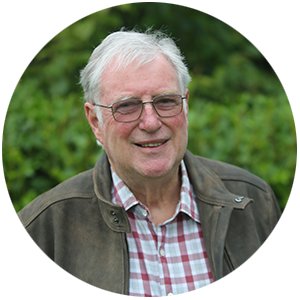
Barry Brown is elected a Distinguished Fellow of Engineering New Zealand for his extraordinary contributions to technical and executive leadership especially in the fields of structural and seismic design. He has made a huge contribution to the development of standards and practice documents over many years as well as demonstrated exemplary leadership in challenging times for the profession.
Barry gets things done. He was the inaugural Chair of SESOC from 1988 at a time when the building industry throughout New Zealand was needing direction and support to respond to the 1987 financial crisis. He was also elected to the IPENZ Council Board from 1986–1992 where he strongly promoted the development of the structural technical group as a truly national body. For his achievements he was made a life member of SESOC and continues to be an enthusiastic contributor to SESOC’s activities, most recently in 2022 leading the SESOC Task Group responsible for the development of the GD#0-GD#3 - Guidance Document on Grouted (Drossbach etc) Connections in Precast Concrete.
From 1988–1990, he was the convenor of a working group of NZIA/IPENZ/ACENZ which (amongst other things) developed the ‘Producer Statement’ concept and made submissions to Government on the Building Act 1991, where many of that group’s concepts were incorporated in the subsequent legislation. In 2001, he was appointed by government to chair the Building Industry Authority (BIA) and in that role was a leader in steering the profession through the testing issue of watertightness of buildings, helping to restore confidence and develop solutions.
Barry was an immediate respondent following the Canterbury Earthquakes and immersed himself in supporting the recovery team that was mobilised in response to that event. This included both technical roles as well as attending to the wellbeing of engineers impacted by this disaster. He was appointed to the Technical Advisory Board for the Earthquake Recovery established by MBIE and was the SESOC representative on the Engineering Advisory Group which prepared technical guidance documents for the repair and reconstruction works.
Barry has spent most of his professional career with Fraser Thomas Ltd where he led the structural team and for several years was Managing Director. His advice has been widely sought, including for forensic assessments of both structural issues and broader engineering matters, an example being his widely applied research on effects of expansive soils on residential foundations in New Zealand.
Barry is a mentor to his team and is a point of reference for a much wider group including his long association extending back to the establishment of HERA. He has also been a key contributor to New Zealand Concrete and Steel standards as well as related codes of practice. His contributions to the engineering profession and sustained leadership roles have been recognised by the MacLean citation awarded in 2005 which acknowledge his contribution to Building Control in New Zealand.
Outside of work, Barry has been a tireless supporter of rowing in New Zealand where he has served as Chair of the Auckland Rowing Association (ARA). His involvement has been recognised by ARA Life Membership Rowing New Zealand and service awards.
Barry is highly approachable and generous with his time. He constantly seeks opportunities to promote use of best practice and focuses on benefits he can contribute to the engineering profession and wider community. He is an excellent role model and is highly deserving of recognition as a Distinguished Fellow.
Don Cleland
DistFEngNZ, BTech(Hons), PhD
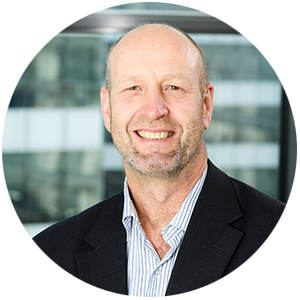
Donald John Cleland is recognised as a Distinguished Fellow of the engineering profession.
Mā mua ka kite a muri, mā muri ka ora a mua. Those who lead inspire others to follow, those who follow bring vitality to the contribution of those who lead.
Don emulates the sentiment of this whakatuakī on many levels as an internationally acclaimed academic, an entrepreneur, an innovator, and as a champion for uniqueness and diversity.
Don led the School of Engineering and Advanced Technology at Massey University, is a theme leader in the Science for Technological Innovation National Science Challenge, and in 2018 chaired the Performance-Based Research quality evaluation for technology, engineering and architecture. This later role included ensuring the even-handed evaluation of every engineering academic, requiring the highest standards in ensuring all were treated fairly and equitably.
Don’s achievements have included the entrepreneurial flare to transform the world-leading research of his team into advice and methodologies for use by industry practitioners and innovating the seed grant portion of the National Science Challenge (20% of all the grants). Don was a strong supporter in the Challenge’s focus on Vision Mātauranga and promoting the opportunity for Māori to lead technological innovation of direct benefit to Māori from research to commercialisation. This recognition of the unrealised potential and unique contribution that Mātauranga Māori could make when tailored to the unique Aotearoa New Zealand context led to a range of engineering research advancements.
Don is an inclusive and open leader who seeks optimum outcomes via a collaborative approach, creating a strong collective culture for achievement. Don’s role in supporting Māori innovation has widely benefited the profession and required fortitude in the face of, at times, tempestuous resistance. Don’s advocacy for promoting women within engineering and early career researchers has been equally strong.
Don is a world-renowned expert in industrial and commercial refrigeration engineering, an area impacting the lives of virtually everyone, both directly and indirectly. His work has received significant international accolades recognising the eminence of his research and its practical engineering application to the combined interdisciplinary arenas of food refrigeration and energy-efficiency. Don’s contributions have helped the national refrigeration industry evolve to less-harmful solutions as ozone-depleting and greenhouse-causing refrigerants have been restricted and phased out. These contributions have had significant impacts on the refrigeration industry and its viability in times of great change.
Don collaborates and shares his expertise to increase efficiencies in refrigeration technology worldwide. He is a leader who gives of himself and shares unreservedly. Refrigeration engineering is a close community, and he stands out in that community for his collegiality.
Don’s eminence is in his international research contribution, his mana in the refrigeration industry and profession, his promotion of the unrecognised potential offered by Mātauranga Māori, and his sustained leadership contribution as an inclusive and empowering leader. It is these attributes that clearly qualify his promotion to Distinguished Fellow.
Rob Jury
DistFEngNZ, CPEng, BE(Hons), ME(Cant), SESOC (Life), NZSEE (Life)
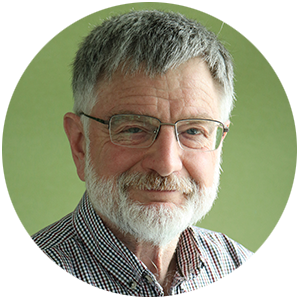
Rob Jury is recognised as a Distinguished Fellow for the outstanding contribution he has made to the oversight and practice of seismic engineering both within New Zealand and internationally.
His work has made significant advances in the understanding and application of appraisal and design techniques across a wide range of infrastructure, industrial and commercial projects. He has also contributed to the structural design of some of New Zealand’s iconic structures, such as SkyTower and the Hāpuawhenua Viaduct.
Rob’s expertise in earthquake resilience is widely sought within New Zealand and internationally for his involvement in major infrastructure and building projects. His advice is sought and respected in all aspects of structural and earthquake engineering where he has led the revision and adoption of the seismic components of the New Zealand Building Code.
That work and its clear understanding of the over-arching philosophy of “earthquake resilience” in existing and planned buildings has been especially important following on from the Christchurch and Kaikōura earthquakes and is recognised internationally as enabling a realistic balance between performance and safety.
Rob is Beca’s chief structural engineer, where he leads the work of more than 400 structural engineers. Most of all, Rob has been a crucial member of the groups revising the New Zealand earthquake building codes over the last 30 years.
Throughout all his professional career, Rob has contributed enormously to the vital technical committees and specialist study groups that have developed New Zealand’s standards and guidelines for the design and resilience of structures to earthquakes, noting that in New Zealand, the lead in these is taken by the private sector rather than by government or academics. His work in seismic engineering widely benefits the profession and the public. He is a leader and critical part of New Zealand’s best practice in seismic engineering. He has a particular ability that allows people to contribute and debate, leading the collective to joint decision making. As a leader in his field, Rob is always focused on best practice and good engineering science in seeking out and achieving the optimal overall outcome for the community, thus making him a worthy recipient of promotion to Distinguished Fellow.
Sulo Shanmuganathan
DistFEngNZ, CPEng, PhD, CPEng(AU), CEng(UK), FIEAust, FICE, FIStructE, MInstD
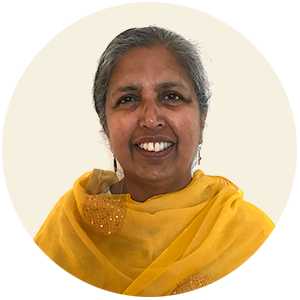
Dr Sulojana Shanmuganathan is recognised as a Distinguished Fellow for her contribution to furthering engineering practice, particularly in structures and large complex engineering projects in New Zealand, the United Kingdom and Australia.
Sulo’s academic life began with a Bachelor of Science in Civil Engineering from the University of Peradeniya in Sri Lanka in 1987, followed by a Master of Science in Structural Engineering from the University of Dundee in Scotland in 1990, completing a PhD in Structural Engineering at Nottingham Trent University in the United Kingdom in 1995. The global theme continues in her professional life with over 30 years’ experience in significant executive, technical and governance roles with major consulting companies in the United Kingdom, Australia and New Zealand, including Beca and WSP, as well as eight years in research and academia.
In her current role as Chief Engineer with Waka Kotahi, Sulo applies her deep technical knowledge, governance and project experience to challenge current practice in the Transport Sector. She is a leader in the industry towards a sustainability rethink with renewed interest in the use of timber in bridge construction, and pushing beyond just rebuilding post weather events to how we can rebuild more efficiently, saving both cost and time. In this role Sulo exhibits her personal commitment to the evolution of our community as she navigates and leads the industry through some of the greatest challenges in the transport sector.
Sulo is a Fellow of Engineers Australia, Institute of Civil Engineers (ICE), IStructE UK, and a Fellow of Engineering New Zealand. She has authored over 30 technical papers, contributed to numerous technical manuals, and is frequently an invited speaker at international conferences. She has received many awards and scholarships for structural, seismic and rehabilitation projects.
In Sulo’s own words “since becoming a fellow, it’s been my time to contribute” which has manifested in her involvement with Engineering New Zealand, serving on the Competency Assessment Board, representing Engineering New Zealand on the International Review Team for the APEC Engineer Agreement with the Council of Engineers of Thailand, advising and assessing various complaints, reviewing Terms of Reference and application processes for Fellow and Distinguished Fellow, serving as a Quake CoRE Board Member, and continuing to be an active participant in the Diversity Agenda and with Women in Engineering. She continues to be active globally as Associate Editor of “Civil Engineering”, the ICE journal and co-chair of their special issue on COVID, she is on the judging panel for IStructE annual people and papers award, and as invited keynote speaker in India and the UK.
Sulo is described as someone who is unassuming and humble but clear on boundaries. This strong moral and ethical compass coupled with her deep technical prowess has built her reputation within the industry as a role model in design and construction. She actively mentors and grows engineers, supporting them in their careers across all disciplines. She has tackled highly sensitive and challenging situations through her ability to open up the conversation and bring people together to tackle hard issues constructively.
For her achievements and significant contribution, Sulo is awarded Distinguished Fellow of Engineering New Zealand.
Fellows
Alan Colin Brent
FEngNZ, BEng, MEng, MSc, MPhil, PhD, CMEngNZ
Since moving to Aotearoa in 2017, Alan has made significant contributions towards a just transition to a net zero carbon emissions economy with energy-focussed research efforts, new education programmes, and service to the engineering profession. He is a highly cited researcher with over 300 publications in the field of sustainability. Alan has introduced a new major, a specialisation, and a postgraduate programme in renewable energy in the Wellington Faculty of Engineering at Victoria University. His efforts in The Sustainability Society and the energy community have helped to foster sustainability thinking in the profession, and the wider society.
Albert Bifet
FEngNZ, PhD
Albert has made notable contributions to ICT engineering research, particularly in the fields of AI and data science, with over 200 peer-reviewed publications and more than 20,000 citations. He has adeptly applied his technical knowledge to primary industry engineering applications and has achieved significant outcomes in the telecommunications and environmental sectors. Furthermore, he played a pivotal role in founding New Zealand's AI Researchers Association. Albert is also a dedicated engineering educator, having developed and taught a diverse range of ICT engineering courses and successfully guided PhD students through to their graduation.
Alexander Macleod Chisholm
FEngNZ, BEng(Civil), CMEngNZ
Alex has 35 years’ experience in civil and structural design and has spent the past 24 years serving communities in the Central North Island of Aotearoa through his work for GHD. In particular, he has made significant contributions to flood emergency responses, recoveries and rebuilds, and earthquake assessments and strengthening. He has built strong and resilient relationships with clients, contractors and local community groups. Alex is a key local member of a long-term Defence Alliance, representing GHD at Linton, Ohakea and Waiouru in a variety of construction projects. He has also recently completed three years as Chair of the Manawatū Branch of Engineering New Zealand.
Andrew Peter McMenamin
FEngNZ, BEng(Hons), MEng, CMEngNZ, CPEng, CEng MICE
Andrew has demonstrated exceptional service to the profession, having spent the last ten years as a Chair of Investigating and Disciplinary Committees. Andrew has played an important role in upholding the integrity of the profession and preserving public trust in the engineering community. Andrew is technical leader of GHD’s bridges and structures group. His leadership is seen in his prominent role in diversity and inclusion initiatives in GHD as well as his role in GHD's programme targeted at early career professionals, through challenge delivery and mentoring.
Azam Khan
FEngNZ, CPEng, MInstD, IntPE(NZ)
Azam is an environmental engineer with over 30 years of experience in the wastewater field. He’s also a specialist environmental consultant to the New Zealand food and fibre sector.
Azam’s career began as a Research Engineer involved in treating meat industry wastewaters prior to joining PDP in 1996. Since joining PDP, he has assisted in growing the three waters business to a strong team of 75 professionals. He has also developed patented wastewater treatment system processes.
Azam is now a Technical Director and an Executive Director at PDP, contributing to developing solutions for a range of environmental challenges.
Willem Bastiaan Kleijn
FEngNZ, FIEEE, FRSNZ, PhD (TUDelft), PhD (UCR), MS, MSEE
Bastiaan Kleijn is Professor of Electronic Engineering at Victoria University of Wellington and a Research Scientist at Google. He’s made significant contributions to speech and audio processing technology and to machine learning.
The speech compression algorithm used by all mobile telephones is based on his invention and the company he co-founded provided the enabling compression technology to Skype, a pioneer in internet communications.
Benjamin Hayward
FEngNZ, BEng(Hons), MEng, MBA, GAICD, CPEng, MIE(Aust)
Ben is the Chief Executive of Fulton Hogan New Zealand, leading a team of 6,000 to build and maintain infrastructure across the country.
Ben has worked across the infrastructure sector, including design, major project construction, and the management of multi-disciplinary construction businesses in New Zealand and Australia. He’s a passionate advocate for effective infrastructure solutions for New Zealand through robust long-term planning and collaborative approaches to delivery.
Ben holds a number of company directorships and is a Board Member of Infrastructure New Zealand and Advisory Board Member for the Department of Civil and Natural Resources Engineering at the University of Canterbury.
Campbell James McGregor
FEngNZ, CPEng, BSurv, MEngSt(Hons), PGDipBus, CMEngNZ
Campbell is a Civil Engineer with more than 20 years consultancy experience and currently leads the Land Development business for Harrison Grierson nationally. He is a Technical Director with significant civil design experience in national large scale public infrastructure as well as residential, commercial, and industrial private developments. Campbell is an experienced Engineer to Contract as well as performing project advisory and governance roles. Campbell was appointed Executive Director to Harrison Grierson’s board in 2021 and recently joined the board of Urban Development Institute of New Zealand.
Craig Robert Scott
FengNZ, BEng, MBA, FIHA, CEng, MICE, CMEngNZ, IntPE(NZ)/APEC
From the start of his career at the Electricity Corporation of New Zealand, Waikato Hydro Group in Hamilton, Craig has built on the education, mentorship and experience garnered from working with talented professionals across Aotearoa to practice engineering on the world stage, with significant accomplishment. Craig carries forward a proud family tradition started by his father’s work on Manapouri power station, and now leads a world class team delivering projects everywhere from the Highlands of Scotland to the Blue Nile River in Ethiopia.
Dale Anthony Carnegie
FEngNZ, BSc, MSc(Hons), PhD
Dale is a multidisciplinary engineer with expertise in mechatronics, musical robotics, sensors, and engineering education. He has over 260 publications to his name including six patents. He is a passionate educator and winner of the Ako Aotearoa National Tertiary Teaching Excellence Award for sustained excellence in tertiary teaching. He has supervised 86 postgraduate thesis students, developed numerous courses and entire majors. He has served in a leadership role at Victoria University’s Faculty of Engineering since its inception, being one of the founding professors and serving eight years as the Faculty’s Dean.
Daniel Ian Kennett
FEngNZ, BEng(Hons), CMEngNZ, CPEng, IntPE(NZ), MInstD
Having been a structural engineer for 19 years, Daniel has extensive expertise in engineering design and construction leadership. His diverse background encompasses consulting and construction roles in both the building and civil sectors within New Zealand and Australia. Since returning to New Zealand in 2016, he has actively contributed to the profession through various roles such as a Practice Area Assessor and a member of the Competency Assessment Board, which he currently chairs. He established, and leads, the structural engineering function at Maynard Marks and frequently acts as an expert witness in legal proceedings, including those of the High Court.
David John Darwin
FEngNZ, CMEngNZ, BEng, MEng, BCA
David has over 40 years’ experience in civil engineering with local and central government after gaining his Bachelor’s and Master’s degrees at the University of Canterbury. Most of his professional career has been in transport asset management, and on sector-wide collaborative activities to improve practice. Among his most significant contributions have been his work to standardise the ways in which data is described, captured, used and shared across the sector through the transport Asset Management Data Standard, enabling greater productivity and value for money for the taxpayer.
Dean Richard Coutts
FEngNZ, BSc, BEng, MEMgt
Over his 29-year career, Dean has led large multidisciplinary engineering teams to deliver many complex transport infrastructure projects in New Zealand and abroad. He has a passion for delivering innovative design solutions and solving difficult challenges for clients. On his largest projects such as the Northern Corridor Improvements, the Huntly Bypass and the Eastern Busway Alliance, Dean has also delivered great legacy infrastructure for stakeholders and communities. Dean has influenced many critical areas of design delivery, including safety, transport design standards and engineering management and reporting.
Emma Ane Fisk
FEngNZ, CPEng, IntPE(NZ), CMEngNZ, MBA, MEngSt, BEng(Hons)
Emma Fisk is a highly experienced Civil Engineer, Design Manager and Programme Director. She is recognised for her outstanding engineering leadership of major infrastructure projects such as Te Tupu Ngātahi Supporting Growth and Pūhoi to Warkworth Motorway, which deliver significant benefits to the communities they serve.
Emma also invests her time in helping the next generation of engineers grow and develop, actively engaging with schools and the University of Auckland and mentoring many engineers across the wider industry. She is strongly committed to supporting women into the profession and engineering leadership roles.
Glen Koorey
FEngNZ, PhD, MEng, BEng(Hons), BSc, CMEngNZ
For nearly 30 years, Glen has contributed to best practice in the transportation industry, through his research and technical expertise, industry and tertiary training, and professional and community service. This has particularly been the case in road safety and sustainable transport, where he has helped to develop and disseminate key industry knowledge and understanding in these areas to students, practitioners, clients, and the general public.
Glen’s expertise has been recognised through various honours and awards, requests for expert advice and comment, appointments to significant committees and panels, and contributions to respected industry guidelines.
Graeme Glasgow
FEngNZ, BEng, MSc, PhD, CEng, CEnv, CWEM, MCIWEM, CMEngNZ
Graeme has over 30 years of experience in the water industry, both in the United Kingdom and New Zealand. His area of expertise is in treatment plant design and operation. He has a PhD in water treatment and a Master of Science in public health engineering. He joined the University of Waikato in 2014 to resume his academic career after working as a process engineer and team leader for water companies and consultancies designing treatment plants. Graeme is a chartered engineer, chartered environmentalist and a chartered water and environmental manager. He is the programme leader for Environmental Engineering at the University of Waikato which recently gained full Washington Accord accreditation under his leadership.
Helen Shaw
FEngNZ, MEng, BTech, CPEng, IntPE
Helen has worked in the New Zealand water industry since 1995. She is an innovative people and technical leader, and a champion for data and its use to support robust decision making. Working as a consultant and in the local government sector, Helen has led one of New Zealand's largest surface water science teams and has been technical lead in a number of high-profile water resource management projects across New Zealand. These include large data projects, the development of hydrological, hydraulic and water quality models, catchment management planning, limit setting, resource allocation, and discharge consenting for many urban and rural catchments.
Jennifer Smith
FEngNZ, CEng, MICE, CMEngNZ, MEng(Hons)
Jen started her career in the United Kingdom and moved to New Zealand in 2017, where she engaged with both the Institute of Civil Engineering and Engineering New Zealand and has recently held a valued role with the New Zealand Geotechnical Society. She has a particular interest in natural hazards and has worked with local councils and the insurance sector on both prevention and disaster response. Her passion for people and leadership role at Tonkin + Taylor drives her support for inclusive work environments, while she also volunteers her time to support diversity. She constantly strives to change the status quo to engender positive change in the engineering industry.
Joanne Wilton
FEngNZ, BEng, PGDipBusAdmin, CPEng
Jo is an experienced Civil Engineer in the infrastructure field. She currently leads the Infrastructure Delivery team in the Waikato/Bay of Plenty Region for New Zealand Transport Agency. Her contributions include the delivery of a range of programmes of works such as the Waikato Expressway, in particular the Hamilton Section, and latterly the response to the North Island Storm Events with the successful completion of the SH25A Taparahi Bridge to reopen SH25A between Kopu and Hikuai.
Jo has championed the development of partnership scholarships with Waikato Tainui to provide opportunities for iwi to develop careers associated with infrastructure. She is also involved in events that promote women in the infrastructure sector. Jo continues to coach and mentor young Engineers, and to inspire young people to work in this industry.
Hui Fen (Joy) Chen
FEngNZ, MSc, BSc, PGDip
With a hydrology and Geographic Information Systems (GIS) background and over 30 years’ experience, Joy is a location intelligence specialist working globally to develop innovative and high-quality digital solutions for engineering projects, providing excellent technical services for clients.
Joy has been passionate about diversity and inclusion in the engineering profession, working to advance the development and growth of the profession by mentoring young, up-and-coming engineers. She has chaired and championed the development of Engineering New Zealand's Special Interest Group for Immigrant Engineers (SIGIE) and led the SIGIE Committee to develop programmes for assisting immigrant engineers to settle in New Zealand.
Joy is also heavily involved in other multicultural organisations, such as the Chinese Women Association of New Zealand, and has been a staunch advocate for ethical standards in engineering practice.
Julian Chisnall
FEngNZ, CMEngNZ, IntPE(NZ)/APEC, AssocIES
Since 1988, Julian has been an innovative contributor to improving safety and saving lives on our road network as a "specialist generalist" and national subject matter expert in road safety hardware and road lighting. Julian has contributed to road safety engineering education and continues to enjoy solving the range of problems presented by an ever-changing sector, endeavouring to reach an optimal compromise between competing demands. He is closely involved with the rapid adoption and development of new technologies in response to climate change and resilience challenges. In his current role he is also working to improve and change attitudes related to professional and social responsibility.
Kathleen (Dawn) Inglis
FEngNZ, CMEngNZ
Dawn has over 35 years’ experience managing and leading engineering programmes. She is a passionate engineer who has worked in the local government sector for most of her career. Dawn has demonstrated a long-term commitment to continuous learning and sharing this knowledge and experience. She is committed to supporting the engineering sector with the use of good quality data in decision making and improving activity management practice.
Dawn is currently the Group Manager Service Delivery with Waipā District Council where she supports her community to strive towards achieving their wellbeing outcomes.
Liam Coleman
FEngNZ, BEng, EurIng, CEng FIEI, MIStructE, CPEngNZ
Liam is the Professional Head (Structures) for KiwiRail, responsible for the technical governance and stewardship of KiwiRail’s Bridges and Tunnels. As Professional Head, Liam leads the development of standards, guidelines and policies, which ensure the best investment and asset management decisions for bridge assets are made. Liam is a subject matter expert in the Asset Management of road and rail Bridge infrastructure, which originates from his experience of managing the oldest rail bridges in Ireland, United Kingdom and now here in New Zealand. He realises the challenges of having to maintain ageing infrastructure while trying to maintain 21st century levels of services. Liam encourages the use of advanced analysis and instrumentation of bridges to better understand their behaviour, inherent capacity and ultimately extend their life.
Mark Crowle
FEngNZ, MInstD, MPM, NZCE
Mark is a Civil Engineer with a master’s in project management. His proven leadership and governance experience has contributed to the delivery of complex multi-disciplinary projects both in New Zealand and Australia. These projects covered large scale water infrastructure, roading, power generation and transmission, rail, ultra-fast broadband, tunnelling and urban developments.
Mark has significant experience in all forms of contracting models especially Alliancing. Mark has had governance roles on five Alliances at Board level and has been Alliance General Manager on three Alliances. He is currently the Alliance General Manager on the LEAD Alliance.
Michael Baker
FEngNZ, BEng(Hons), CPEng, CMEngNZ, IntPE(NZ), GSAP
Michael’s career began in railways infrastructure before taking him into the world of consulting engineering as a building services engineer. He became chartered within three years of leaving university, leading a hydraulics team. In 2010 he started TM Consultants with two others, becoming managing director in 2015 and now leading the practice of 115+ staff across seven locations. Michael has achieved firsts in the sustainable world, including first and highest whole building NABERSNZ rating, first carboNZero certified building and highest Green Star rating. He has written books and run seminars for 4,000+ professionals on energy and sustainability since 2020.
Michael Whaley
FEngNZ, BBus, BEng, CPEng
Michael has worked as an engineer for over 30 years in the electricity transmission and distribution sector, fulfilling engineering leadership roles during the last twenty or so years and is now a consultant specialising in asset management, electricity distribution network planning and conceptual design advice. He has served on the Electricity Engineers Association committee for the past 16 years and has convened the Electricity Engineers’ Association’s Asset Management Group, Capability Development Group and various other national working groups. He takes a special interest in training and development, mentoring of other technical professionals, defining and solving technical problems, and how infrastructure organisations go about fulfilling their objectives.
Paul Morgan (Kāi Tahu)
FEngNZ, BEng(Hons), BSc, BPhEd, DipTchg, Dip Te Reo Māori, CMEngNZ
Paul is a Technical Leader at Stantec and has over 25 years' experience developing solutions for hydro power, irrigation and river engineering. He also managed the South Island business for Riley Consultants through the challenges of the GFC and the Christchurch earthquakes.
Paul has developed a good understanding of the relationship between New Zealand freshwater fish and engineering structures, making significant contributions in this area. He has worked closely with leading freshwater ecologists and other experts in developing both engineering solutions and providing design guidance for industry to improve the future for our fish, including successfully leading the design of our largest and most complex fish screens at river intakes. With his whakapapa to Kāi Tahu, Paul is also providing leadership in the integration of mātauraka Māori with our western engineering through the approach of Te Mana o te Wai.
Robert (Chris) Mann
FEngNZ, BEng, CMEngNZ, CPEng, IntPE
After studying Mechanical Engineering at the University of Auckland, Chris embarked on a 40-year career in the electricity industry. Much of it has focused on power station design and maintenance engineering, but with significant forays into the water and dairy industries, as well as contributions to the petrochemical and forestry industries.
Chris has built a strong team and reputation for his business, MTL, especially in the geothermal space, delivering multiple geothermal projects in New Zealand and around the world, including several in Indonesia and a large 82MW geothermal power project in Kenya.
Chris and MTL have contributed to a legacy of safe, reliable community assets, such as the Poihipi Geothermal Project, automation of the Ardmore Water Treatment Plant, the Warkworth Water Treatment Plant and the Eildon Hydro Power Station Upgrade in Victoria, Australia.
Rodney Urban
FEngNZ, PhD, MScEng, BEng, CPEng, IntPE(NZ), CMEngNZ
Rodney is a recognised technical expert in the fields of earthing, electromagnetic compatibility, electromagnetic transients, rail traction power and transmission line electrical design. He has a PhD in electronic engineering and was involved in Research and Development in the fields of electromagnetic compatibility and high voltage engineering for the first seven years of his career. He immigrated to New Zealand in 2008 and has worked as a consultant over the past sixteen years on numerous projects across New Zealand and Australia. He is currently the Technical Director for Electromagnetic Transients and Earthing in the Asia Pacific region in Jacobs’ global Power Business.
Rolando Orense
FEngNZ, PhD, PE, MASCE, CMEngNZ
Rolando has over 35 years of professional experience, both as an educator/researcher and as a practising engineer/consultant in the field of geotechnical engineering. Before coming to New Zealand, Rolando worked with highly respected consulting firms in Tokyo and Manila on a range of complex engineering projects in Japan, Singapore and the Philippines. He was also an academic at three universities in the Philippines and Japan.
Rolando joined the University of Auckland in 2007 and is currently a Professor in the Faculty of Engineering. He is also presently an New Zealand Geotechnical Society Management Committee member with a strong interest in linking academic research outputs and engineering practice.
Ross Copland
FEngNZ, BEng, BCom, MBA
Ross is the inaugural Chief Executive of the New Zealand Infrastructure Commission and was a co-founder of Engineers Without Borders New Zealand. He has a Bachelor of Civil and Environmental Engineering with First Class Honours, a Bachelor of Commerce and a Master of Business Administration.
Over his construction and infrastructure career Ross has been a champion of sustainable construction methods, materials and asset management practices. Under Ross' leadership the Infrastructure Commission has built a reputation for producing compelling, practical and fearless advice on addressing New Zealand's most pressing infrastructure challenges and opportunities.
Shane Turner
FEngNZ, BEng(Hons), CPEng, MACRS, IntPE(NZ)
Dr Shane Turner has over 30 years’ experience in road safety and transport engineering and research.
He has provided road safety advice to national, state and local government clients across several countries, including New Zealand, Australia, USA, Fiji and Indonesia. This includes strategy, safety analysis, guidance, training and policy advice.
Shane’s honours include being appointed as an Adjunct Senior Fellow at the University of Canterbury, joining the editorial board of the USA Transport Research Record and the Australian Road Safety Journal and becoming an International Member on three TRB (USA) standing research committees.
Shelley Wharton
FEngNZ, BEng, NZDipBus, PRINCE2
Shelley is a highly in-demand engineer, holding positions as a Board Member at Water New Zealand, Manager of Infrastructure Programmes at Whangārei District Council, Planning Manager in the Civil Defence Emergency Operations Centre, and is seconded to the Department of Internal Affairs' Water Reform Transition Programme.
With a consulting and local government career spanning 24 years, Shelley manages multiple complex and transformational infrastructure portfolios with a total value of over $400 million.
Shelley has recently featured in Engineering New Zealand’s ‘Women in Engineering Heritage Project’, and as a Unitec Alumni. She is a proud role model to young professional women in the infrastructure and water sectors.
Simon Finn
FEngNZ, BSc(Hons), CE, AMIStructE, IEng(EU), CPEng, CMEngNZ
Simon has been a structural engineer for over 25 years working in the United Kingdom and New Zealand.
Over the last ten years Simon has dedicated his career to natural disaster damage investigation and remediation, leading to developing specialist skills in the field of forensic assessment, having been involved in well over 1,000 claims mostly relating to the Christchurch and Kaikōura Earthquakes. Simon has provided expert witness services for large numbers of legal matters requiring attendance at mediations and giving evidence to the High Courts. Simon has been on the Engineering New Zealand natural disaster recovery panel from the outset and has assisted in developing more robust services and support documentation that has now been rolled out for national use in response to any future natural disaster events, ensuring learning is not lost.
Simon established his own practice in 2017 which has grown in strength and numbers to provide a wide range of services which support the core expert witness and forensic assessment capabilities. Simon believes it is important that we continue to learn from past experiences to maintain better services to the community in the future, especially during challenging times following any major natural disaster events.
Stuart Smith
FEngNZ, NZCE, BEng(Hons), CPEng
Stuart is a Senior Principal and Technical Fellow at Beca. As a mechanical building services engineer he has led Beca's portfolio of Health Sector work for more than 20 years, most recently as Market Director. This has included leadership roles in campus master planning, business case support and the design and construction of an extensive range of major healthcare projects across New Zealand.
This experience saw Stuart appointed as a Technical Advisor to the then Ministry of Health during the COVID-19 Pandemic response to establish medical oxygen capacity and infectious containment facilities to support patient care practices.
Theunis (Theuns) Henning
FEngNZ, MEng, PhD
Theuns immigrated to New Zealand in 1998 to implement asset management software as part of a national initiative under Ingenium (now Āpōpō – Infrastructure asset management professionals). He subsequently completed his postgraduate education in New Zealand, obtaining his PhD at the University of Auckland in 2009. Through significant industry leadership and later academic work, he made significant contributions to the asset management and climate adaptation sector in New Zealand. He is currently an Associate Professor and Programme Director at Auckland University for the postgraduate degree in Infrastructure asset management, a programme he created.
Troy Brockbank
FEngNz, BEng, MSPPEEx, MInstD
Troy Piripi Brockbank, a proud descendant of Te Rarawa, Ngāti Hine, Ngāpuhi, Ngātiwai and Ngāti Kahu, holds a Bachelor of Engineering (Civil) from the University of Auckland. He has extensive involvement in water & environmental projects spanning tangata whenua entities, engineering consultancies, civil contractors, suppliers and local & central government.
Troy’s exceptional role as an intermediary, bridging the worlds of engineering and Te Ao Māori, positions him as a catalyst for embracing holistic, culturally enrich methodologies in water management. His advocacy for integrating mātauranga Māori into resource preservation underscores his profound recognition of waters intrinsic mauri and mana. He continuously endeavours to elevate consciousness by uniting Te Ao Māori and the Engineering Industry, both domestically and internationally fostering dialogue and understanding between these diverse realms.
Ulvi Salayev
FEngNZ, PhD, MBA, CPEng, CMEng
Ulvi holds an MBA and a PhD in Philology, which he credits with improving his ability to view problems from different angles. He has over 20 years of project delivery experience, providing expertise from initiation to design and construction across a range of industries, especially transport and three waters. Ulvi has helped deliver some of New Zealand’s most high-risk and high-value legacy infrastructure projects, including the Kapiti Expressway, Wellington Water Resilience thinking and Te Ara Tupua cycleway.
Ulvi has extensive experience working with various procurement models. In each of his roles Ulvi has provided an in-depth understanding of issues at operational and governance levels. Ulvi is also committed to the growth of our profession serving as a CPEng practise area assessor as well as providing mentoring and guidance to immigrant engineers.
Warner Cowin (Ngāti Porou)
FEngNZ, BEng(Hons), AssocDip, PGDipBus, CMEngNZ, CMInstD
Warner’s passion for aviation saw him join the Royal New Zealand Air Force as an Engineering Officer in 1995 after completing his BE(Mech) at the University of Auckland. He concluded his military career in 2001 as a United Nations Peacekeeper in the East Timor conflict. Subsequent opportunities to travel and take on new experiences saw him evolve into civil engineering project management with roles at Électricité de France, London Underground, Hitachi Corporation, Metronet and then Downer. In 2013, Warner founded Height, a technical tendering and social procurement consultancy, in his garage in Auckland. Nearly 11 years later, Height is a team of 36 consultants across Australia and New Zealand that uses technical infrastructure procurement and project delivery to drive social change and enhance the mana of communities. As a Māori engineer and business leader, he has also been a vocal and active champion of improving supplier diversity for Māori and Pasifika businesses in the construction and engineering sector.
Honorary Fellows
William Cockerill
HonFEngNZ, BSc, BEng(Hons), PGDipBusAdmin
William completed a double degree in Mathematics and a first-class honours degree in Civil Engineering ahead of founding Octa Associates Limited in 1973 while one of eight students studying a Post Graduate Diploma in Business Administration at the University of Canterbury under Professor Frank Lu, the pioneer of Critical Path Method (CPM) and Project Management in New Zealand. As such, Octa was New Zealand’s first independent, specialist project management company which led to this becoming a discipline in its own right as part of Engineering Management. Over the last 50 years under William’s leadership, Octa has grown to more than 100 staff with offices throughout New Zealand. Many of his former and current employees have benefited in their careers from William’s support and mentoring over that same period.
2023 Fellows
Distinguished Fellows
John Hare
FEngNZ IntPE(NZ)/APEC Engineer, SESOC (Life), NZSEE (Life), PE(Calf.)
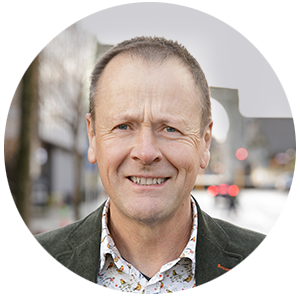
John is elected a Distinguished Fellow of Engineering New Zealand for his inspirational contributions to technical and executive leadership, especially in the fields of structural and seismic design.
John has a strong passion for engineering and the responsibilities the profession has to safety and future sustainability of the community. He has a unique ability to bring engineering to life, is an excellent communicator, and widely sought to participate on panels and advisory groups. His appointment to numerous technical committees, investigation teams and governance groups reflects the respect with which he is held both within and beyond the profession.
John has been particularly effective in raising awareness of earthquake and structural engineering design standards, especially following the Canterbury and Kaikōura Earthquakes where his commitment to the recovery processes and applying the learnings has been legendary. For these services he is one of a few who have been recognised as a Life Member of both the Structural Engineering Society (SESOC) and New Zealand Society for Earthquake Engineering (NZSEE).
John has spent most of his professional career with Holmes, where he has worked in New Zealand and international offices and provided effective leadership roles including as Chief Executive of the New Zealand-owned group of companies. After the Canterbury Earthquakes, his organisational and technical skills were sought for roles as Principal Advisory Engineer to Christchurch City, by CERA and the Ministry of Education to prepare their Guidance for Design, and currently by MBIE’s and Engineering New Zealand’s Seismic Risk Working Group. He also contributes as a member of the QuakeCore Board and a member of Canterbury Civil and Environmental Engineering Advisory Group. John has also co-authored many technical papers on seismic risk, structural design, and post-earthquake response. He is prominent in challenging conventional thinking and has been instrumental in leading changes in the design approach for vulnerable buildings.
John is recognised for his commitment and enthusiasm for the mentoring of young staff both within and outside his company, and constantly seeks opportunities to promote use of best practice and benefits to the wider community. John is highly approachable, generous, and humble. He is an excellent role model for the engineering profession and is highly deserving of recognition as a Distinguished Fellow.
Dr Te Kīpa Kēpa Brian Morgan
DFEngNZ, BE, PGDip (Mgmt), MBA, PhD, DFEngNZ, LMSPPEEx
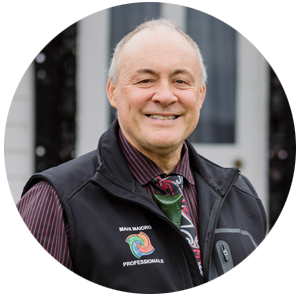
Dr Kēpa Morgan is elected a Distinguished Fellow of Engineering New Zealand in recognition of his contribution towards including Māori culture (tikanga) and Māori knowledge (matauranga) into engineering education, and in establishing ways in which Māori can succeed in delivering engineering to the benefit of the wider community.
Kēpa’s mana in his own iwi and whānau is extremely high. He has shown himself to be a pioneering leader and innovator in demonstrating how greater benefits are able to be drawn in bringing together knowledge of both Māori and western-derived engineering, and how to be true to oneself as Māori and a professional engineer. In the 1980s, Kēpa incorporated te ao Māori principles into his work to design the entirely sustainable development at Whenuakura for his whānau – long before low-impact design began to be considered in wider engineering practice. His innovations also include alternative construction systems like Uku (a flax fibre and reinforced earth composite).
In education, and in recognising and challenging otherwise long-established traditions and practices, Kēpa has shown himself to be a role model in bringing cultural change in engineering education in a positive way. His work has been shared and referenced in many spheres, both nationally and internationally, and has extended and strengthened engineering through successfully showing how to integrate matauranga Māori with western knowledge and methods to create solutions and decision tools responding to the needs of Māori and others. Kēpa devised the Mauri Model, a decision framework known as the Mauri Model, to assist discussions and decisions about municipal water use that incorporate cultural considerations. As well as Te Mana O Te Wai and Three Waters Reform, the Mauri Model is now applied in many other contexts such as assessment reports for climate change, historic change, and contaminated sites.
Since 2019, Dr Morgan has led the incorporation of mātauranga Māori in freshwater monitoring and reporting, including bespoke digital monitoring frameworks and assessments for Rotoitipaku, Te Roto Whaiti i kitea e Ihenga, Waiāri, and Ngā Rua Hu wai o Tahu Matua. In addition to these practical solutions, Kēpa is also co-leading research projects including Pohewa Pae Tawhiti, Pūhiko Nukutū Green Hydrogen, and Electric Vehicle Uptake and Māori.
Kēpa is recognised as an outstanding engineer in terms of eminence, sustained leadership, professional behaviour, profile – all of which encapsulate the qualities of a Distinguished Fellow.
Mike Underhill
FEngNZ
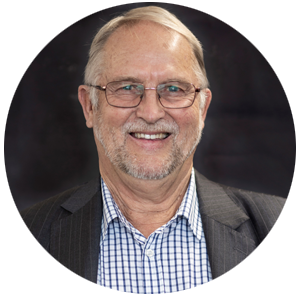
Mike Underhill is recognised as a Distinguished Fellow for his contribution to the engineering profession and the electrical energy sector of New Zealand. During his long career, Mike has constantly raised awareness and kept a focus on issues related to the supply, delivery and use of electrical energy. He has influenced and enabled the significant changes in government policy necessary to ensure energy supply keeps pace with energy needs in a way that responsibly deals with the impacts of this key infrastructure.
With an electrical engineering degree, Masters of Commerce (Hons) and Harvard University’s Advanced Management Programme, Mike has held key chief executive roles in both the private and public sector of engineering and energy related organisations including Energy Direct, TransAlta, WEL Networks and EECA. His engineering background coupled with commercial savvy give him a unique perspective of the energy sector. In his ‘retirement’, Mike serves as a Director for Network Waitaki, Electra, The Lines Company and Wellington Water, chairing committees in each of these organisations.
At EECA, Mike oversaw the implementation of the Warm Up New Zealand insulation and clean heating programmes, Minimum Energy Performance Standards for electrical appliances, electric vehicle programme (which sets the path for the decarbonisation of our transport system) and energy efficiency and renewable energy programmes for commercial and industrial businesses. He continues to work with Government and other leaders, influencing policy and programmes, and ensuring decisions and strategies are backed with solid technical reasoning.
Mike is regarded as an inspirational leader by his staff and his organisations have been within the top 20 best places to work while he was at the helm. He has championed gender and ethnic diversity, created pathways for development and promotion, and mentored and supported staff at all levels. He has been a member of interview panels for professional registration at IPENZ/Engineering New Zealand.
Mike has a strong set of personal values that he brings to his work, believing that everyone can add value and that this should be acknowledged and respected. Mike has constantly applied himself to balancing economic, social and environmental issues as an organisational leader and in his personal life. He spent three years with Volunteer Service Abroad working with the Electric Power Corporation in Apia, Samoa. Consistent with this philosophy, Mike is a strong customer advocate and promoter of energy affordability to address the many New Zealanders who are suffering from energy and economic hardship. While at EECA, Mike declined salary increases for a number of years so that the limited funding pool could be spread more equitably amongst those on lower wages.
Mike has been a considerable role model for positive change over his decades long career. Mike’s tribal affiliation is Ngāti Raukawa.
Honorary Fellows
Brett Williams
Brett Williams is appointed an Honorary Fellow of Engineering New Zealand for his contribution to developing and maintaining the processes for engineering accreditations, as well as for his leadership, both in New Zealand and internationally, through his engagement and role in the International Engineering Alliance. Brett’s contribution has had significant impact for the New Zealand engineering profession in terms of international and domestic recognition in engineering educational accords and professional competency mobility agreements.
Fellows
Andrew McKillop
CMEngNZ, NZCE (Civil)
Andrew has 40 years’ experience managing and leading engineering programmes. He's an excellent communicator who focuses on building relationships to achieve tangible results. His in-depth knowledge of policy, governance and operational requirements helps drive outcomes and provides continuous improvement for communities.
As a natural leader, Andrew encourages and enables others to succeed. He's passionate about supporting the engineering profession and wider transport sector to develop and grow.
Andrew is the programme director for Te Ringa Maimoa Transport Excellence Partnership, a unique and enduring alliance that champions excellence in transport asset management.
Bing Xue
PhD, MSc, BSc
Bing has made significant contributions to ICT engineering research, technical expertise applications, engineering education, and Women in Engineering. She has more than 300 fully refereed publications and 10,000 citations to her name. Her major contribution also includes the applications of AI and data science techniques to various engineering applications, ranging from the New Zealand primary industry to health or (bio)medical domains. Bing co-led the establishment of the first AI postgraduate qualifications and AI undergraduate major in New Zealand, and has supervised a large number of research students from diverse backgrounds.
Cathy Forrest
CPEng, MEngNZ, IntPE, M.Eng
Cathy is a Civil Engineer with over 30 years’ experience and leads the Civil Infrastructure team for AECOM in the South Island. Cathy is a Technical Director with extensive experience covering large public infrastructure projects and smaller upgrade works as well as private developments. She has worked in the South Island as Project Director, Team Leader, Design Manager, Engineer to the Contract and Engineer’s Representative on various local council and Waka Kotahi projects for the past 16 years and has become a trusted client advisor and collaborative team leader to key clients in that time.
Chris Bauld
NZCE, BE, ME, CMEngNZ, CPEng
Chris is a geotechnical engineer and project governance specialist who has worked widely across vertical and horizontal infrastructure projects, including the Canterbury Earthquake Recovery, the second Tauranga Harbour Crossing and the Puhoi to Warkworth Expressway. He started his career as a cadet in 1986, completing a New Zealand Certificate of Engineering and followed this with a Bachelor of Engineering (Civil) and Master of Engineering (Geotechnical). Chris has had a varied career, with roles in construction and consultancy businesses, covering highly technical specialist modelling to commercial and project governance roles.
Chris Purchas
BTech (Hons), MEngNZ
Chris is a waste and resource recovery sector leader, with more than 25 years’ experience helping businesses and governments increase resource recovery and improve solid waste management systems. Chris has worked in resource recovery, waste strategy and infrastructure projects across New Zealand, Australia, and the Pacific for a wide range of clients including the Asian Development Bank, Governments, both local and regional authorities. Chris provides expert advice to senior decision makers using holistic frameworks to deliver best value for communities. Chris remains active in project delivery with current projects across the Pacific, in New Zealand and Victoria.
Clive Anderson
BE (Civil)(Hons), MSc (Soil Mechanics and Engineering Seismology, Distinction), Diploma of Technical Management (Deakin), CPEng
Clive’s geotechnical engineering career spans nearly 40 years. He has contributed to some of New Zealand’s major engineering projects including the Clyde Dam landslides, the post-earthquake recovery of Christchurch and the Kaikoura Coast transport corridor reinstatement following the 2016 earthquake. Clive also worked extensively in the coal mining sector designing highwalls, tailings and water management dams. He is a Risk Director and Senior Project Director with Tonkin + Taylor where he manages business risks and oversees the design of large geotechnical and coastal engineering projects. He champions sound geotechnical practice, which he demonstrates through his peer review and expert witness work.
Daniel Crichton
MEngSt(Hon),CMEngNZ, CPEng
Daniel is a passionate Civil Engineer. He has 20 years of experience in the design and construction of a wide range of Civil infrastructure including bridges, ports, pavements, and wind farms. This experience has been in a diverse range of environments, from the mountains of Fiordland to remote areas of the Pacific. In his current role as Director of Engineering at Downer, he is responsible for the structures, rail, geotechnical and pavements professional engineering disciplines in their Transport business.
David Brierley
CMEngNZ, IntPE(NZ)/APEC Engineer
Dave is a Civil Engineer and project manager with proven leadership experience in the delivery of major complex multi-disciplined transportation projects in New Zealand and internationally. His career has taken him around the world, working on some exciting mega-projects, meeting a wide array of people, and providing cultures and developing enduring relationships. Dave now enjoys ‘paying it back’ to the profession, sharing his knowledge and wisdom as a mentor and coach, and volunteering his time to the management and administration of Engineering New Zealand. Dave is currently Treasurer of the Auckland Branch and serves on the Auckland Transportation Group committee.
David McLernon
BE, CPEng, PMP, CMEngNZ
After 10 years with McConnell Dowell in the Middle East, David joined Octa Associates Ltd in 1993 as their Christchurch-based Branch Manager and Director/Shareholder, a role he held for nearly 30 years. As such, he has played a key role in the mentoring and development of many young project managers across New Zealand. He has worked on numerous large-scale projects across all industry sectors with many of his recent roles being in governance as Project Director or Engineer to Contract including the $1.47bn new Dunedin Hospital. David has acted as an independent RMA Commissioner, a Development Contributions Commissioner and a Gateway Reviewer. He has recently been appointed to Engineering New Zealand’s pilot panel for Engineers to Contract.
Evan Giles
CMEngNZ
Evan has found engineering a fulfilling profession that is endless in providing opportunities for increasing knowledge and improving society. Encouraging younger practitioners is a current driver for him at WSP, where Evan is Project Director – passing on a passion to build a better society for all.
He pioneered the New Zealand Chapter of the Australasian Tunnelling Society, fostering cooperative work between owners and builders of subterranean infrastructure that enriches and enhances communities. Two years ago, the Engineering New Zealand linked technical society became a country member of the International Tunnelling Association, changing its name to the NZ Tunnelling Society.
Evan considers himself to be a people-person who likes and promotes teamwork, enthusiastically motivating synergy.
Rick Wentz (Frederick)
CMEngNZ, IntPE(NZ)/APEC Engineer, BSc., MSc. (Geotechnical CPEng, GE (Calf), CE (Calf.)
Rick Wentz has been a practising geotechnical engineering for 30 years. He has worked internationally on a variety of large infrastructure projects including nuclear power plants and large dams. Rick came to New Zealand in 2011 initially to work on the Christchurch rebuild and was a co‐principal investigator for the EQC ground improvement trials project. He has since served as a technical expert on various review panels and working groups including the Seismic Risk Working Group and developed site investigation and design guidance for geotechnical engineers. Rick also has a strong interest in helping to link the outputs from academic research to engineering practice, and helping to improve technical awareness and standards amongst geotechnical engineers.
Gordon Young
BE, MBA (Technology Management) , CMEngNZ, FIEAust, MIEEE, MIET, CPEng, RPEQ, NER
Gordon has considerable Air Navigation Service Provider management, project, safety, and New Zealand high voltage electrical experience. His time with Airservices Australia and Airways New Zealand has afforded him aviation experience, through management and engineering responsibilities for the New Zealand Airways’ Navigation System Modernisation Project, Ground Based Augmentation System, flight inspection, safety audits, and risk assurance.
An internationally recognised subject matter expert in Global Navigation Satellite Systems, Gordon is currently working on the Satellite Based Augmentation System (known as the Southern Augmentation Positioning Network – SouthPAN) to provide Australia and New Zealand aviation with more accurate GPS guidance for aircraft approaches to airports.
Kathryn Ward
CMEngNZ, IntPE(NZ)/APEC Engineer
CMEngNZ, IntPE(NZ) / APEC Engineer MInstD CMEngNZ MBAt area of HV Power Systems Protection and Automation. She has worked predominantly in the New Zealand power systems industry during her career and has led the protection design on many significant power systems projects. Her goal is to demonstrate by example that a female in this industry can, through a technically focused career, become a recognised technical specialist in their chosen engineering discipline.,
Kennie Tsui
CMEngNZ, IntPE(NZ)/APEC Engineer, MInstD, CMEngNZ, MBA
Kennie is the Chief Executive of the New Zealand Geothermal Association. Her desire to make a positive impact transformed her to become a purposeful leader, leading industries, communities and society to strive for climate actions. She has over 25 years’ experience in private, public and not-for-profit sectors pioneering climate initiatives in Aotearoa through diverse, skilled and innovative teams that provide collaborative and innovation solutions.
Kennie is a Chartered Professional Engineer, a Board member of Engineering New Zealand, global member of USA Geothermal Association and a Fellow of the Gates Foundation. Her strength is drawn from: “Ehara tāku toa i te toa takitahi, engari he toa takitini” (“My superpower is not as an individual, but as a collective”).
Kevin Reid
BSc (Hons), FEngNZ, CEng (UK), MICE, MInstD
Kevin has been an engineer for over 35 years and is proud of the difference he has made to communities in New Zealand and overseas. Kevin has worked equally in private and public sector roles and across the breadth of the transport system value chain. This makes Kevin a ‘Specialist Generalist’ and allows him to get involved in complex projects and change programmes at the same time.
Kevin believes engineers have an important role to play in a sustainable future and looks forward to continuing to help make a difference.
Krish Shekaran
B.E.(Hons), DipEng, CPEng (Structural) , CMEngNZ, MInstD
Krish is a Principal in the Structural team in Beca and has been leading seismic risk reduction programmes for clients with large nationwide portfolios. He loves working with clients to help them address their seismic risks, primarily with respect to H&S implications for their staff and business. Krish believes in having fun with his team regularly as a happy mind means better solutions for the challenges we face.
Krish actively supports Engineering New Zealand’s drive to get engineers chartered and also is a committee member of the Special Interest Group of Immigrant Engineers, where he helps seek employment opportunities for our members. Krish is on the committee for Tennis Auckland Seniors where he helps to get our whānau to improve their health through tennis. He also has recently completed the Company Director’s Course from Institute of Directors.
Martin Larisch
MSc, PhD, CPEng MIE Aust, CMEngNZ
Martin has been involved in the design, delivery and certification of the foundation systems for various complex major infrastructure, building and marine projects across New Zealand, Australia and the South Pacific.
He is passionate about sharing knowledge and facilitates numerous technical training courses for Engineering New Zealand, Engineering Education Australia, and the Deep Foundations Institute in the United States. Over the last decade he has been involved in the development of various international guidance documents for deep foundations, temporary works and underwater concrete applications.
Martin currently chairs the New Zealand Geotechnical Society’s climate change focus group.
Mason Reed
BE (Civil), CMEngNZ (Geotechnical) CPEng, IntPE(NZ)
Mason has over 26 years’ experience in assessing geotechnical hazards for a variety of projects in New Zealand and overseas. He was lead author for the ‘Marlborough District Council – Liquefaction Assessment Guidelines’ (September 2021) and has been a Practice Area assessor for the past seven years. He has particular expertise in forensic engineering, to determine the cause of damage to buildings, slope stability assessments and the geotechnical design aspects of municipal landfills.
Mason is the Geotechnical Director for Fraser Thomas, a multi-discipline engineering firm with six offices throughout New Zealand. He established its South Island operations.
Michelle Grant
CMEngNZ, IntPE(NZ)/APEC Engineer
Michelle Grant is awarded a Fellowship for her significant contribution to leadership and structural engineering. She has championed small practitioners and leads by example in upholding high professional and technical standards through her work. Her leadership in the profession has included involvement with the Structural Engineering Society (SESOC), fronting national interviews, to promoting high professional quality standards.
Michelle is a role model within structural engineering, leading, and supporting women in engineering, emerging professionals and members in small practices.
Murray Burt
MBA, MSc, BE, CPEng, MICE, IntPE(NZ), NZSSM
Murray is the Chief Engineer at Auckland Transport and has significant organisational responsibility for a portfolio of $25 billion worth of transport assets on behalf of the people of Tāmaki Makaurau. He has extensive experience in governance of complex infrastructure projects as a project alliance board member and holds governance roles on several industry bodies.
Murray has served as an engineer with United Nations, and other agencies, bringing hope and saving lives in some of the world’s worst humanitarian disasters and conflict zones including the Syrian war, Haiti earthquake and Asian tsunami – service for which he was awarded the New Zealand Special Service Medal by the New Zealand Government.
Neil Dodgson
BSc(Hons), PhD ScD CEng, CMEngNZ, FIET ,FIMA
Neil Dodgson is Professor of Computer Graphics in the Faculty of Engineering and Dean of the Faculty of Graduate Research at Victoria University of Wellington, having moved there in 2016 from the University of Cambridge. He co-leads the largest computer graphics research group in the Southern Hemisphere. His research career is in 3D television (displays that do not require special glasses), modelling of three-dimensional shape (in both CAD and animation), and the intersection of art, design, aesthetics, computing, and psycho-physics. He has over 140 publications and four patents.
Philippa Martin
PhD, PGCertStratLdrship, PGCertCounSt, PGCertTertTchg, BE Hons (1), SMIEEE, FEngNZ
Prof. Philippa Martin is a Professor of Wireless Communications at the University of Canterbury. She has 25 years’ research experience and publications in the field of wireless communications and is internationally known for designing high throughput communication systems and reduced complexity receiver algorithms.
Philippa is an award-winning educator. She feeds her engineering education research into innovative teaching practice, such as video tutorials after the Christchurch earthquakes and orientation programmes to foster inclusive cohort formation. As a public advocate for women and inclusion in engineering, she led the development of a peer mentoring system for over 1,000 first-year engineering students.
Raed El Sarraf
BSc(Eng), MEngSt, MEng(Hons), CMEngNZ, IntPE(NZ)/APEC Engineer
Raed El Sarraf has made major contributions to improving the knowledge relating to the durability of steel structures, especially bridges, in Australasia; as well as leading the way for the resurgence of steel bridges in New Zealand. He has achieved this through being involved in developing standards and guidance documents regularly used by design engineers and asset managers as well as thorough organising and presenting technical papers, seminars and conferences on these topics both in New Zealand and overseas.
He continues his voluntary service to Australasian Corrosion Association committees since 2011, and currently serves on the HERA Executive Board.
Rajika Jayaratne
CMEngNZ, IntPE(NZ)/APEC Engineer, CPEng, InPE, PhD (Civil Eng)
Rajika has undertaken strategic planning, hydraulic modelling, designing water infrastructure, research, and teaching for several organisations for twenty-five years or more.
Currently, she has a national role as a stormwater engineer with Waka Kotahi and assists with many environmental issues. In several technical leadership roles, Rajika led three waters projects covering environmental, catchment management planning, development specifications, standards, and guidelines.
Rajika has been a practice area assessor to Engineering New Zealand since 2011, a committee member for Auckland Branch, and a voluntary mentor to women engineers. With great satisfaction, she coaches and mentors’ younger engineers and other professionals to enjoy their profession, maximise their careers and add value to society through their work.
Ralph Fouche
CMEngNZ, CPEng (Civil, Management)
Ralph Fouche is Managing Director for Stantec New Zealand. He has more than 30 years’ engineering and management experience including design engineering, project management, client management, general management, and leadership within a multi-disciplinary consulting engineering business. He is passionate about collaborative approaches that provide good community outcomes. Ralph is a dedicated advocate for inclusion and diversity for the engineering industry.
Ralph is a Chartered Professional Engineer, a Director of Stantec New Zealand and of PAE New Zealand Limited. He has served on several governance boards including Engineering New Zealand.
Rishen Maharaj
FCIBSE, CEng (UK), CPEng (NZ), CMEngNZ, IntPE(NZ)/APEC Engineer
Rishen is a Chartered Professional Engineer and a Fellow of the Chartered Institution of Building Services Engineers (CIBSE). He is the Operations Director for Building Services at WSP NZ
Rishen has nearly 20 years’ experience in the electrical engineering field and has delivered major projects in New Zealand, Australia, UK, Middle East, USA and Antarctica. Rishen established and chairs the Electrical Engineering Group at Engineering New Zealand, which has made a significant impact to the Low Voltage Electrical Engineering profession.
Rishen has contributed to the development of numerous standards during his career, and he represents Engineering New Zealand on standards committees.
Rob Bond
BEng(Hons), CPEng, CMEngNZ, Ceng (UK), ACSM
Rob is a Technical Principal with WSP based in Central Otago. He has worked primarily in the UK and New Zealand and has provided expert advisory roles on major infrastructure and power projects across New Zealand. He has been a key lead engineer on post natural disaster recovery projects, as well as advising and taking a design lead on major infrastructure projects.
Rob continues to influence the development of future engineers and contribute to the technical health of WSP. He is working to develop rockfall mitigation and protection systems and has presented papers on rockfall mitigation both in New Zealand and abroad.
Robert Swears
NZCE (Civil), BE(Civil)(Hons), MengSc (Transp)(UNSW), CMEngNZ, CPEng
Robert Swears is a Chartered Professional Engineer who specialises in road safety and transport engineering. With over thirty years’ experience in these fields, Robert uses his engineering skills and experience to improve the safety, efficiency and function of our road networks, focusing in particular on safe speeds and safe roads and roadsides.
Through his transport engineering work, Robert advises central and local government agencies in relation to a wide range of projects. This includes acting as an expert witness and leading the development of industry best practice guidance documents. His underlying aim is to provide future generations with the best practicable multi-modal road transport network.
Ross Roberts
BSc(Hons), MSc CGeol, FGS, GMICE, PEngGeol
Ross is Head of Engineering Resilience at Auckland Council, where he leads teams that deliver projects ranging from guideline development and geohazard studies to geotechnical and coastal design, construction and management. He has a background in geotechnical engineering and natural hazards and has worked on large-scale projects in the UK, Europe, Indonesia, Australia and New Zealand. He is particularly interested in building resilience through better governance, planning, asset management, sustainable design and procurement.
Ross is the co-ordinator of the Auckland Lifelines Group, a volunteer in Auckland Emergency Management as a Lifeline Utility Coordinator during emergency events, and is immediate past chair of the New Zealand Geotechnical Society. He has taught at universities in New Zealand and Indonesia on the topics of slope stability, natural hazards and geotechnical investigation.
Ruili Wang
PhD
Professor Ruili Wang has made a long-lasting impact on artificial intelligence and speech/signal processing through his contributions to theoretical study, algorithm innovation, industry applications, and societal services. He is recognised as a world-class research leader, having supervised many PhD students to completion.
Ruili has also made significant contributions to disseminating knowledge and research to the public and community, mentoring emerging researchers, and improving the international reputation of New Zealand. Particularly, his achievements in Māori speech processing are extremely valuable to Māori and New Zealand in terms of language protection, promotion and popularisation.
Scott Elwarth
CMEngNZ
With 30 years’ engineering experience in New Zealand, Europe and the South Pacific, Scott is one of New Zealand’s leading engineers specialising in the delivery of large-scale infrastructure projects. Scott has previously owned an engineering consulting business, received industry peer recognition for his work and has taken a New Zealand lead in introducing contractual innovation which has resulted in significant engineering, environmental and social outcome benefits.
As the Owners Interface Manager on the Link Alliance Leadership team Scott has a key role on the City Rail Link project, the largest infrastructure project in New Zealand history. He currently serves on the Board of Engineering Without Borders New Zealand and continues to be an active contributor to advance and promote the engineering profession.
Steven Knowles
CMEngNZ, NZCE, BE(Hons), CPEng, AAMINZ
Steven has held senior management and project roles and has been a board member of the Association of Consulting and Engineering, New Zealand (ACE NZ).
Steven co-led the NZAID programme to provide training to Nepali structural engineers. Steven has been engaged as an expert witness for Christchurch earthquake claims by most of the parties and is a member of the Engineering New Zealand panel that has provided technical assistance to the Greater Christchurch Claims Resolution Service and the Canterbury Earthquakes Insurance Tribunal. Steven was jointly awarded the Engineering New Zealand Gold Medal in 2022 along with the other members of the panel.
Wayne Hatcher
CMEngNZ, CPEng
Wayne Hatcher is Technical Director – Asset Management at WSP in New Zealand. In his wider leadership role, he provides oversight for the technical health of WSP in New Zealand and supports career development and accreditation for all WSP New Zealand’s emerging professionals.
Wayne has been at the forefront of asset management practice in New Zealand and internationally from its infancy and has used that position to enhance New Zealand Asset Management practice to the benefit of all Kiwis by drawing on his extensive experience and deep understanding of infrastructure systems and community expectations.
Yi Mei
PhD, SMIEEE, MACM
Yi has significantly contributed to ICT engineering research in artificial intelligence and optimisation. He has over 180 peer-reviewed publications and 4,700 citations. He has successfully applied his technical expertise to various engineering applications in high-value manufacturing, transportation and primary industry.