At the time of its completion in 1905 the Ongaroto Bridge, across the Waikato River, was reputedly the longest single span timber bridge in the Southern Hemisphere. This bridge was demolished in the early 1930s.
Ongaroto Bridge was part of a railway link constructed by the Taupo Totara Timber Company (TTT) between its base at Putaruru and sawmill at Mokai, 23km northwest of Taupo. The sawmill was built to extract Totara and Matai timber from the surrounding forests.
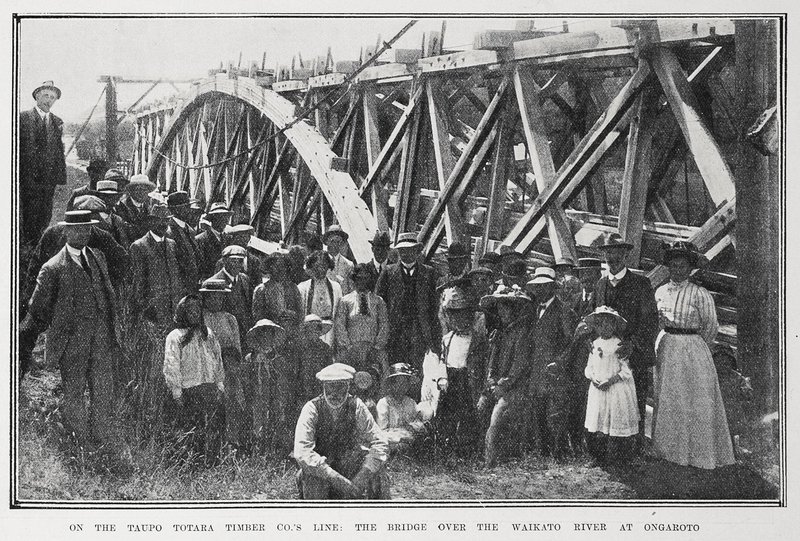
Auckland Libraries Heritage Collections AWNS-19130206-11-03
The TTT’s 80km of one metre track, and associated river and stream crossings, were designed by James Edward Fulton (1854-1928). Fulton was a Wellington-based consultant civil engineer experienced in railway construction.
The Waikato River formed the major barrier for Fulton in designing the TTT’s railway. Initially, a two span girder bridge was considered to span the approximately 60m at the crossing point. However, this idea was abandoned because of the river’s high flows and difficulty in founding a central pier. Instead a laminated timber through truss arch bridge was selected. Construction began with a temporary suspension bridge being erected at the site to provide limited access, as well as a platform from which to build the bridge.
The Ongaroto Bridge was built using green heart totara timber. The pairs of circular arches on each side of the bridge were created by seven 375mm x 100mm laminations bolted together at approximately 1m centres. The arches enclosed a parallel chord girder truss, which provided load distribution. A feature of the design was that tension forces were transferred from member to member either by notches in the connected members, or timber “joggles” set into notches, or wrought iron plates set into notches. The locomotive and wagon loads were carried by rail beams which were mounted on transom beams. These transom beams were located in notches in the substantial vertical truss members, which in turn transferred the load to the arches through short bearers. The horizontal trusses, at top and bottom chord levels, provided lateral stiffness.
The bridge was completed in 1905 and served the needs of the TTT until 1931, when it was replaced with a two span steel girder rail bridge. This replacement structure was used until about 1950 when construction of Whakamaru Dam was taking place. Today there is a forestry road bridge over the lake at the old bridge’s site, 6km downstream of the present day Atiamuri dam.
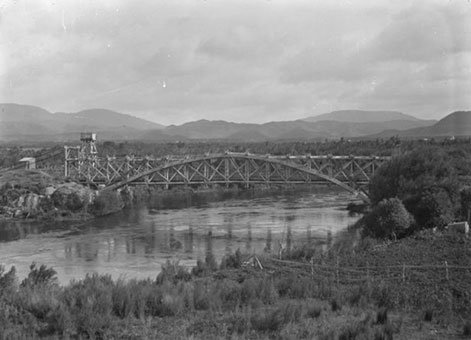
Longest single span wooden bridge in New Zealand, carrying the Taupo Totara Timber Company line over the Waikato River at Ongaroto. Godber, Albert Percy, 1875-1949: Collection of albums, prints and negatives. Ref: APG-1160-1/2-G. Alexander Turnbull Library, Wellington, New Zealand. /records/22823593
More information
Access
From Atiamuri Dam drive west along State Highway 30/Ongaroto Road, towards Whakamaru. Turn left at Tram Road. The former site of the bridge was over the Waikato River, near the intersection of Tram and Tirohanga Roads.
References
Fifty Years of Progress 1901-1951: Taupo Totara Timber Co. Ltd, Auckland, Taupo Totara Timber, 1951.
Kevin Cudby and Trevor Mitchell, 'Old Growth: Our timber engineering heritage - Ongaroto timber arch bridge,' New Zealand Timber Design Journal, Vol. 20:3 (2012), pp.3-7.
Location
This bridge has been demolished. The site of the bridge was 6 kilometres downstream of existing Atiamuri Dam, Waikato.