Jack Woodward achieved much during his academic life as an electrical engineer, but he will be greatly remembered for his humanitarian work for many social causes, particularly in developing countries.
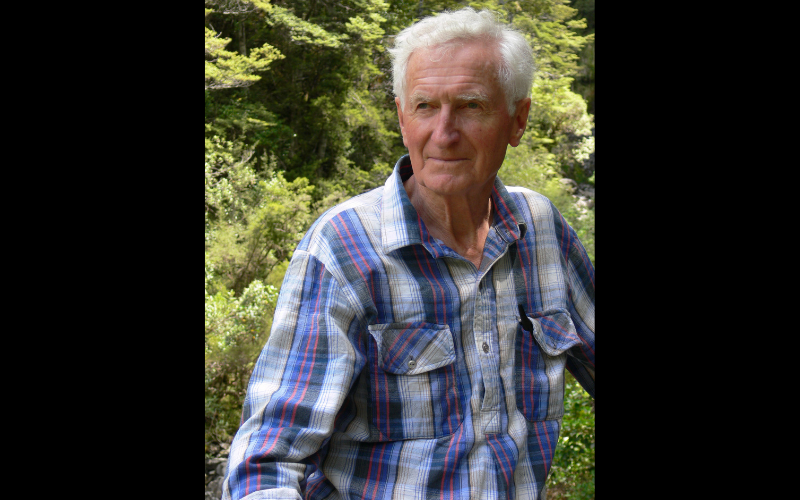
Jack Woodward at Arthur's Pass in 2007.
Early years and education
Jack Woodward was born on 5 July 1926 in Ohakune. He attended Ohakune High School and then completed an engineering degree at Canterbury University in 1947. Following graduation, he worked for three years as Assistant Engineer at New Zealand State Hydro Electric Department. In 1950 Jack went to Canada. He worked as a test engineer for the Canadian General Electric Company and then as an engineer for the Ontario Hydro Electric Power Commission. Both roles were in Toronto. While he was there, Jack also completed a Master of Applied Science degree at Toronto University.
Academic career
Jack returned to New Zealand and to Canterbury University in 1953. He began as a lecturer and progressed to Acting Head of the Department of Electrical Engineering in 1965. In 1966 Jack moved to Australia to take up the position of Professor and Head of Department of Electrical Engineering at the University of Adelaide. Between 1967-69 he also served as Dean of Engineering.
In 1971, Jack went to Papua New Guinea University of Technology in Lae to head the newly established Department of Electrical and Communication Engineering. As well as Head of Department, Jack was Dean of Engineering in 1974 and Acting Vice-Chancellor in 1977. At PNG UniTech Jack provided vital tertiary education for local students. Jack returned to New Zealand in 1977, but he maintained a connection with Papua New Guinea that lasted for the next 50 years. He worked in a mainly voluntary capacity providing assistance with the the design, installation and commissioning of micro-hydro schemes in Morobe and East Sepik provinces. Of significance was the Faseu Village micro-hydro project for which Jack established the Friends of Faseu Trust to provide funding support.
In 1976 Jack was appointed to the Chair of Electrical Engineering at University of Auckland where he served with distinction before retiring in 1992. He was Assistant Vice-Chancellor for three terms between 1980 and 1991; Acting Vice-Chancellor in 1991; Pro-Chancellor in 1997 and served as a member of the University of Auckland Council from 1986 to 1991 and again from 1995 to 1998.
Social justice and research interests
Jack was a keen supporter and active participant in many social justice organisations. He was a founding member of Engineers for Social Responsibility (ESR), a group formed in 1984 to “encourage and support social responsibility and a humane professional ethic in the uses of technology.” Jack was Chair of the Auckland Branch of ESR from 1986-1997 and National President 1991-1993. He was elected a life member in 2006. In 1988, Jack, along with other engineers, including a number from ESR, established a charitable trust, Water for Survival. Jack served as Chair of the Board of Trustees from its establishment, to 2003 when it amalgamated with Oxfam NZ. Over those years, the Trust assisted over half a million people in seventeen developing countries to get clean water supplies and improved sanitation.
Jack’s particular research interest was the dynamic behaviour of electric power systems as well as hydro-power, particularly for small micro-hydro plants and associated equipment. He authored 67 technical papers and reports. Jack completed periods of sabbatical leave to undertake research at Cambridge, Edinburgh and Melbourne Universities. He also travelled extensively through Africa, India, Nepal, Indonesia, Southeast Asia and the Pacific to study and research energy supplies and electricity utilisation.
Jack always had a love for the outdoors and climbed throughout the Southern Alps and across the rugged Saruwaged Mountains in Papua New Guinea. Even in his 90s, he continued tramping, although mainly at lower levels.
Awards and honours
Jack served on many engineering committees, including for IPENZ. He was actively involved with the Canterbury Branch and Electro-Technology Group and also served as a member of the IPENZ Electrical Engineering Advisory Committee 1983-1991.
In recognition of his achievements and contribution to many organisations, Jack was elected Fellow of Institution of Electrical Engineering and Technology; Fellow of Engineers Australia; and Honorary Fellow of the Institution of Engineers Papua New Guinea. Jack was elected Distinguished Fellow of Engineering New Zealand in 2000.
More information
The University of Auckland holds an oral history interview with Jack Woodward, recorded in 2005 as part of University of Auckland School of Engineering oral history project (MSS-Archives-2023/18).
“Jack Woodward: 'Infectious diseases are part of our lives'” 25 June 2020, University of Auckland.
Biography by John La Roche
Page last updated 10 March 2026