
2 Mar 2026
How engineers and other experts are helping to protect New Zealand’s electricity grid against solar storms.
New Zealanders are familiar with natural hazards: earthquakes, volcanoes, landslips, floods, hydrothermal activity, tsunami – many of us have had our daily lives impacted by at least one of these. But there is a natural hazard missing from that list. One that doesn’t pose the same immediate risk to our safety, but which has dire implications for our electricity infrastructure, putting it front-of-mind for a growing number of organisations across Aotearoa: space weather. This is a catch-all term to describe a range of phenomena originating from the Sun, which, despite being ~150 million km away, influences every aspect of life on Earth. We’re most familiar with the Sun’s photons – the light it generates – which drive everything from the process of photosynthesis to our planet’s weather and water cycles. But light is not the only thing that reaches us from the Sun.
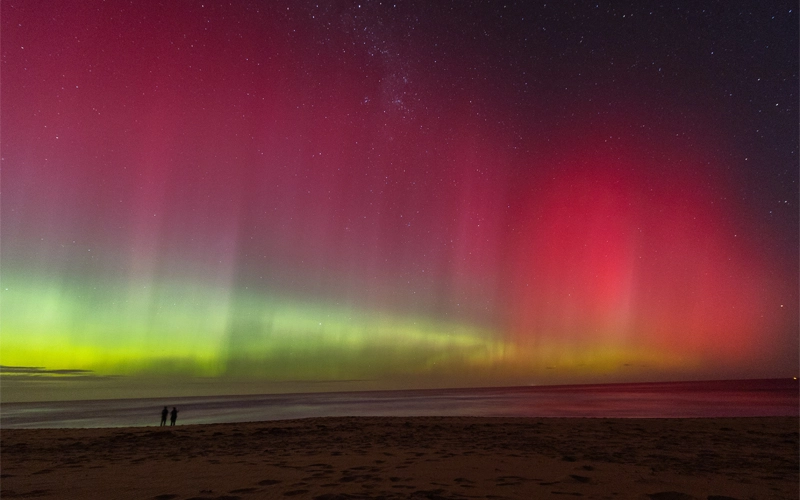
Aurora australis, photographed from Southern Melbourne during the May 2024 solar storms. Photo: Yash Soorma
Our Sun screams… and belches
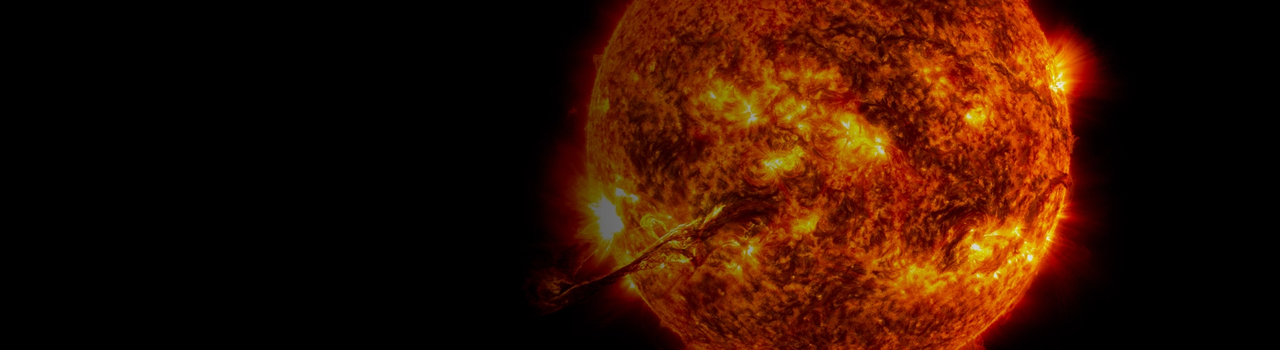
As a massive, dynamic ball of super-hot plasma, the Sun also creates twisted magnetic fields whose complex interactions lead to more dramatic solar activity.
“You can think of both solar flares and coronal mass ejections (CMEs) as huge explosions on the Sun,” says Professor Craig Rodger from the University of Otago. While these two events can occur simultaneously, they differ from one another, and they each have different impacts on Earth.
Flares are bright bursts of radiation (everything from gamma rays to microwaves) that travel in all directions at the speed of light. US-based space weather scientist Dr Tamitha Skov describes flares as “solar screams” which might be loud, but don’t physically hurt anything. The strongest flares do nothing more than disrupt radio communications that pass through the upper atmosphere, leading to temporary radio blackouts.
In contrast, CMEs are giant clouds of the Sun’s plasma – and its magnetic fields – that are expelled from the Sun, akin, Tamitha says, to “… a belching out of tonnes of material” – not just photons but particles too. That difference has a huge impact on speed. Light travels at approximately 300,000 km per second through the vacuum of space, which means it takes about eight minutes for sunlight to reach us. In contrast, the slowest CME moves at around 300 km per second, so its journey to Earth can take up to five days. Once a CME gets here, its magnetic fields interact with the Earth’s, which can trigger geomagnetic storms.
“For most of human history, the only sign of a geomagnetic storm occurring was the aurora dancing across the sky,” says Craig. But today, for those managing electricity grids, strong CMEs can spell disaster. A CME’s arrival can induce powerful electrical currents, known as geomagnetically induced currents (GICs), and voltage instabilities in long transmission lines. In extreme conditions, these unwanted GICs can even overload transformers, causing them to fail, leading to widespread power outages.
For most of human history, the only sign of a geomagnetic storm occurring was the aurora dancing across the sky.
Where science meets industry
Thankfully, none of this is news to Matt Copland MEngNZ, Transpower’s Head of Grid and System Operations, who says, “We’ve been thinking about and making preparations for extreme solar storms for years.”
Part of this preparedness comes through accessing data and alerts from satellites that are dedicated to monitoring solar activity. These tend to sit at the L-1 point – a location in space between the Earth and Sun where their gravitational forces balance out.
“L-1 is about 1.5 million kilometres away,” says Craig. “So, for normal CMEs, we get about an hour’s warning that it’s coming. For the really fast ones, we might only get 15 or 20 minutes.”
“That’s not enough time for us to actually implement a response,” says Matt. Instead, Transpower must act on forecasts of previous storms, “… assume it’s going to be the big one, and get the grid into the best state of readiness we can before the CME hits that L-1 satellite”.
Once the CME approaches Earth, ground-based measurements become important. Magnetic observatories, including at Eyrewell in north-west Christchurch and at Scott Base in Antarctica, can measure changes in the Earth’s magnetic field. And there is a network of sensors across the electricity grid that monitor GICs and temperature spikes.
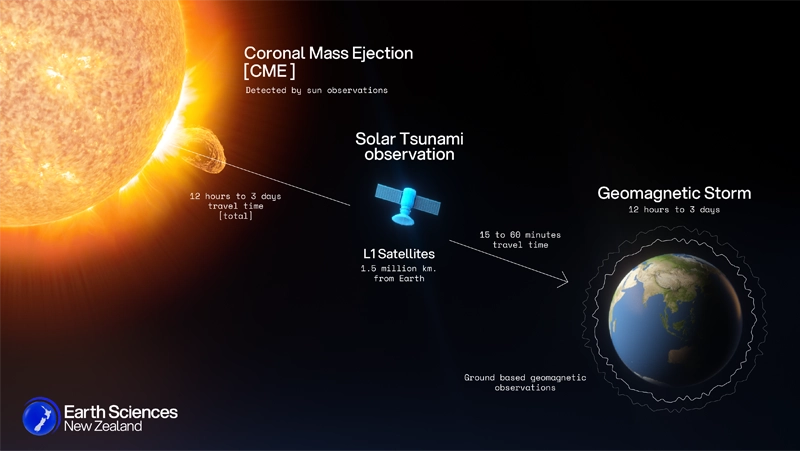
Diagram showing the travel time for solar activity from the Sun to L1 satellites, and satellites to Earth, where the activity is picked up by magnetometers. This warning allows organisations like Transpower to engage their contingency plans for geomagnetic storms. Image: Earth Sciences New Zealand.
Transpower’s multilayered response strategy sits on firm science foundations. Since 2015, the company has worked closely with Craig and his team at the University of Otago, supported by the Ministry of Business, Innovation and Employment’s (MBIE) Endeavour Fund.
“The Solar Tsunami Programme started with wanting to understand the science of space weather,” explains Craig. “But it quickly morphed into a way to tackle real-world questions about the hazard’s potential impact on our electricity infrastructure.”
“Transpower gave us 15 years’ worth of data and observations to start working with,” Craig recalls. This unprecedented data-sharing enabled researchers to model GIC behaviour across the network and identify vulnerable locations. This, in turn, allowed Transpower and the Otago team to develop a mitigation plan, “a switching cookbook,” says Craig, that Transpower could use to minimise the impact of any future space weather events on the normal operation of the grid.
In May 2024, the plan faced its first test.
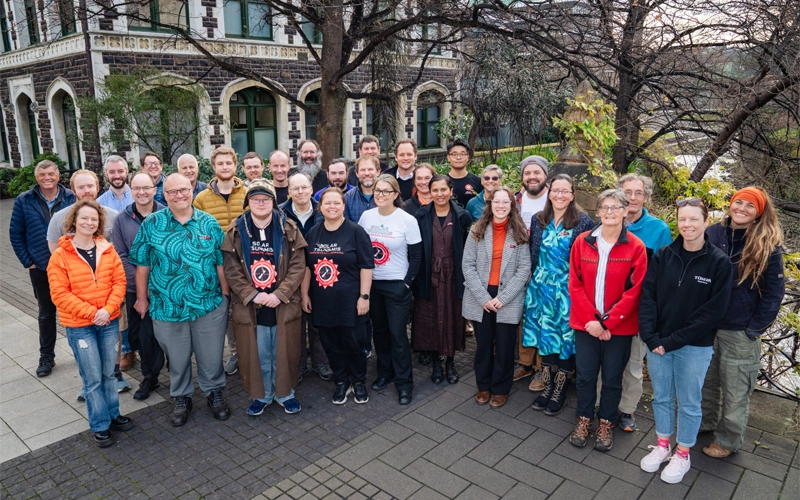
The Solar Tsunamis team at the University of Otago, June 2025. Photo: Dave Bull, University of Otago
National preparedness
For days, social media platforms were flooded with images of aurora australis dancing across New Zealand skies – the most widespread showing of the southern lights in decades. It was caused by a series of powerful solar storms now collectively referred to as the Gannon event, named after space physicist Dr Jennifer Gannon who had sadly passed away a week prior.
“On the morning of Saturday 11 May, I woke to an alert on my phone from NOAA’s Space Weather Prediction Centre,” Craig explains. “It said that the event had reached G4/G5, which is basically the biggest geomagnetic disturbance level,” so he was not surprised when Matt Copland called him.
“That event met Transpower’s threshold for enacting our switching plan,” Matt says. So, he and his team started working through it, reconfiguring the grid and disconnecting some transmission lines to safeguard key transformers across the network.
Over the following 48 hours as the storm rolled on and more CMEs arrived, Transpower continued to monitor it, issuing grid emergency notices and switching circuits where needed. Measurements made across the network confirmed the accuracy of the University of Otago models. There was no loss of power to customers throughout the event, and no damage caused to the grid.
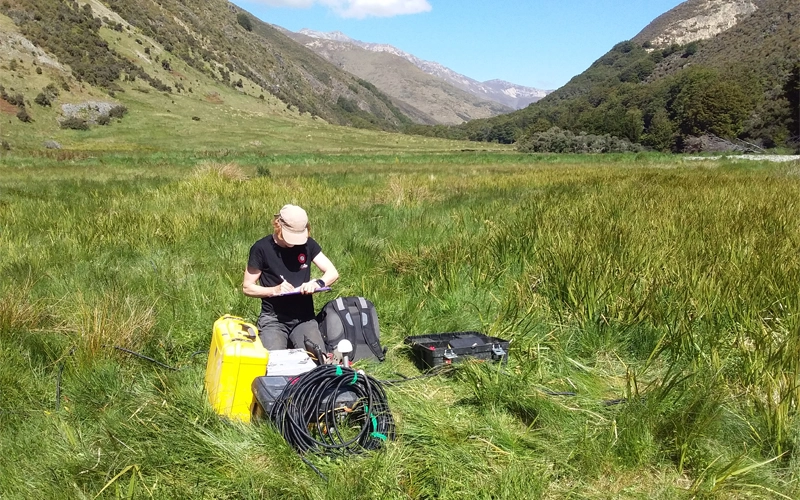
GNS geophysicist Wiebke Heise undertakes field work to investigate the electrical properties of the New Zealand landscape. Photo: Earth Sciences New Zealand
Professor Tom Wilson, Chief Science Advisor at the National Emergency Management Agency (NEMA), emphasises the significance of this industry-academia partnership: “Transpower’s culture of embedding research into their operational decision-making and their operational resilience... is celebrated internationally as an exemplar of best practice.”
NEMA had been the first to flag the impending storm on 10 May 2024. “Space weather has been on the National Risk Register since 2016,” says Tom. “Responsibility for planning for it sits across MBIE and NEMA.” But the Gannon event “energised” the agency and wider government do even more, he says.
“We’ve had a massive lift in operational readiness in the last 16 months.”
NEMA developed a National Space Weather Response Plan and established a Space Weather Science Advisory Panel – which includes scientists from universities, science agencies, Transpower, and NEMA – with an operational response subgroup. In November 2025, the agency conducted its first national exercise, Tahu-nui-a-Rangi, simulating a major space weather event.
“We ran that in the National Crisis Management Centre, aka “The Bunker” below the Beehive,” says Tom. “That gave us an opportunity to test what a big event might look like and more importantly, to test the national system.”
Preparing for the big one
Transpower is continuing to expand and develop its plans too. In 2026, working with the Electricity Authority, it will run a large-scale, hands-on industry exercise focused on space weather.
Matt explains: “We’ll work with the distributors, retailers, generators. The aim, as always, is to improve capability and preparedness.” And building on their ongoing MBIE-funded work with the University, Transpower has also been carrying out studies with transformer supplier Hitachi to understand how their hardware might respond to a solar storm 10 or 100 times bigger than the Gannon event.
This is not just a theoretical exercise. While it might seem to the wider public that the Sun is especially active right now, “… this is just it beginning to come back to normal,” Tamitha cautions.
“The previous cycle, which lasted from 2008 to 2019, was the anomaly. It was unusually quiet.” The Sun’s activity cycles, she explains “… are modulated over very long timescales – it doesn’t just wax and wane over 11 years.” And what we’re seeing now sits just below the median of all the solar cycles we’ve ever logged, she says. In other words, we can expect to see a more active Sun in the coming decades.
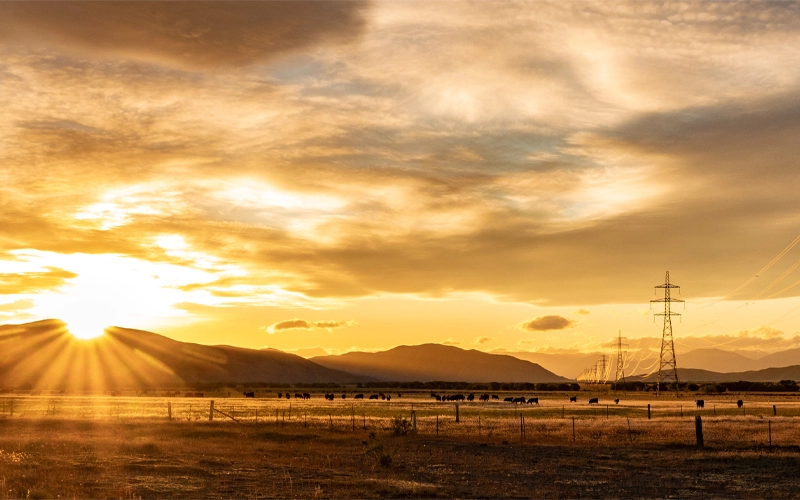
Sunset over Transpower's Twizel-Christchurch 220 kV line through Mackenzie Pass, South Canterbury. Photo: Transpower
Alongside their science-led operational protocols, Transpower is also exploring hardware solutions. In 2026, the company will install its first GIC blocker at Benmore substation. These devices can absorb the unwanted DC currents before they reach transformers, but they are expensive.
“We’ve been working with a modeller to understand the economic consequences of doing nothing,” says Craig, weighing the costs of mitigation against potential losses. What that analysis has shown is that, even with mitigation measures in place, a one-in-100-year event could cost the country in excess of $1.4 billion.
“Discussions are ongoing and new hardware will take years to implement. But it feels good to know that we’re on the journey together and we have a plan for tomorrow.”
This article was first published in the March 2026 issue of EG magazine.