
8 Jan 2026
Elite diver Frazer Tavener loved physics and maths in high school and says he knew that the natural progression was engineering. He enjoyed mechanics and coding in his first year at the University of Auckland and he specialised in mechatronics.
In August, he transferred to the University of Tennessee after getting an offer from Olympian Tom Daley’s coach. He’s competing in the National College Athletic Association league while pursuing a degree in aerospace engineering. Frazer, who has competed for New Zealand for six years, specialises in 3m springboard and 3m synchronised diving with Liam Stone. The pair recently placed seventh at the World Aquatics Championships in Singapore.
How did you first get involved with diving?
Mum enrolled me in a holiday programme at West Wave Aquatic Centre in Auckland when I was 12 and I loved it from day one.
What’s your earliest memory diving or jumping off something into water?
Visiting my Grandma in Mount Maunganui when I was seven or eight and jumping off some rocks. Little did I know I would spend a lot more time doing that in the future.
Are you from a family of high-performing athletes?
Although none of my family are high-performing athletes, my parents have always been exceedingly active. My dad played a lot of high-level sport when he was younger but never competitively, and my parents love hiking (to a point where my legs would nearly fall off as a kid).
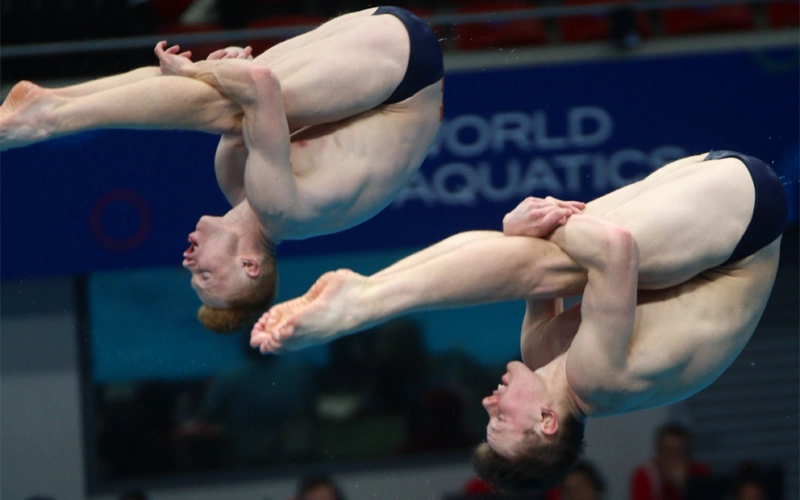
World Championship divers Frazer Tavener (foreground) and Liam Stone. Photo: Nathan Brown
What’s your current involvement with diving?
I train 20–25 hours per week. About half of this involves diving off boards and into the pool. The other half is spent lifting weights, doing diving specific strengthening like abs and making sure we can point our toes and keep our legs straight.
How often do you learn a new dive and what’s your approach to this?
At this stage in my career, it’s about one a year. There are a certain set of dives which are considered optimal to compete when you get to a high level and I’ve done many of them and only have a few to go. They’re also very difficult and take a long time to build up to now. Earlier in my career I would be learning new dives every month.
Do you have a favourite dive?
Reverse 1.5 somersaults and 3.5 twists (you end up facing the opposite way to how you started as you do 3 twists then an extra half!).
What do you love about synchronised diving?
Diving can be a lonely sport. Everything depends on you – every mistake is yours, as is every victory. That’s a blessing and a curse. Synchronised diving makes it much more of a team effort.
What achievement with diving makes you most proud?
My recent achievement of 7th in the world. The past year has been very intense, exciting and scary and I've invested a lot of time and effort. It was all for the World Championships in July and all of that hard work, in that moment, felt worth it!
What’s one diving experience you’d rather forget?
At an international competition at the end of 2023 I had my worst performance ever. I had been training harder than ever, but on that day none of it showed. I felt embarrassed and disappointed in myself in front of some of my heroes (who were fellow competitors).
Tell us something about diving that might surprise people.
Most diving pools have large air tanks underneath them and outlets into the bottoms of the pool. This allows the air to come up from under the water and break the surface tension. This is usually used when divers are learning new dives so that if it goes wrong and you bellyflop, the impact doesn’t hurt as much.
What’s the best advice you’ve received about mental preparation for diving?
Just to enjoy diving and competing. Often, I will be really focused on coming a certain place or diving a certain way or improving to a certain point. It is good to have goals but when I lose sight of why I started doing this sport in the first place, to have fun, it usually ends up in a worse performance or training session.
What is your dream role as an engineer?
I’m passionate about climate action and wish to work in the sustainability space. Given I will graduate with a degree in aerospace engineering, I would love to work with aircraft companies to make their planes more efficient or maybe work on electric or hydrogen powered aircraft.
What’s next for you?
Studying and competing for the University of Tennessee, plus I’ll do training camps with Liam Stone back in New Zealand or in the USA. My big goal is the LA 2028 Summer Olympics – and graduating with an engineering degree of course!
This article was first published in the December 2025 issue of EG magazine.