

3 Feb 2026
Take five with Professor Rajesh Dhakal, Head of the Department of Civil and Environmental Engineering at the University of Canterbury. Find out what inspired him to pursue engineering, how he incorporates AI into his teaching and what lessons his students have taught him over the years.
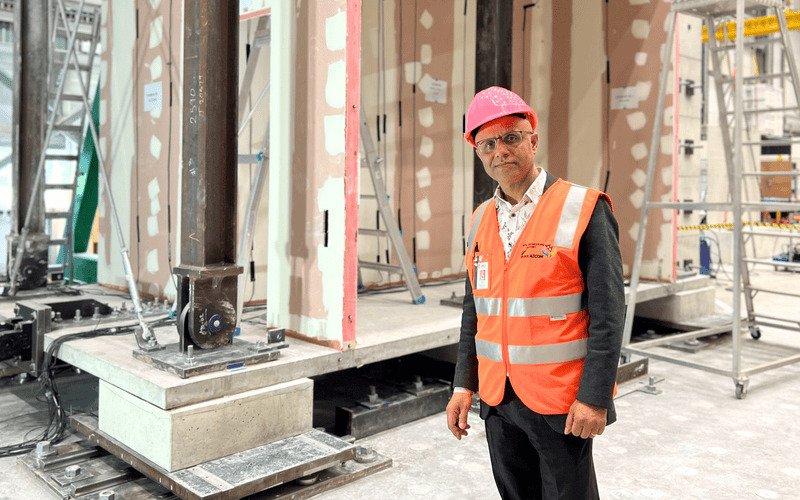
Photo: supplied
Name: Professor Rajesh Dhakal
Job title: Professor of Structural and Earthquake Engineering, Head of Civil and Environmental Engineering Department
Organisation: University of Canterbury
Location: Ōtautahi Christchurch
Who or what inspired you to enter the world of engineering?
A strong earthquake struck my hometown in Nepal in 1988, destroying many houses (including mine) and killing more than a hundred people in my neighbourhood. The aftermath of that earthquake inspired me to become an earthquake engineer.
Where has your career taken you around the globe?
My engineering education took place in three different countries: Nepal (BE in Civil Engineering from Tribhuvan University), Thailand (ME in Structural Engineering from the Asian Institute of Technology) and Japan (PhD from the University of Tokyo).
My professional career as an engineer and engineering researcher/educator has also spanned three countries: Nepal, working as a Civil Engineer; Singapore, as a Research Fellow at Nanyang Technological University; and here in New Zealand.
What lessons have your engineering students taught you over the years?
Engineering students constantly remind me of the importance of curiosity, resilience and adaptability. They've taught me:
- Learning is a two-way street. Students often bring fresh perspectives that challenge traditional thinking.
- The importance of teamwork – "one and one makes eleven."
- The value of diversity in problem solving. Different backgrounds lead to innovative solutions.
- How technology and societal expectations are evolving. Students are often ahead of the curve in adopting new tools and values.
How do you explain the Washington Accord to your students?
I introduce the Washington Accord to my students as a global mutual recognition agreement among countries that accredit engineering degrees. I tell them that the Accord opens the door for international mobility and professional recognition in member countries like the US, UK, Australia, Canada and more.
How do you incorporate AI in your classroom?
AI is undoubtedly going to be a big and important part of the engineering profession and the future – if not already. It's important to ensure our engineering graduates are introduced to using AI efficiently and productively to solve engineering problems. We have recently added an introductory AI course in our undergraduate curriculum for this very reason.
While we have in-person invigilated final exams in all our courses to assess students’ understanding of the core engineering fundamentals (which cannot be replaced by AI or any other tool), they are allowed to use AI for select assessments within the bounds of ethical practice as defined by the university level AI use policy.
Why do you maintain Chartered Professional Engineer (CPEng) and International Professional Engineer (IntPE) status?
I maintain these statuses for a few reasons:
- They demonstrate professional competence and commitment to lifelong learning.
- They build credibility with my students, industry and peers.
- They set an example for students about the importance of professional development and ethics.
What do you value about being a member of Engineering New Zealand?
The best part being a member of Engineering New Zealand is the community and support. It facilitates access to cutting-edge resources, CPD opportunities and industry updates. It also serves as a strong advocacy voice for engineers in policy and public discourse.
And your SESOC and NZSEE memberships?
I'm a member of the Structural Engineering Society of New Zealand (SESOC) and the New Zealand Society for Earthquake Engineering (NZSEE) because they align with my academic and professional interests. SESOC provides insights into structural design, standards and innovations, while NZSEE connects me with the latest in earthquake engineering, which is my area of expertise and interest.
Both offer research collaboration, technical seminars and policy influence, helping bridge academia and practice.
Complete the following sentence: Every day, engineers bring...
... solutions to life, bettering the world with innovation, safety and sustainability.
What's your favourite engineering icon in Christchurch?
A personal favourite of mine is the Christchurch Town Hall, which is a symbol of resilience and architectural elegance. Its restoration after the earthquakes showcases structural ingenuity and a deep respect for heritage.