

29 Jan 2026
When Ian McCrae first began building software to streamline healthcare, he never imagined that one day he’d be using similar technology to help save his own life.
The founder of pioneering Kiwi health tech company Orion Health, Ian McCrae has long been known as a visionary engineer. But now, facing stage-four glioblastoma, he’s taken his talents to a new frontier, using AI to guide his personal cancer treatment.
Ian says growing up in rural New Zealand in the 1960s helped forge his approach to life, business and innovation.
“It was a wonderful time to grow up. We had so much freedom – you were never told you couldn’t do things.”
Always a restless student, while studying engineering at the University of Auckland, Ian found that he was spending more time up the road at Kiwi Tavern rather than the lecture theatre.
“I knew if I carried on, I was going fail.”
He packed a bag and set off to hitchhike around the world. From the highways of America to the streets of post-revolution Iran, Ian wandered with a map in hand, pointing out he was from New Zealand, which brought warm welcomes. He nearly made it to Afghanistan, but when a German tourist was shot there, the borders were abruptly closed. Broke in Australia, he worked in the desert to fund his return to Aotearoa. It was a journey that shaped a fearless innovator.
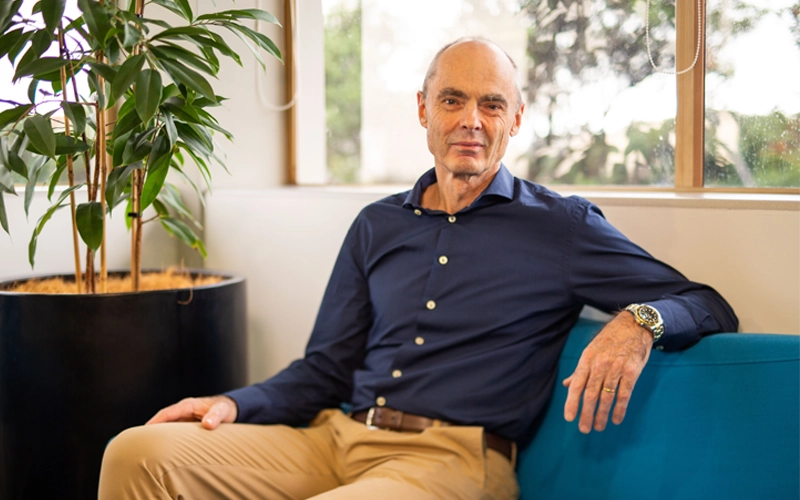
Photo: McCrae Tech
After completing his studies, including a master’s degree in engineering sciences and a spell in Antarctica, mathematically modelling ice shelf flows, Ian worked in various roles before establishing Orion. What began as a small software venture grew into a global health technology powerhouse, its patient record software now serving more than 450 million patients across 25 countries.
Fast forward 30 years, Ian has recently established McCrae Tech, a cutting-edge health technology company singularly focused on the use of AI to streamline data and clinical workflows, personalise treatment, and transform how patients and clinicians interact with complex medical information.
One morning about four years ago, Ian woke up to find strangers in his bedroom. Confused, he told them they were in the wrong room, only to discover later that he had suffered a grand mal seizure. A hospital scan revealed the cause: a stage-four glioblastoma.
Surgeons removed what they could, but as Ian explains: “You can never get it all, these things have tentacles.”
The prognosis was grim. Most patients don’t survive beyond 14 months, but true to his engineering instincts, Ian turned to data.
“I built a burn-down chart, time to death,” he says matter-of-factly. Using spreadsheets, he mapped out his survival probabilities, colour-coded from green (alive) to red (dead).
“I’m very good at spreadsheeting,” he adds with a wry smile. The numbers were stark, signalling a steep decline in survival odds after just a few months.
Researching first online, then later with the help of AI, Ian mapped out a treatment plan, including diet and medication. And he’s defied the statistics. Nearly four years on, he’s still here, alert, active and innovating, which puts him in the top one to two percent of survivors.
“Even if I had a relapse tomorrow, it wouldn’t kill me instantly. I think I’ve got at least a couple more years.”
He says the very first step of any AI process is to assemble the data, and that is what McCrae Tech’s AI platform, Orchestral, is being built to do.
This is clearly the major thing which is going to transform society and I want to be in the vanguard.
“Pulling your medical records together today, you’d have to get them from the GP, from the pharmacist, from labs, hospitals, if you’ve had your genome done you can throw that into the mix as well. It’s a big job.”
He continues: “Different health organisations use different codes, but all that data is fed into Orchestral, which tidies it up and pushes into an LLM [large language model].
“Once that’s done you can ask it, for example, I want to take a certain off-label drug, what’s the efficacy of this in treating glioblastoma? What are the interactions with the drugs that I’m currently taking. What’s the recommended dosage? It’s also capable of answering more complicated queries and tapping into all of PubMed, all the latest clinical knowledge in the world. How could humans keep up with that? That’s just not possible.”
He says as long as someone is asking the right questions about diagnosis and treatment, based on symptoms, they can get in-depth information about their condition.
“This AI technology is going to completely transform healthcare for people with life-threatening conditions like mine, but it also has all sorts of usefulness right across healthcare, the ability to diagnose and treat.”
If he had a magic wand, what would this veteran of health management do with the country’s failing health system?
“I would implement subsidiarity, moving decision-making away from the bureaucrats to the coalface where healthcare is being delivered. There is a clear correlation between where decisions are made and innovation.”
He says at the end of the 1990s, New Zealand led the world in health innovation. “We had Crown Health Enterprises and huge fragmentation. But then things were centralised and all decisions made in Wellington. And how much innovation is going on? Zero.”
Has he any secrets to share with engineers intent on building a business?
“When I started Orion, I had negligible leadership CEO experience, but my secret power was I had a huge inferiority complex that other people knew more than I did, so I’d always ask two or three people, what do you reckon about this situation? My secret power was that I didn’t assume that I knew everything.”
And, he adds, work with your customers.
“It’s not about raising massive amounts of venture capital or getting an MBA. Just innovate, ask your customers what they want, and listen like hell.”
Ever the innovator with an insatiable curiosity, Ian dedicates much of his time to staying up to date with AI advancements.
“This is clearly the major thing which is going to transform society and I want to be in the vanguard. Even when I was on the cycle this morning, I was watching AI podcasts. Every day I wake up and think ‘oh God, I’ve got to learn about that’.
“My biggest regret in life is that I’m a pensioner and this is the most exciting time. I’ve been in IT now 40 years, been through quite a few changes, but we’re on the brink of one of the most exciting and risky times in history and so much is about to change.”
This article was first published in the December 2025 issue of EG magazine.