
31 Mar 2026
Why one award-winning engineer sees the climate crisis and its urgent need for solutions as an opportunity for engineers to redefine how they design and build for a resilient, regenerative future.
“The beauty of engineers is that we are problem solvers,” says new Te Ao Rangahau Fellow Tania Hyde.
“But we’ve been asking the same questions for 100 years and it’s time for us to start thinking differently.”
The 2025 winner of ACE New Zealand’s Futurespace Award, Tania has been intrinsic to the adoption of circular economy concepts and sustainable practices, both at Beca, where she is Technical Director and Circular Design Lead, and in the wider engineering profession.
She’s the co-creator of Beca’s Circular Design Framework (CDF), a tool to help engineers adopt circular economy principles such as waste reduction, the circulation of materials, the inclusion of cultural perspectives and the regeneration of nature. The framework, which was gifted from Beca to Engineering New Zealand, has shaped Practice Note 32 and is a now a key resource for climate action Continuing Professional Development modules.
The CDF was borne from a shared vision with a colleague and an unequivocal wake-up call from her then six-year-old son.
“We were discussing the issues and he came up to us and said: ‘You know the planet is for the plants and animals and the insects too, right? You just need to think differently to fix it’.”
Tania says the framework is about thinking differently and asking different questions.
“Do you understand where your waste streams are coming from? What are you sending to landfill, by design? Can you remove waste through your designs? What are the natural systems, such as water, that you are disrupting?”
In Aotearoa, Tania says, we’re often pushed to do the bare minimum to protect the environment.
“I was recently in Europe and heard a lot about how Australians and New Zealanders are too risk averse, too concerned with IP to innovate. We need to build different risk profiles, work together for a better New Zealand, not a better me or a better company.”
Tania is an advocate for AI platforms such as Planet Price, which turns the environmental impact of a project into a single financial metric.
“What I liked about partnering with Planet Price is that it considers not just carbon, but all the planetary costs, such as water, ocean acidification and biosphere integrity – the externalities that we don’t pay for during construction.”
She provides an example: “We designed two road options, each with a cost of $30 million to build. We put it through the software so it could apply an environment dollar value to them. It gave us two different planet prices, one at an additional cost to the planet of $3 million and the other at $1.6.
“Why wouldn’t we choose the latter? It gives the whole picture at the decision-making table.”
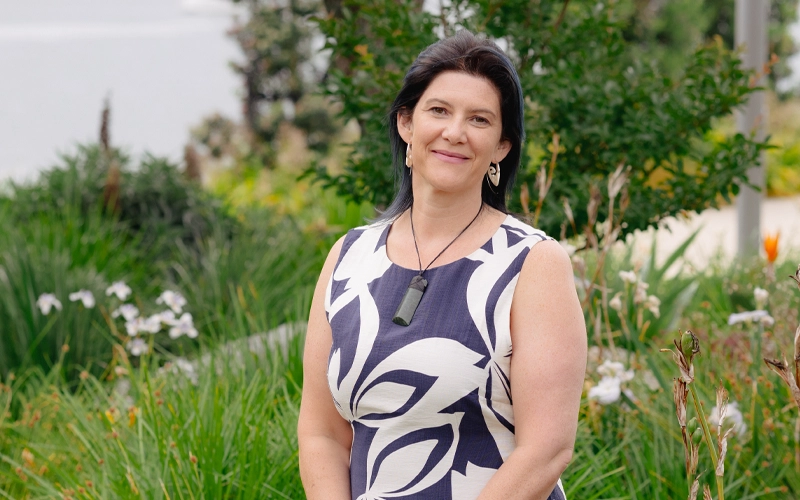
Photo: Paper + Pearl Photography
We need to build different risk profiles, work together for a better New Zealand, not a better me or a better company.
With a deep reverence for Māori and indigenous knowledge, Tania sees many resonances between her own Celtic ancestry and Māori worldviews, such as a respect for land and strong kinship ties, and she and Beca’s Te Ahi Tūtata team are currently bringing indigenous knowledge systems more sharply into a new version of the CDF, in their Pou Whakahaere tool.
She says the importance of storytelling is key to relationships as it makes listeners take notice.
“I've noticed that Māori are particularly good at bringing things into focus and inspiring people to become much more invested. Addressing climate change requires a behaviour change and that’s the piece that’s lacking. It's about knowing how to tell a story and build a shared vision.”
Tania has dyslexia and she believes it gives her the ability to think differently – and that’s a good thing.
“When I was at school, my Mum was told I would never amount to much, but I’ve come to understand that it’s my superpower. I see how things connect to form complex systems. Now I get called into brainstorming sessions because I come at things from a different angle.”
Tania believes engineers play a pivotal role in safeguarding our natural world by designing and delivering the built environment sustainably. She recommends engineers ask themselves three key questions to shape their designs: Where does this asset sit in the system, not just the site? How am I designing to avoid waste and landfill? Does this asset restore more than it takes?
“We see the impacts of what we do in weather events, the billions of dollars spent on infrastructure recovery costs. The current model is not working. We can’t just build back stronger, build back better, we must build back differently, and I feel the pressure of that every day.”
This article was first published in the March 2026 issue of EG magazine.