Date: |
31 Mar 2026, 5.30PM – 7.00PM |
duration: |
1 hr 30 mins |
Venue: |
WSP Auckland |
Address: |
Level 3/100 Beaumont Street Auckland |
Cost: |
Free event |
Testing historical Whirokino bridge piers – Annecy Bal
Three 84‑year‑old reinforced‑concrete piers were lifted from the decommissioned Whirokino trestle and tested at the University of Auckland to ascertain probable performance of 1930s Ministry of Works detailing. Under quasi‑static lateral loading, the specimens—reinforced with plain round bars and showing differing corrosion—sustained drifts of at least 6.5%, demonstrating surprising residual capacity in ageing substructures. A final specimen was retrofitted with post‑tensioned steel clamps to explore a rapid, practical strengthening option for multi‑column bents after a quake. The work builds on field pushover tests of the trestle’s piles and on long‑bridge “whipsaw” dynamics observed during deconstruction—insights now informing assessment and retrofit decisions nationwide.
Design and Construction of modern Whirokino bridges – Don McLaren Smith
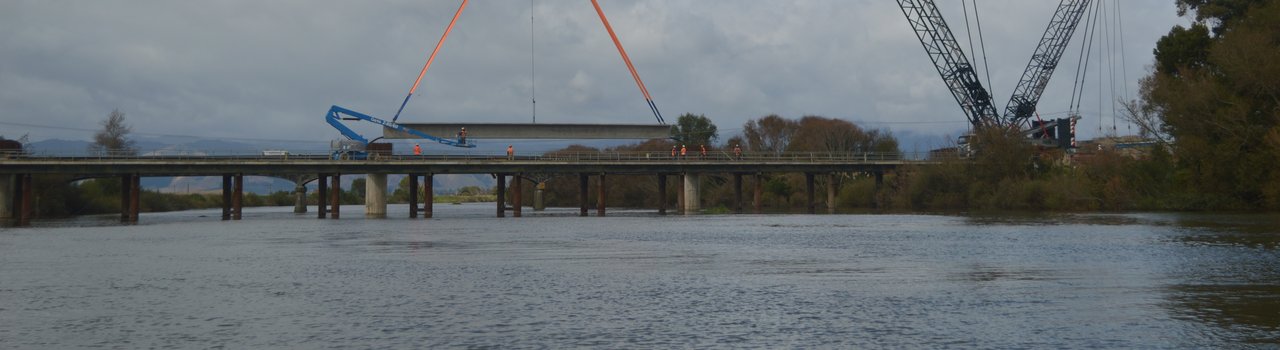
The replacement of the SH1 Manawatū River and Whirokino (Moutoa Floodway) crossings delivered two new structures, 192 m long over the river and 609 m long over the floodway. Delivered under D&C with Brian Perry Civil and Novare Design as lead constructor/designer, the project removed a 14 km HPMV detour, lifted resilience and safety, and was completed ahead of the original schedule through disciplined staging, temporary works, and local stakeholder engagement. The result: a safer, stronger corridor with lower maintenance burden and better cycling provision through the floodplain.
About our speakers:
Annecy Bal is a doctoral candidate in Civil & Environmental Engineering at the University of Auckland whose research focuses on the seismic performance and retrofit of ageing bridge substructures, including the Whirokino pier programme.
Don McLaren Smith is a director at Novare Design with 30+ years’ experience spanning bridges, buildings and complex temporary works in New Zealand and abroad.
Learn how 84‑year‑old Whirokino bridge piers perform under modern seismic testing, and what this means for assessing and strengthening ageing infrastructure. Then hear how the new Whirokino bridges were delivered ahead of schedule through disciplined D&C delivery, innovative temporary works, and close collaboration between designers and constructors.
Testing historical Whirokino bridge piers – Annecy Bal
Three 84‑year‑old reinforced‑concrete piers were lifted from the decommissioned Whirokino trestle and tested at the University of Auckland to ascertain probable performance of 1930s Ministry of Works detailing. Under quasi‑static lateral loading, the specimens—reinforced with plain round bars and showing differing corrosion—sustained drifts of at least 6.5%, demonstrating surprising residual capacity in ageing substructures. A final specimen was retrofitted with post‑tensioned steel clamps to explore a rapid, practical strengthening option for multi‑column bents after a quake. The work builds on field pushover tests of the trestle’s piles and on long‑bridge “whipsaw” dynamics observed during deconstruction—insights now informing assessment and retrofit decisions nationwide.
Design and Construction of modern Whirokino bridges – Don McLaren Smith
The replacement of the SH1 Manawatū River and Whirokino (Moutoa Floodway) crossings delivered two new structures, 192 m long over the river and 609 m long over the floodway. Delivered under D&C with Brian Perry Civil and Novare Design as lead constructor/designer, the project removed a 14 km HPMV detour, lifted resilience and safety, and was completed ahead of the original schedule through disciplined staging, temporary works, and local stakeholder engagement. The result: a safer, stronger corridor with lower maintenance burden and better cycling provision through the floodplain.
About our speakers:
Annecy Bal is a doctoral candidate in Civil & Environmental Engineering at the University of Auckland whose research focuses on the seismic performance and retrofit of ageing bridge substructures, including the Whirokino pier programme.
Don McLaren Smith is a director at Novare Design with 30+ years’ experience spanning bridges, buildings and complex temporary works in New Zealand and abroad.